The Significance of Preparation and Commitment in Spiritual Warfare
“And David took from him a thousand chariots, and seven thousand horsemen, and twenty thousand footmen: David also houghed all the chariot horses, but reserved of them an hundred chariots.” — 1 Chronicles 18:4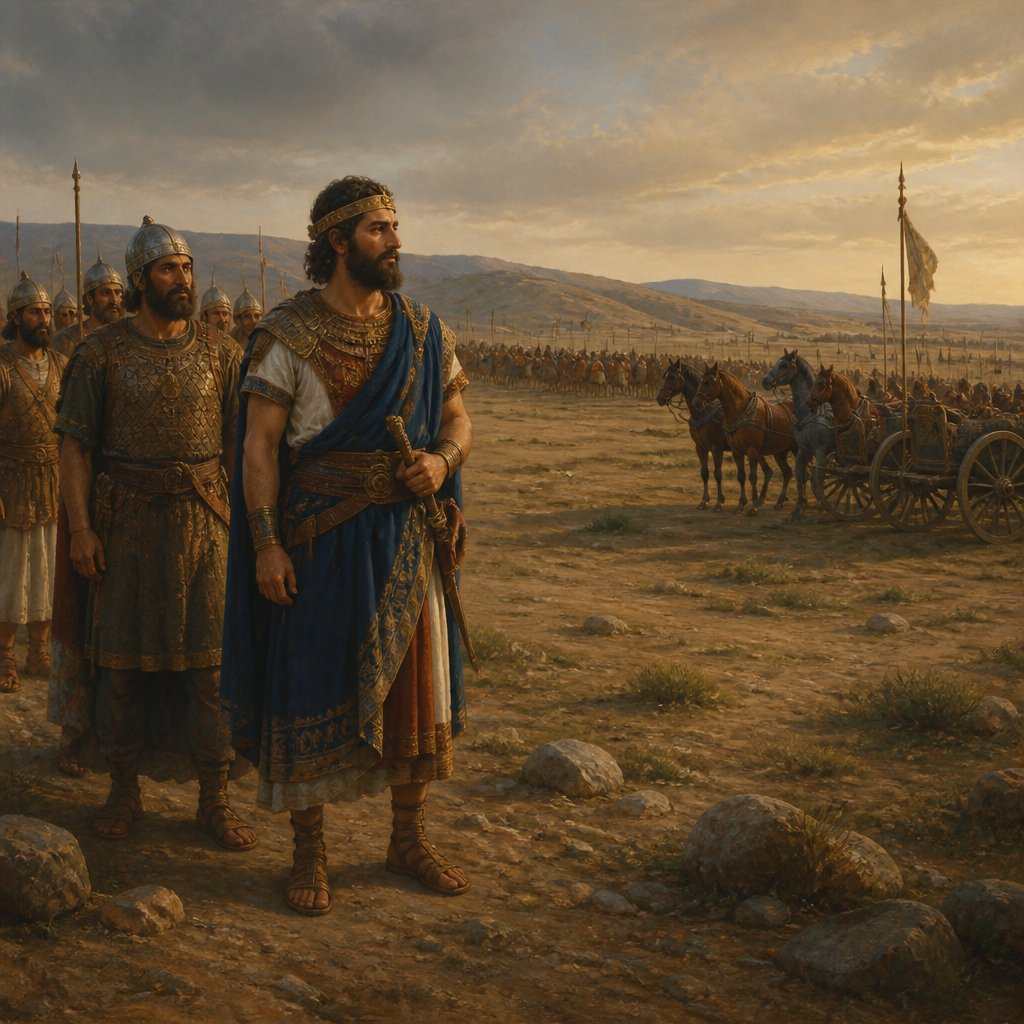
In the intricate tapestry of Biblical history, few figures stand out as prominently as King David. His narrative is filled with triumph, trials, and a relentless pursuit of God’s will. A pivotal moment in this saga is captured in 1 Chronicles 18:4, where it states, "And David took from him a thousand chariots, and seven thousand horsemen, and twenty thousand footmen: David also houghed all the chariot horses, but reserved of them an hundred chariots" (KJV). This verse, though seemingly straightforward, unravels profound truths that resonate with our spiritual journey today.
### The Context of Victory
David, having established his kingdom, seeks to secure his reign against adversaries. Here, he captures not only the physical resources—chariots, horsemen, and footmen—but also demonstrates a strategy for warfare. In ancient times, chariots were symbols of military strength and power. By acquiring these, David reinforces not just his military might but lays the foundation for a kingdom that honors God. This reminds us that God blesses our efforts and preparation in the face of spiritual battles we encounter in our own lives. Just as David acted, we must gather our resources and fortify our faith when preparing for challenges that might come our way.
### Understanding the Houghed Horses
The act of "houghed" or hamstringing the horses bears another layer of significance. In biblical times, horses were crucial to mobility and battle efficiency. David’s decision to render the majority of the horses unusable aimed to ensure that reliance was not placed on cavalry, but rather on the Lord. This speaks volumes about David's understanding of military strategy intertwined with spiritual principles. He was making a declaration that victory belongs to God, not to the might of men or their chariots.
This beckons us to evaluate our dependence on our own strength versus trusting in God’s power. In our spiritual walk, it is easy to rely on what we can see, feel, or manage. Yet, like David, we must cut away those dependencies on our ‘chariots’—be it wealth, intellect, or human relationships— and lean solely on God for our security and direction.
### Commitment to God’s Will
By reserving one hundred chariots, David acknowledges that while he prepares for battle, his ultimate trust lies in God. The number is not even significant by military standards; however, it symbolizes a commitment to humility and reliance on God’s sovereignty. In our lives, God does not call us to be unprepared or to neglect the gifts and resources He has given us. Instead, He desires our commitment to use those gifts for His glory and our dependency on Him through it all.
### Our Spiritual Warfare
The battles we face today may not be as tangible as those of David, but they are no less real. Ephesians 6:12 reminds us that “for we wrestle not against flesh and blood, but against principalities, against powers, against the rulers of the darkness of this world, against spiritual wickedness in high places” (KJV). This scripture resonates deeply with David’s actions. Just as David took physical measures for war, we too must equip ourselves with the armor of God, prayer, and His Word, rather than mere human strategies.
### Conclusion
As we reflect on 1 Chronicles 18:4, we are challenged to uphold a dual reality in our spiritual walk—preparation mixed with unwavering faith. We are called to gather our resources, hone our skills, strategize effectively, but above all, to remember that true victory belongs to the Lord. Let us embrace the wisdom of David, understanding that in every effort, every battle, and every triumph, our eyes must remain fixed on God, the ultimate source of our strength.
As we venture into our own battles, may we ask God to reveal to us how we can prepare while firmly anchoring our hope in His divine providence and direction.
Get our apps


Artwork for 1 Chronicles 18:4

1 Chronicles 18:4 - "And David took from him a thousand chariots, and seven thousand horsemen, and twenty thousand footmen: David also houghed all the chariot horses, but reserved of them an hundred chariots."
"And David took from him a thousand chariots, and seven thousand horsemen, and twenty thousand footmen: David also houghed all the chariot horses, but reserved of them an hundred chariots." - 1 Chronicles 18:4

1 Chronicles 4:18 - "And his wife Jehudijah bare Jered the father of Gedor, and Heber the father of Socho, and Jekuthiel the father of Zanoah. And these are the sons of Bithiah the daughter of Pharaoh, which Mered took."

2 Chronicles 18:4 - "¶ And Jehoshaphat said unto the king of Israel, Enquire, I pray thee, at the word of the LORD to day."

1 Chronicles 1:18 - "And Arphaxad begat Shelah, and Shelah begat Eber."

1 Chronicles 23:18 - "Of the sons of Izhar; Shelomith the chief."

2 Chronicles 4:18 - "Thus Solomon made all these vessels in great abundance: for the weight of the brass could not be found out."

1 Chronicles 1:4 - "Noah, Shem, Ham, and Japheth."

1 Chronicles 8:18 - "Ishmerai also, and Jezliah, and Jobab, the sons of Elpaal;"

1 Chronicles 24:18 - "The three and twentieth to Delaiah, the four and twentieth to Maaziah."

1 Chronicles 26:18 - "At Parbar westward, four at the causeway, and two at Parbar."

1 Chronicles 3:18 - "Malchiram also, and Pedaiah, and Shenazar, Jecamiah, Hoshama, and Nedabiah."

1 Chronicles 7:18 - "And his sister Hammoleketh bare Ishod, and Abiezer, and Mahalah."

2 Chronicles 4:22

1 Chronicles 6:18 - "And the sons of Kohath were, Amram, and Izhar, and Hebron, and Uzziel."

1 Chronicles 4 : 10
1 Samuel 4:18

1 Chronicles 4:29 - "And at Bilhah, and at Ezem, and at Tolad,"

1 Chronicles 4:30 - "And at Bethuel, and at Hormah, and at Ziklag,"

1 Chronicles 8:4 - "And Abishua, and Naaman, and Ahoah,"

Luke 8:4-18

2 Corinthians 4:18
1 Samuel 4:18

1 Chronicles 4:1 - "The sons of Judah; Pharez, Hezron, and Carmi, and Hur, and Shobal."
1 Samuel 4:18

1 John 4:18

1 John 4:18

1 Chronicles 27:18 - "Of Judah, Elihu, one of the brethren of David: of Issachar, Omri the son of Michael:"

1 Chronicles 25:18 - "The eleventh to Azareel, he, his sons, and his brethren, were twelve:"

2 Chronicles 18:1 - "Now Jehoshaphat had riches and honour in abundance, and joined affinity with Ahab."