The Cost of Conflict: Lessons from 1 Chronicles 19:7
“So they hired thirty and two thousand chariots, and the king of Maachah and his people; who came and pitched before Medeba. And the children of Ammon gathered themselves together from their cities, and came to battle.” — 1 Chronicles 19:7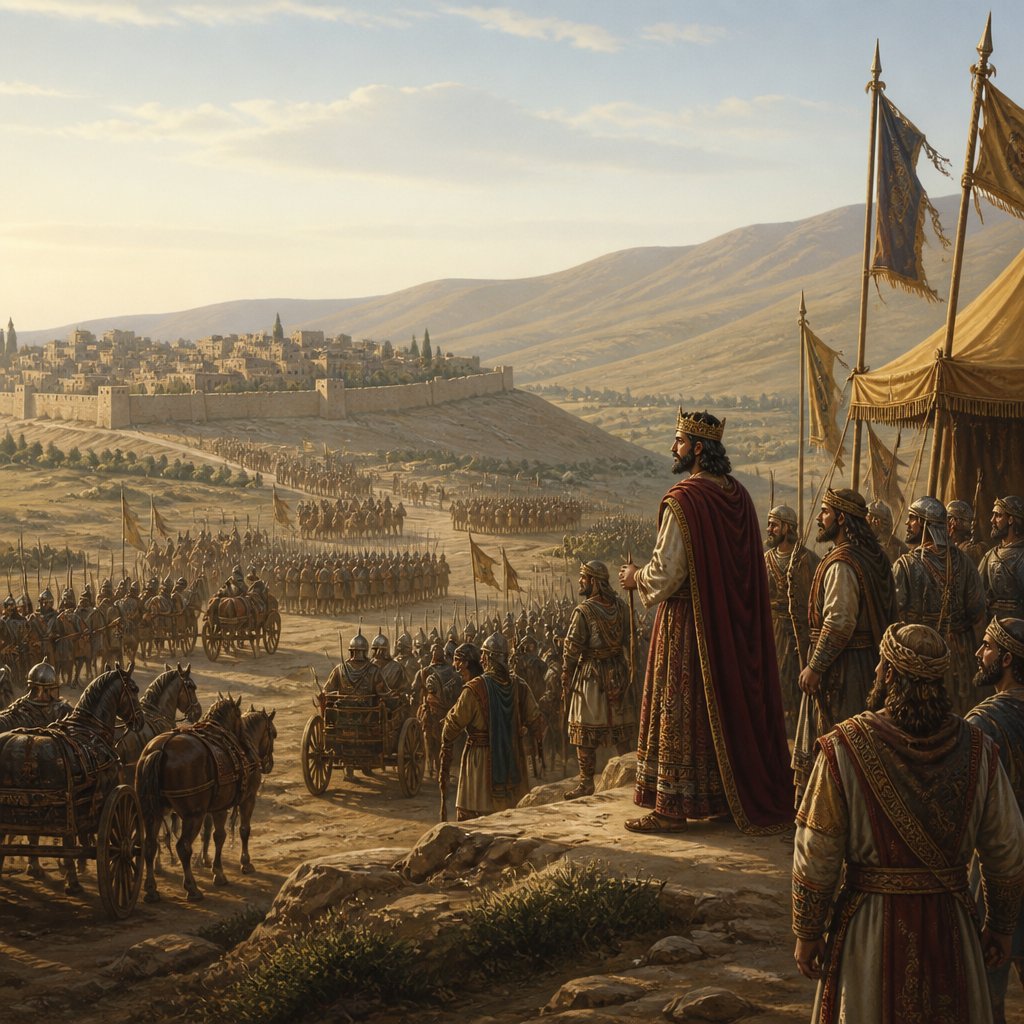
The biblical narrative of 1 Chronicles 19:7 presents us with a powerful depiction of conflict and its implications. In the King James Version (KJV), the verse reads: "So they hired thirty and two thousand chariots, and the king of Maachah and his people; who came and pitched before Medeba. And the children of Ammon gathered themselves together from their cities, and came to battle." As we delve into this verse, we will explore the deeper meanings and lessons that can be gleaned from the unfolding drama of ancient warfare and the choices made by the involved kingdoms.
### Context and Background
At this juncture in biblical history, David, the king of Israel, faced a significant conflict with the Ammonites, a neighboring kingdom. The events leading to this confrontation highlight the intricate politics and shifting allegiances that characterized the time. David had previously sent messengers to comfort the king of the Ammonites after the king’s death, but these gestures of peace had ended in humiliation and animosity.
In response, the Ammonites gathered a substantial army, striking alliances with other nations, notably Maachah, to bolster their forces against Israel. The hiring of thirty-two thousand chariots illustrates the determination and seriousness of the Ammonite leaders. This moment is critical, not only in understanding the physical battle set to ensue but also in reflecting upon the spiritual and moral battles we face in our lives.
### The Reality of Self-Sufficiency
The escalation of tensions and the mobilization of armies serve as a warning against self-sufficiency. The Ammonites, drawing on their own resources and the might of their allies, reveal a dependency on human power rather than reliance on divine guidance. It is easy to trust in our own strength, skills, and alliances, thinking that they can secure our victory in various life situations. However, the scriptures repeatedly remind us that such reliance can lead to downfall. We must ask ourselves—are we sometimes like the children of Ammon, rallying our resources without turning to God in prayer and dependence?
Isaiah 31:1 warns us about this very attitude: "Woe to them that go down to Egypt for help; and stay on horses, and trust in chariots, because they are many; and in horsemen, because they are very strong; but they look not unto the Holy One of Israel, neither seek the Lord!" Here, we see the futility of arms and alliances when they are not accompanied by faith in God. We need to consistently evaluate where our trust lies. Are we approaching life's battles through our understanding alone, or are we avenues for God's guidance and wisdom?
### The Gathering of Forces
In the latter part of the verse, the phrase "the children of Ammon gathered themselves together from their cities" portrays a scene of unity among the enemy ranks. This emphasizes the importance of collective action in achieving their objectives. Contrarily, we, as believers, are also called to gather together—not in conflict, but in fellowship and support for one another. Ephesians 4:3 reminds us to endeavor to keep the unity of the Spirit in the bond of peace.
### Moving Toward God in Conflict
As we encounter challenges, whether they be familial, emotional, financial, or spiritual, we can often feel close to the strategies employed by the Ammonites. Our inclination may be to plot, gather our resources, and rally support to fight against our "enemies." But in every battle that we face, we must remember that our first course of action should be to move toward God, seeking His face, His wisdom, and His strength.
### The Battle Belongs to the Lord
Ultimately, the confrontations depicted in 1 Chronicles highlight a significant spiritual truth: the battle belongs to the Lord. As the narrative unfolds in the following verses, we see God’s hand at work, determining the outcome of the struggle. Likewise, when we are faced with our challenges, we should take heart—no matter the size of the forces arrayed against us, our God is greater than any conflict we may face.
In conclusion, 1 Chronicles 19:7 is a poignant reminder of the choices we make in warfare, both physical and spiritual. Let us engage in a consistent examination of our reliance on God versus our own understanding. Let us not just gather resources for the fight ahead but gather in prayer, faith, and unity among the believers, remembering that regardless of the number of chariots or size of the armies, victory ultimately rests in God’s hands.
Get our apps


Artwork for 1 Chronicles 19:7

1 Chronicles 19:7 - "So they hired thirty and two thousand chariots, and the king of Maachah and his people; who came and pitched before Medeba. And the children of Ammon gathered themselves together from their cities, and came to battle."
"So they hired thirty and two thousand chariots, and the king of Maachah and his people; who came and pitched before Medeba. And the children of Ammon gathered themselves together from their cities, and came to battle." - 1 Chronicles 19:7

1 Chronicles 7:19 - "And the sons of Shemidah were, Ahian, and Shechem, and Likhi, and Aniam."

"And the sons of Shemidah were, Ahian, and Shechem, and Likhi, and Aniam." - 1 Chronicles 7:19

1 Chronicles 8:19 - "And Jakim, and Zichri, and Zabdi,"

1 Chronicles 5:19 - "And they made war with the Hagarites, with Jetur, and Nephish, and Nodab."

1 Chronicles 1:7 - "And the sons of Javan; Elishah, and Tarshish, Kittim, and Dodanim."

1 Chronicles 16:19 - "When ye were but few, even a few, and strangers in it."

1 Chronicles 14:7 - "And Elishama, and Beeliada, and Eliphalet."

1 Chronicles 3:7 - "And Nogah, and Nepheg, and Japhia,"

1 Chronicles 26:19 - "These are the divisions of the porters among the sons of Kore, and among the sons of Merari."

1 Chronicles 6:19 - "The sons of Merari; Mahli, and Mushi. And these are the families of the Levites according to their fathers."

2 Chronicles 19:7 - "Wherefore now let the fear of the LORD be upon you; take heed and do it: for there is no iniquity with the LORD our God, nor respect of persons, nor taking of gifts."

1 Chronicles 27:19 - "Of Zebulun, Ishmaiah the son of Obadiah: of Naphtali, Jerimoth the son of Azriel:"

2 Chronicles 19:1 - "And Jehoshaphat the king of Judah returned to his house in peace to Jerusalem."

1 Chronicles 23:7 - "¶ Of the Gershonites were, Laadan, and Shimei."

1 Chronicles 25:19 - "The twelfth to Hashabiah, he, his sons, and his brethren, were twelve:"

1 Chronicles 7:39 - "And the sons of Ulla; Arah, and Haniel, and Rezia."

1 Chronicles 7:38 - "And the sons of Jether; Jephunneh, and Pispah, and Ara."

1 Chronicles 12:7 - "And Joelah, and Zebadiah, the sons of Jeroham of Gedor."

1 Chronicles 19:1 - "Now it came to pass after this, that Nahash the king of the children of Ammon died, and his son reigned in his stead."

1 Chronicles 7:1 - "Now the sons of Issachar were, Tola, and Puah, Jashub, and Shimron, four."

"And Jakim, and Zichri, and Zabdi," - 1 Chronicles 8:19

1 Chronicles 15:19 - "So the singers, Heman, Asaph, and Ethan, were appointed to sound with cymbals of brass;"

1 Chronicles 19:8 - "And when David heard of it, he sent Joab, and all the host of the mighty men."

1 Chronicles 21:19 - "And David went up at the saying of Gad, which he spake in the name of the LORD."

1 Chronicles 23:19 - "Of the sons of Hebron; Jeriah the first, Amariah the second, Jahaziel the third, and Jekameam the fourth."

1 Chronicles 7:6 - "¶ The sons of Benjamin; Bela, and Becher, and Jediael, three."

1 Chronicles 4:7 - "And the sons of Helah were, Zereth, and Jezoar, and Ethnan."

1 Chronicles 7:34 - "And the sons of Shamer; Ahi, and Rohgah, Jehubbah, and Aram."