The Perils of Inaction: A Reflection on 1 Chronicles 20:1
"And it came to pass, that after the year was expired, at the time that kings go out to battle, Joab led forth the power of the army, and wasted the country of the children of Ammon, and came and besieged Rabbah. But David tarried at Jerusalem. And Joab smote Rabbah, and destroyed it." - 1 Chronicles 20:1
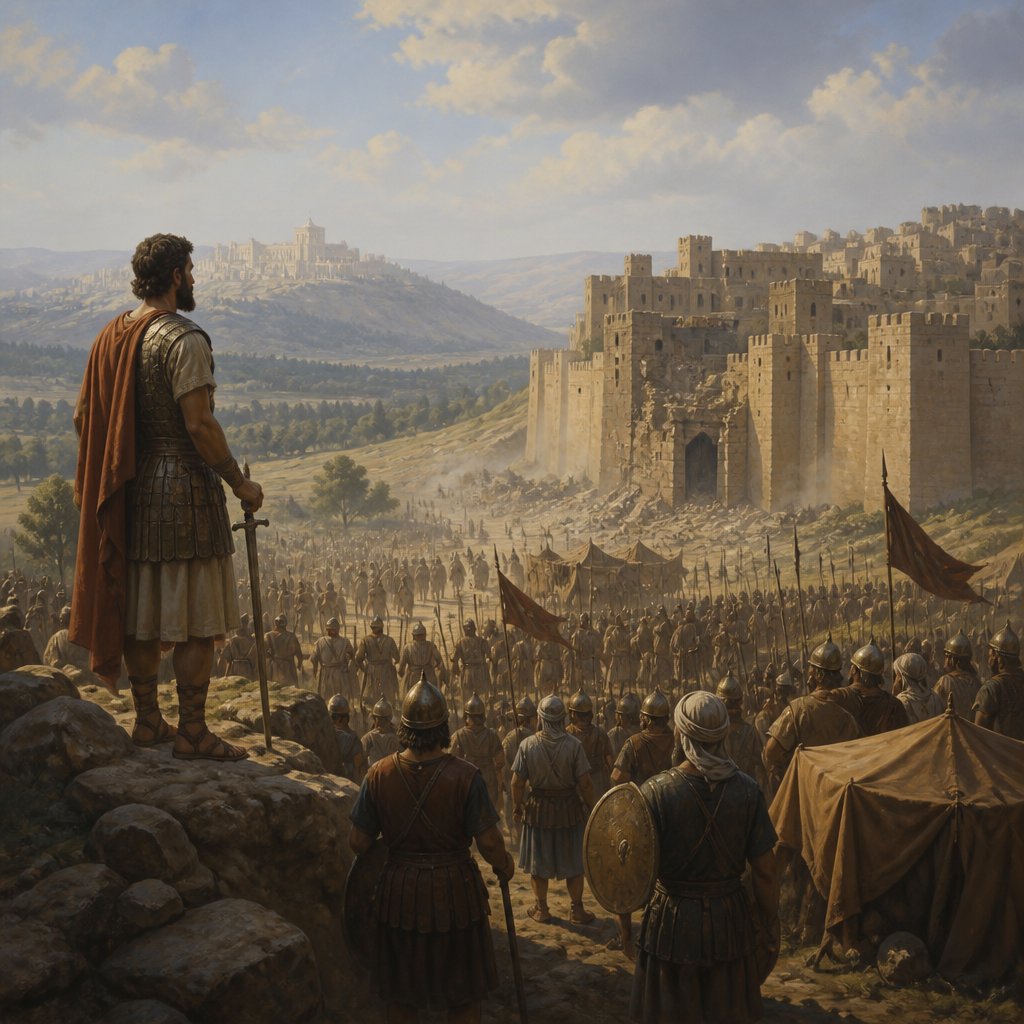
In 1 Chronicles 20:1 we encounter a snapshot from the life of King David, which reveals a profound truth about leadership, duty, and the challenges faced by even the mightiest of kings. The scripture states, "And it came to pass, that after the year was expired, at the time that kings go out to battle, Joab led forth the power of the army, and wasted the country of the children of Ammon, and came and besieged Rabbah. But David tarried at Jerusalem. And Joab smote Rabbah, and destroyed it."
At first glance, we observe a pivotal moment in Israel’s military history. Joab, the commander of David’s army, takes action against the Ammonites, an enemy that sought to challenge Israel’s reign. This calculation and military wisdom illustrate the need for decisive action in the face of threats. However, the crux of this verse unfolds not merely in the actions of Joab but in the stark contrast posed by David’s decision to remain in Jerusalem. This moment is not just a historical detail; it reflects the spiritual ethos of human responsibility versus divine calling.
First, we recognize the timing of battles in the ancient world, where seasons dictated military campaigns. "At the time that kings go out to battle" infers a duty inherent to kingship—leadership mandates that a king does not remain idle while his subjects face danger. It was during this critical time that David chose to stay behind in Jerusalem, where he should have been leading from the front. This choice raises questions about his priorities and the implications of his inaction.
David was no novice in battle; he was revered for his courage and military prowess, having once faced down Goliath in his youth. Yet, in this moment of apparent comfort, we are reminded of the reflective nature of sin and complacency. When leaders fail to uphold their responsibilities, it creates a vacuum, often leading to dire consequences.
While David’s absence may seem minor, the repercussions are profound. Joab, filled with zeal and loyalty toward his king, may have been left to bear not only the physical burden of leading the army but also the emotional weight of facing the enemy without his king’s presence. The tension of expectation looms large; the people looked to David for inspiration, but his choice to tarry could have contributed to a disconnect between him and his army, a critical blow to morale.
Moreover, this incident serves as a mirror to our own lives. Oftentimes, we find ourselves in situations where we must make decisive choices. Are we leading courageously in the face of challenges, or are we allowing distractions and ease to dictate our actions? We are called to stand firm against the spiritual battles that rage around us, not retreat into the comforts of our own Jerusalem. Each day provides an opportunity to respond to God’s call for action, whether through serving others, sharing the Gospel, or simply living out our faith with integrity.
As this narrative concludes with Joab’s victory over Rabbah, one cannot help but ponder what David might have missed as a result of his choice to remain behind. Victory for the people of Israel is clear, yet it comes at a moment where the bond between the leader and his people is tested. In following the narrative, we learn that in the next chapter, David will ultimately face his own trials, and his previous inactions could lead to personal failure in the not-too-distant future.
In our pursuit of faith and responsibility, let us be reminded that sometimes the greatest battles are not fought on the fields of war but in the daily choices we make in our lives. May we choose to take up our spiritual swords, move beyond complacency and engage actively in the battle set before us. Let our lives reflect the importance of engagement and leadership in faith, encouraging those around us by embodying the virtues we profess, actively seeking God’s will even when it means stepping outside our comfort zone. As we delve deeper into our relationship with God and our communities, let us heed this powerful reminder: that to tarry is to risk forfeiting not just victories, but closer walks with God.
Want to reflect more on 1 Chronicles 20:1?
Continue your spiritual journey with Bible Chat — an AI-powered tool for exploring God's Word through conversation. Ask questions, discover connections, and deepen your understanding.
Get Our Apps


1 Chronicles 20:1 Artwork

1 Chronicles 20:1 - "And it came to pass, that after the year was expired, at the time that kings go out to battle, Joab led forth the power of the army, and wasted the country of the children of Ammon, and came and besieged Rabbah. But David tarried at Jerusalem. And Joab smote Rabbah, and destroyed it."
"And it came to pass, that after the year was expired, at the time that kings go out to battle, Joab led forth the power of the army, and wasted the country of the children of Ammon, and came and besieged Rabbah. But David tarried at Jerusalem. And Joab smote Rabbah, and destroyed it." - 1 Chronicles 20:1

1 Chronicles 1:20 - "And Joktan begat Almodad, and Sheleph, and Hazarmaveth, and Jerah,"

1 Chronicles 8:20 - "And Elienai, and Zilthai, and Eliel,"

1 Chronicles 23:20 - "Of the sons of Uzziel; Michah the first, and Jesiah the second."

1 Chronicles 2:20 - "And Hur begat Uri, and Uri begat Bezaleel."

1 Chronicles 3:20 - "And Hashubah, and Ohel, and Berechiah, and Hasadiah, Jushab-hesed, five."

"And Joktan begat Almodad, and Sheleph, and Hazarmaveth, and Jerah," - 1 Chronicles 1:20

1 Chronicles 25:20 - "The thirteenth to Shubael, he, his sons, and his brethren, were twelve:"

"And Elienai, and Zilthai, and Eliel," - 1 Chronicles 8:20

1 Chronicles 6:20 - "Of Gershom; Libni his son, Jahath his son, Zimmah his son,"

1 Chronicles 15:20 - "And Zechariah, and Aziel, and Shemiramoth, and Jehiel, and Unni, and Eliab, and Maaseiah, and Benaiah, with psalteries on Alamoth;"

1 Chronicles 16:20 - "And when they went from nation to nation, and from one kingdom to another people;"

1 Chronicles 9:20 - "And Phinehas the son of Eleazar was the ruler over them in time past, and the LORD was with him."

1 Chronicles 24:20 - "¶ And the rest of the sons of Levi were these: Of the sons of Amram; Shubael: of the sons of Shubael; Jehdeiah."

1 Chronicles 26:20 - "¶ And of the Levites, Ahijah was over the treasures of the house of God, and over the treasures of the dedicated things."

1 Chronicles 20:8 - "These were born unto the giant in Gath; and they fell by the hand of David, and by the hand of his servants."

1 Chronicles 20:7 - "But when he defied Israel, Jonathan the son of Shimea David's brother slew him."

1 Chronicles 27:20 - "Of the children of Ephraim, Hoshea the son of Azaziah: of the half tribe of Manasseh, Joel the son of Pedaiah:"

1 Kings 16:20 - "Now the rest of the acts of Zimri, and his treason that he wrought, are they not written in the book of the chronicles of the kings of Israel?"

1 Chronicles 4:20 - "And the sons of Shimon were, Amnon, and Rinnah, Ben-hanan, and Tilon. And the sons of Ishi were, Zoheth, and Ben-zoheth."

1 Chronicles 7:20 - "¶ And the sons of Ephraim; Shuthelah, and Bered his son, and Tahath his son, and Eladah his son, and Tahath his son,"

1 Chronicles 21:20 - "And Ornan turned back, and saw the angel; and his four sons with him hid themselves. Now Ornan was threshing wheat."

"Of the sons of Uzziel; Michah the first, and Jesiah the second." - 1 Chronicles 23:20

"And Hur begat Uri, and Uri begat Bezaleel." - 1 Chronicles 2:20

2 Chronicles 20:1 - "It came to pass after this also, that the children of Moab, and the children of Ammon, and with them other beside the Ammonites, came against Jehoshaphat to battle."

1 Chronicles 12:20 - "As he went to Ziklag, there fell to him of Manasseh, Adnah, and Jozabad, and Jediael, and Michael, and Jozabad, and Elihu, and Zilthai, captains of the thousands that were of Manasseh."

1 Chronicles 20:5 - "And there was war again with the Philistines; and Elhanan the son of Jair slew Lahmi the brother of Goliath the Gittite, whose spear staff was like a weaver's beam."

1 Chronicles 20:4 - "¶ And it came to pass after this, that there arose war at Gezer with the Philistines; at which time Sibbechai the Hushathite slew Sippai, that was of the children of the giant: and they were subdued."

1 Chronicles 17:20 - "O LORD, there is none like thee, neither is there any God beside thee, according to all that we have heard with our ears."