The Legacy of a King: Reflecting on David's Reign
“And the time that he reigned over Israel was forty years; seven years reigned he in Hebron, and thirty and three years reigned he in Jerusalem.” — 1 Chronicles 29:27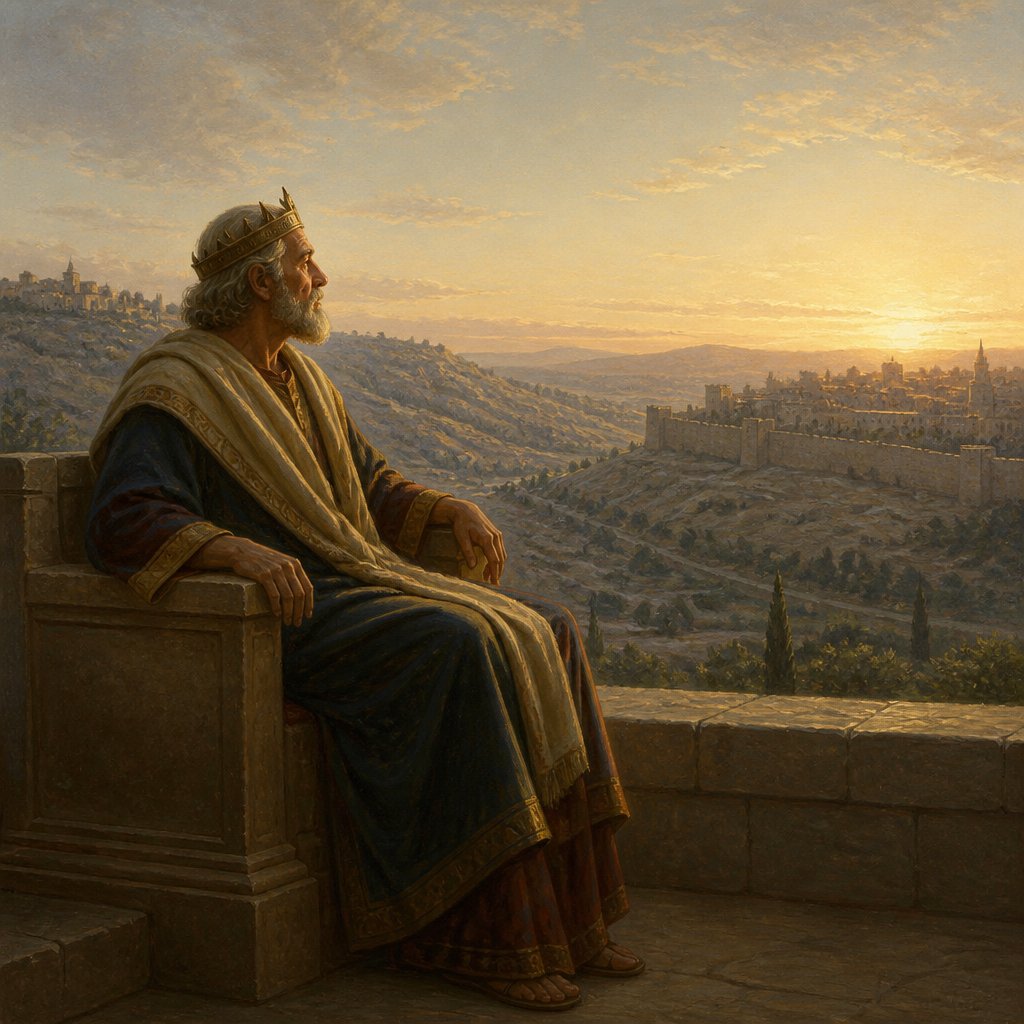
In the annals of biblical history, few figures stand as tall as King David of Israel. As we consider 1 Chronicles 29:27, we are reminded vividly of the expanse of his reign: “And the time that he reigned over Israel was forty years; seven years reigned he in Hebron, and thirty and three years reigned he in Jerusalem.” This verse is not merely a factual recount of his rule; it encapsulates a profound narrative of legacy, leadership, and divine purpose that resonates deeply with us today.
David's reign of forty years signifies not only a substantial period but also a time filled with both monumental successes and grievous trials. From his humble beginnings as a shepherd boy who trusted God against a giant named Goliath, to the complexities he faced as a king dealing with betrayal, loss, and the consequences of his own sins, David’s life tells a story of growth and dependence on God’s grace.
The first part of his reign, lasting seven years in Hebron, signifies a time of unification and establishment. Hebron was the city of his ancestry, the burial place of Abraham and Sarah, Isaac and Rebekah, and Jacob and Leah; it was a place rich with heritage and significance. In this phase, David was consolidating his power, rallying the tribes of Israel, and proving to be a leader who could unite a fractured kingdom. We, too, must take time to recognize our own roots and understand our past to lead effectively in the present. Just as David was grounded in his heritage, we should explore our own spiritual roots and understand the heritage of faith that influences us.
Transitioning to Jerusalem—the City of David—David’s reign flourished. The thirty-three years spent ruling in Jerusalem can be seen as a period of prosperity, stability, and worship. David achieved much: he expanded the boundaries of Israel, established a strong military, and most importantly, he sought to bring the Ark of the Covenant into Jerusalem, thus centralizing worship in an undivided nation. This act of devotion reminds us of the importance of worship in our own lives. Are we seeking to centralize our worship around God, placing Him at the heart of our community and our personal lives, just as David did?
However, the victory of David’s reign was not without its struggles. Even as he reigned, David faced myriad challenges, including family strife, civil war, and personal failures. It is essential to remember that even the most God-ordained leaders face adversity. Just as David sought God’s counsel through prayer and worship, we, too, must lean on God in our struggles. Our moments of challenge can serve to deepen our faith, steering us toward a more profound relationship with the Lord.
David’s life was also marked by repentance and humility. Despite his victories, David’s sins, notably with Bathsheba, revealed his humanity. In 2 Samuel 12:1-13, we see his genuine repentance when confronted by the prophet Nathan. This teaches us that acknowledging our failings before God is critical in our walk of faith. God desires a contrite heart more than offerings (Psalm 51:17). Thus, as we reflect on David’s legacy, may we aspire to live with integrity and be willing to rectify our wrongs.
As we ponder David's total of forty years of reign, let us consider how we are reigning over our own domains—be that our families, workplaces, or personal lives. Are we leading with the heart of a shepherd, focused on care and guidance? Are we fostering unity, worship, and resilience in the face of adversity?
In conclusion, the reign of David is a powerful testament of a life devoted to God amid complexity. As you reflect on 1 Chronicles 29:27 today, ask yourself how you can emulate David's dependence on God and his commitment to his people. May David’s legacy guide us as we navigate the responsibilities and challenges of leadership in our own spheres, always striving to echo the heart of God in all that we do.
Get our apps


Artwork for 1 Chronicles 29:27

1 Chronicles 29:27 - "And the time that he reigned over Israel was forty years; seven years reigned he in Hebron, and thirty and three years reigned he in Jerusalem."
"And the time that he reigned over Israel was forty years; seven years reigned he in Hebron, and thirty and three years reigned he in Jerusalem." - 1 Chronicles 29:27

1 Chronicles 27:29 - "And over the herds that fed in Sharon was Shitrai the Sharonite: and over the herds that were in the valleys was Shaphat the son of Adlai:"

1 Samuel 20:27-29

1 Chronicles 1:27 - "Abram; the same is Abraham."
"And over the herds that fed in Sharon was Shitrai the Sharonite: and over the herds that were in the valleys was Shaphat the son of Adlai:" - 1 Chronicles 27:29

1 Chronicles 4:29 - "And at Bilhah, and at Ezem, and at Tolad,"

1 Chronicles 1:29 - "¶ These are their generations: The firstborn of Ishmael, Nebaioth; then Kedar, and Adbeel, and Mibsam,"

1 Chronicles 11:29 - "Sibbecai the Hushathite, Ilai the Ahohite,"

1 Chronicles 27:27 - "And over the vineyards was Shimei the Ramathite: over the increase of the vineyards for the wine cellars was Zabdi the Shiphmite:"

1 Chronicles 24:29 - "Concerning Kish: the son of Kish was Jerahmeel."

2 Chronicles 29:27 - "And Hezekiah commanded to offer the burnt offering upon the altar. And when the burnt offering began, the song of the LORD began also with the trumpets, and with the instruments ordained by David king of Israel."

1 Chronicles 11:27 - "Shammoth the Harorite, Helez the Pelonite,"

1 Chronicles 8:27 - "And Jaresiah, and Eliah, and Zichri, the sons of Jeroham."

"Abram; the same is Abraham." - 1 Chronicles 1:27

1 Chronicles 7:27 - "Non his son, Jehoshua his son."

1 Chronicles 29:29 - "Now the acts of David the king, first and last, behold, they are written in the book of Samuel the seer, and in the book of Nathan the prophet, and in the book of Gad the seer,"

1 Chronicles 27:17 - "Of the Levites, Hashabiah the son of Kemuel: of the Aaronites, Zadok:"

1 Chronicles 29:26 - "¶ Thus David the son of Jesse reigned over all Israel."

1 Chronicles 8:29 - "And at Gibeon dwelt the father of Gibeon; whose wife's name was Maachah:"

1 Chronicles 27:33 - "And Ahithophel was the king's counsellor: and Hushai the Archite was the king's companion:"

1 Chronicles 24:27 - "¶ The sons of Merari by Jaaziah; Beno, and Shoham, and Zaccur, and Ibri."

1 Chronicles 2:29 - "And the name of the wife of Abishur was Abihail, and she bare him Ahban, and Molid."

"And at Bilhah, and at Ezem, and at Tolad," - 1 Chronicles 4:29

1 Chronicles 27:22 - "Of Dan, Azareel the son of Jeroham. These were the princes of the tribes of Israel."

1 Chronicles 16:27 - "Glory and honour are in his presence; strength and gladness are in his place."

1 Chronicles 2:27 - "And the sons of Ram the firstborn of Jerahmeel were, Maaz, and Jamin, and Eker."

1 Chronicles 27:3 - "Of the children of Perez was the chief of all the captains of the host for the first month."

1 Chronicles 27:19 - "Of Zebulun, Ishmaiah the son of Obadiah: of Naphtali, Jerimoth the son of Azriel:"

1 Chronicles 25:29 - "The two and twentieth to Giddalti, he, his sons, and his brethren, were twelve:"