Courage in Humility: Lessons from Bath-sheba
"And Bath-sheba bowed, and did obeisance unto the king. And the king said, What wouldest thou?" - 1 Kings 1:16
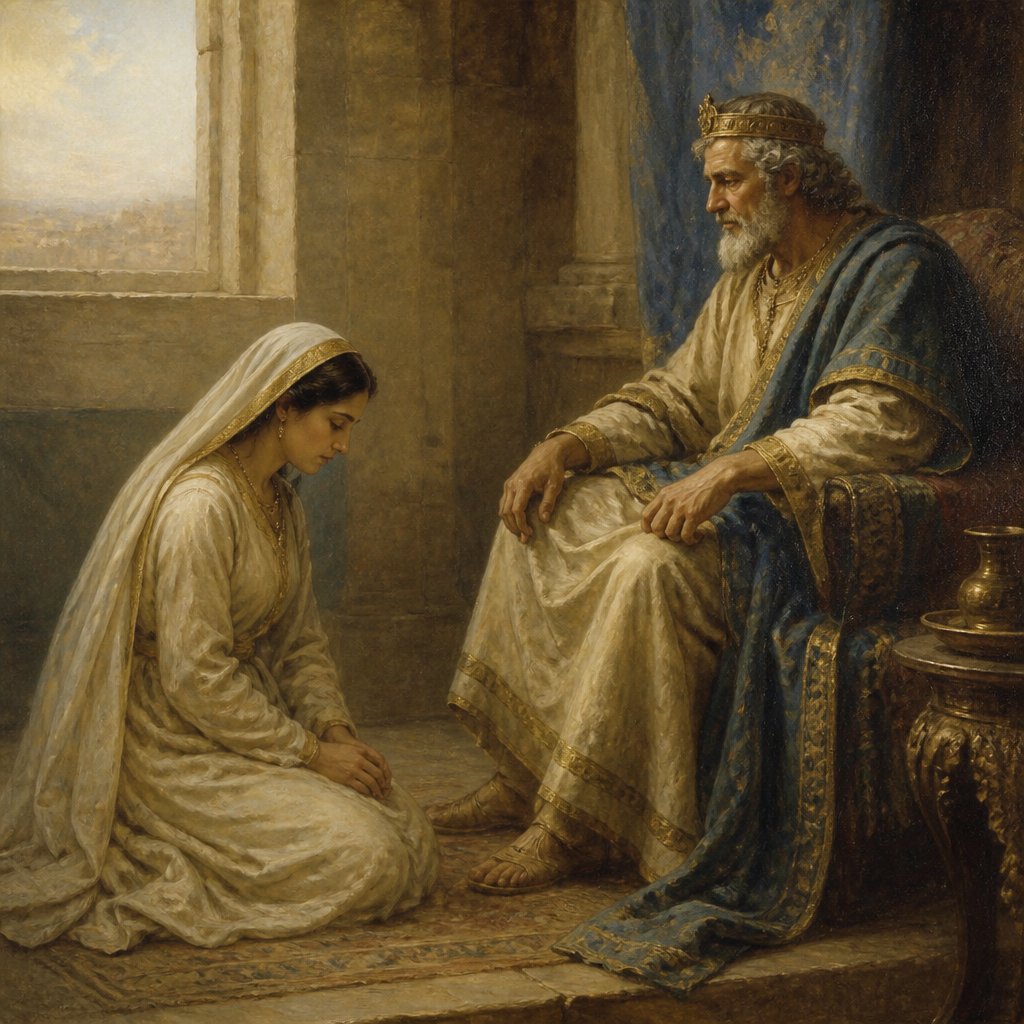
In 1 Kings 1:16, we find an intriguing scene set in the court of King David. The verse reads: "And Bath-sheba bowed, and did obeisance unto the king. And the king said, What wouldest thou?" Reading this verse, we might initially think of it merely as a historical account, a moment captured in the annals of the monarchy of Israel. However, within this brief interaction lies a rich tapestry of lessons about humility, courage, and the interplay of power.
To understand the depth of Bath-sheba's actions, we must consider her position. Bath-sheba was not only the wife of King David but also the mother of Solomon, who was to be the next king. Despite her royal status, the circumstances surrounding her at this moment were fraught with danger. Adonijah, another son of David, had declared himself king while David was old and weakened. The court was in a state of turmoil, with power struggles threatening the very fabric of their lineage and legacy. Bath-sheba's decision to approach King David at such a precarious time reveals not only her bravery but also her wisdom.
Bowing down before the king was an act of obeisance, a sign of submission and respect. It signifies the understanding that even in nobility, there are moments where humility must be manifested. Bath-sheba knew that her plea for Solomon's ascension to the throne needed to be presented with reverence. In doing so, she illustrates one of the quintessential attributes of a strong leader: the ability to remain humble even when advocating for oneself or a loved one.
Humility in leadership is oftentimes seen as a weakness, particularly in the cutthroat world of politics and power. Yet, Bath-sheba demonstrates that true strength lies in understanding one’s position and purpose and engaging with others with reverence and respect. She teaches us that sometimes, in order to make our voices heard, we must first listen and submit, presenting our case with humility and grace.
The question posed by King David, "What wouldest thou?" is as profound as it is simple. It opens the door for communication and sets the stage for Bath-sheba's plea. This moment of inquiry reminds us of the power of listening. When leaders take the time to inquire about the needs and concerns of those around them, they foster an environment of trust and understanding. Bath-sheba’s courage to approach David and the king’s willingness to ask about her needs create a moment of connection that is pivotal for their relationship and the future of Israel.
This interaction prompts us to ask ourselves: How do we approach authority? Are we willing to bow when necessary? Do we come with our requests and needs clothed in humility? And do we also remain open to listen closely to those who seek us out?
As we reflect on the life of Bath-sheba, we see her not merely as the wife of King David or the mother of Solomon but as a woman of agency and strength, approached with humility and grace during a time of immense turbulence. Her story encourages us all—regardless of our status—to embrace humility, to bow in reverence when necessary, and to enter conversations with genuine intent to seek understanding.
In moments of uncertainty, may we find the courage to approach those in authority respectfully, just as Bath-sheba did. And may we echo her spirit, knowing that humility is a vessel for our messages, allowing truth and love to flourish within the ties of our relationships.
Want to reflect more on 1 Kings 1:16?
Continue your spiritual journey with Bible Chat — an AI-powered tool for exploring God's Word through conversation. Ask questions, discover connections, and deepen your understanding.
Get Our Apps


1 Kings 1:16 Artwork

1 Kings 1:16 - "And Bath-sheba bowed, and did obeisance unto the king. And the king said, What wouldest thou?"
"And Bath-sheba bowed, and did obeisance unto the king. And the king said, What wouldest thou?" - 1 Kings 1:16

1 Kings 16:1 - "Then the word of the LORD came to Jehu the son of Hanani against Baasha, saying,"

1 Kings 4:16 - "Baanah the son of Hushai was in Asher and in Aloth:"

1 Kings 16:14 - "Now the rest of the acts of Elah, and all that he did, are they not written in the book of the chronicles of the kings of Israel?"

1 Timothy 6:15-16 – "God, the blessed and only Ruler, the King of kings and Lord of lords."

1 Timothy 6:15-16 – "God, the blessed and only Ruler, the King of kings and Lord of lords."

1 Timothy 6:15-16 – "God, the blessed and only Ruler, the King of kings and Lord of lords."

1 Kings 1:6 - "And his father had not displeased him at any time in saying, Why hast thou done so? and he also was a very goodly man; and his mother bare him after Absalom."

1 Kings 20:16 - "And they went out at noon. But Ben-hadad was drinking himself drunk in the pavilions, he and the kings, the thirty and two kings that helped him."

1 Timothy 6:15-16 – "God, the blessed and only Ruler, the King of kings and Lord of lords."

1 Kings 15:16 - "¶ And there was war between Asa and Baasha king of Israel all their days."

1 Kings 16:20 - "Now the rest of the acts of Zimri, and his treason that he wrought, are they not written in the book of the chronicles of the kings of Israel?"

1 Kings 16:5 - "Now the rest of the acts of Baasha, and what he did, and his might, are they not written in the book of the chronicles of the kings of Israel?"

1 Timothy 6:15-16 – "God, the blessed and only Ruler, the King of kings and Lord of lords."

1 Kings 3:16 - "¶ Then came there two women, that were harlots, unto the king, and stood before him."

1 Kings 16:27 - "Now the rest of the acts of Omri which he did, and his might that he shewed, are they not written in the book of the chronicles of the kings of Israel?"

2 Kings 16:1 - "In the seventeenth year of Pekah the son of Remaliah Ahaz the son of Jotham king of Judah began to reign."

1 Kings 16:33 - "And Ahab made a grove; and Ahab did more to provoke the LORD God of Israel to anger than all the kings of Israel that were before him."

1 Kings 16:17 - "And Omri went up from Gibbethon, and all Israel with him, and they besieged Tirzah."

1 Chronicles 16:21 - "He suffered no man to do them wrong: yea, he reproved kings for their sakes,"

1 Kings 18:16 - "So Obadiah went to meet Ahab, and told him: and Ahab went to meet Elijah."

Soothing the Soul: The Gospel of Gentle Care 1 Kings 19:3-8; 1 Samuel 16:14-23

1 Kings 16:30 - "And Ahab the son of Omri did evil in the sight of the LORD above all that were before him."

1 Kings 16:25 - "¶ But Omri wrought evil in the eyes of the LORD, and did worse than all that were before him."

1 Kings 16:32 - "And he reared up an altar for Baal in the house of Baal, which he had built in Samaria."

Soothing the Soul: The Gospel of Gentle Care 1 Kings 19:3-8; 1 Samuel 16:14-23

"Baanah the son of Hushai was in Asher and in Aloth:" - 1 Kings 4:16

"Then the word of the LORD came to Jehu the son of Hanani against Baasha, saying," - 1 Kings 16:1

1 Kings 10:16 - "¶ And king Solomon made two hundred targets of beaten gold: six hundred shekels of gold went to one target."