The Perils of Desperation: A Reflection on 1 Kings 16:18
"And it came to pass, when Zimri saw that the city was taken, that he went into the palace of the king's house, and burnt the king's house over him with fire, and died," - 1 Kings 16:18
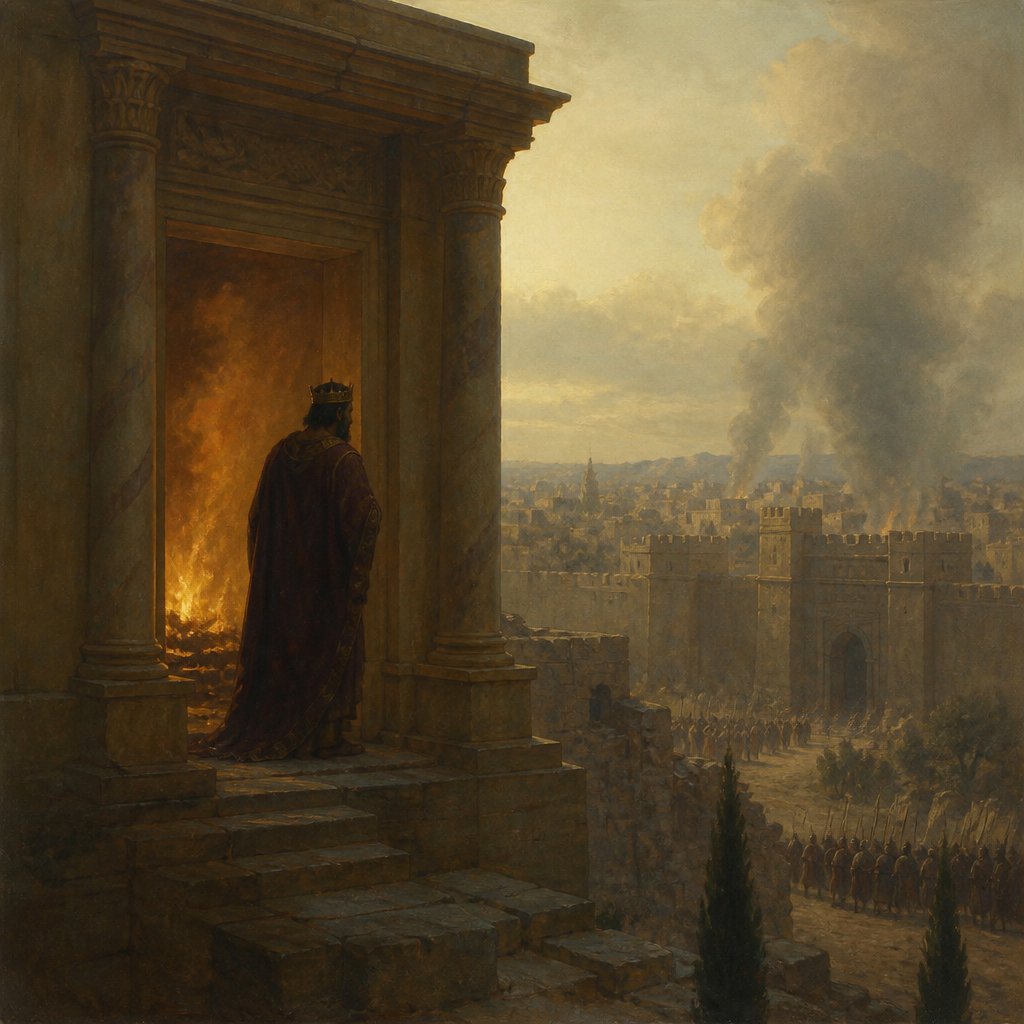
As we delve into the narrative found in 1 Kings 16:18—"And it came to pass, when Zimri saw that the city was taken, that he went into the palace of the king's house, and burnt the king's house over him with fire, and died"—we encounter a dramatic and poignant ending to an era marked by betrayal, violence, and despair. This verse is not merely a historical recount but serves as a powerful reminder of the consequences of desperation and the choices we make when faced with impending doom.
Zimri, a military commander of the army of Israel, finds himself in the midst of a chaotic struggle for power. His ascent to the throne was characterized by treachery, as he murdered Elah, the reigning king, while the latter was merrily indulging in wine in Tirzah. Zimri’s actions are emblematic of a kingdom fraught with division, moral decay, and the quest for control at any cost. In his bid for power, he chose a path set by greed and the lust for dominance, likely believing he could establish his reign despite its bloody foundation.
When Zimri realizes that his hold on power is slipping, witnessing that the city is taken, fear and panic seize him. He retreats into the very palace where he had once celebrated his exploitative victory. In this moment of desperation, instead of surrender or repentance, he resorts to an act of self-destruction by setting the king's house ablaze around him. This tragic decision is not only the culmination of his own hubris but a vivid illustration of the futility of trying to maintain power through malicious means.
In our lives, we may not find ourselves literally burning a palace, but how often do we resort to destructive behaviors when faced with the collapse of our ambitions and dreams? When we are confronted with the consequences of our actions—often because we have ignored the moral compass God has placed within us—we may panic and react in ways that harm ourselves and others. Zimri's story illustrates how despair can lead to pitiable choices when one abandons plans rooted in righteousness for short-sighted schemes.
Furthermore, Zimri’s tragic end serves as a mirror reflecting the importance of humility and the need for divine guidance in our pursuits. When volatile emotions rule our lives—fear, anger, jealousy, and pride—we often overlook that genuine strength lies not in taking but in yielding. The call of God throughout Scripture is not to authoritarianism but to servanthood, and the paradox of His kingdom is that true greatness is found in humility (Matthew 20:26).
As we ponder the message of 1 Kings 16:18, let us consider the areas in our lives where we may be tempted to act out of desperation. Are there relationships we are willing to jeopardize for the sake of maintaining control? Are we willing to indulge in morally dubious actions to secure our place at the top? Zimri's end forces us to confront these questions honestly. It also calls us to reflect on the beauty of surrendering our ambitions to God, who promises that in our weakness, His strength is manifested (2 Corinthians 12:9).
Let us seek to cultivate a spirit of repentance and trust in God’s sovereign plan instead of resorting to desperate measures that lead to self-destruction. May we be reminded that the path of righteousness, though sometimes difficult, leads to life and peace, while the path of unrighteousness only culminates in despair, as we see so evidently in Zimri’s demise. In the end, his choice was not just a fiery act of despair but a lesson for us all that the fleeting nature of power, devoid of integrity and faith, leads us to an inevitable ruin.
Want to reflect more on 1 Kings 16:18?
Continue your spiritual journey with Bible Chat — an AI-powered tool for exploring God's Word through conversation. Ask questions, discover connections, and deepen your understanding.
Get Our Apps


1 Kings 16:18 Artwork

1 Kings 16:18 - "And it came to pass, when Zimri saw that the city was taken, that he went into the palace of the king's house, and burnt the king's house over him with fire, and died,"
"And it came to pass, when Zimri saw that the city was taken, that he went into the palace of the king's house, and burnt the king's house over him with fire, and died," - 1 Kings 16:18

1 Kings 18:16 - "So Obadiah went to meet Ahab, and told him: and Ahab went to meet Elijah."

"So Obadiah went to meet Ahab, and told him: and Ahab went to meet Elijah." - 1 Kings 18:16

2 Kings 16:18 - "And the covert for the sabbath that they had built in the house, and the king's entry without, turned he from the house of the LORD for the king of Assyria."

1 Kings 19:1-18
Numbers 32:16-18
Numbers 32:16-18

Psalm 10:16-18

1 Kings 4:18 - "Shimei the son of Elah, in Benjamin:"

1 Kings 9:18 - "And Baalath, and Tadmor in the wilderness, in the land,"

2 Kings 1:18 - "Now the rest of the acts of Ahaziah which he did, are they not written in the book of the chronicles of the kings of Israel?"

1 Kings 1:18 - "And now, behold, Adonijah reigneth; and now, my lord the king, thou knowest it not:"

1 Kings 20:16 - "And they went out at noon. But Ben-hadad was drinking himself drunk in the pavilions, he and the kings, the thirty and two kings that helped him."

1 Kings 16:14 - "Now the rest of the acts of Elah, and all that he did, are they not written in the book of the chronicles of the kings of Israel?"

1 Kings 1:16 - "And Bath-sheba bowed, and did obeisance unto the king. And the king said, What wouldest thou?"

1 Kings 4:16 - "Baanah the son of Hushai was in Asher and in Aloth:"

1 Kings 16:1 - "Then the word of the LORD came to Jehu the son of Hanani against Baasha, saying,"

2 Kings 18:16 - "At that time did Hezekiah cut off the gold from the doors of the temple of the LORD, and from the pillars which Hezekiah king of Judah had overlaid, and gave it to the king of Assyria."

1 Kings 16:5 - "Now the rest of the acts of Baasha, and what he did, and his might, are they not written in the book of the chronicles of the kings of Israel?"

1 Kings 16:20 - "Now the rest of the acts of Zimri, and his treason that he wrought, are they not written in the book of the chronicles of the kings of Israel?"

1 Timothy 6:15-16 – "God, the blessed and only Ruler, the King of kings and Lord of lords."

1 Timothy 6:15-16 – "God, the blessed and only Ruler, the King of kings and Lord of lords."

1 Timothy 6:15-16 – "God, the blessed and only Ruler, the King of kings and Lord of lords."

1 Kings 10:18 - "¶ Moreover the king made a great throne of ivory, and overlaid it with the best gold."

1 Kings 2:18 - "And Bath-sheba said, Well; I will speak for thee unto the king."

1 Timothy 6:15-16 – "God, the blessed and only Ruler, the King of kings and Lord of lords."

1 Kings 15:16 - "¶ And there was war between Asa and Baasha king of Israel all their days."

1 Timothy 6:15-16 – "God, the blessed and only Ruler, the King of kings and Lord of lords."

1 Kings 3:16 - "¶ Then came there two women, that were harlots, unto the king, and stood before him."