The Ashes of Repentance: A Prophetic Reflection
"And he hasted, and took the ashes away from his face; and the king of Israel discerned him that he was of the prophets." - 1 Kings 20:41

In 1 Kings 20:41, we encounter a powerful moment in the narrative of the prophet Elijah and his mission to call God’s people back to Himself. The verse states: "And he hasted, and took the ashes away from his face; and the king of Israel discerned him that he was of the prophets." This brief yet profound encounter warrants our reflection, as it encapsulates themes of repentance, identity, and divine calling.
The context of this passage is crucial. Israel, under King Ahab’s leadership, had strayed from genuine worship and was immersed in idolatry. The prophet had a daunting task; he was called to confront a king and a nation that largely ignored God’s commands. In this pivotal moment, the prophet disguises himself with ashes, signifying mourning and humility, yet it is the act of hastily removing those ashes that reveals his identity as a prophet.
This brings us to our first point of reflection — the significance of ashes. In biblical times, wearing ashes was a sign of repentance and contrition. When the prophet covered his face with ashes, he not only identified with the grief of his people but also with the seriousness of their sin. Similarly, when we come before God, we must recognize the weight of our own sin. Ashes remind us of our mortality and our need for redemption. The act of disrobing oneself of ashes signifies a turning point — a receiving of God’s forgiveness, a moving from mourning to restoration.
The urgency with which the prophet hastens to remove the ashes signifies our need to respond actively to God’s call. In the New Testament, we see a pattern of immediate obedience from Jesus’s disciples, who left everything to follow Him. The desire of the prophet to reveal himself to Ahab is an act of courage, a clear understanding that his identity as a prophet demands action. He cannot remain incognito when God's judgment is at hand. Likewise, we are called to remove the ashes of our lives when God prompts us. What are the burdens or sins we carry that obscure our identity in Christ? What must we hasten to cast off, so we may fully operate in our purpose as children of God?
When the king of Israel discerns him as one of the prophets, we also see the recognition of spiritual authority. There is something immensely powerful about being recognized as belonging to God. The truth is, when we fully embrace our identity as sons and daughters of the Most High, we can claim the authority that comes with that identity. The world will notice — just as Ahab recognized the prophet, those around us will see the transformative work of Christ in us. This brings to light an important question: Are we living in a way that others can discern our identity as followers of Christ? Do our lives reflect the calling we carry?
Moreover, this encounter teaches us about the relationship between God’s prophets and His people. Being a prophet is not just about bearing bad news; it is also about bearing the hope of redemption. Today, we may not wear ashes, but our humble hearts communicate our dependence on God. We are vessels carrying His message of grace and truth. Even the faintest recognition, that we belong to God, can lead someone to repentance or spark a desire for deeper understanding.
In conclusion, let us heed the call to not just bear the ashes of our sins but to actively seek the cleansing grace of God. Let us remember who we are in Him and live in such a way that our identity as His children is evident to all. As we strip away whatever weighs us down, may we embrace the prophetic call on our lives to be lights in a dark world, hastening to share the good news of redemption with urgency and joy.
Want to reflect more on 1 Kings 20:41?
Continue your spiritual journey with Bible Chat — an AI-powered tool for exploring God's Word through conversation. Ask questions, discover connections, and deepen your understanding.
Get Our Apps


1 Kings 20:41 Artwork

1 Kings 20:41 - "And he hasted, and took the ashes away from his face; and the king of Israel discerned him that he was of the prophets."

"And he hasted, and took the ashes away from his face; and the king of Israel discerned him that he was of the prophets." - 1 Kings 20:41

1 Kings 2:41 - "And it was told Solomon that Shimei had gone from Jerusalem to Gath, and was come again."

1 Kings 22:41 - "¶ And Jehoshaphat the son of Asa began to reign over Judah in the fourth year of Ahab king of Israel."

1 Kings 11:41 - "¶ And the rest of the acts of Solomon, and all that he did, and his wisdom, are they not written in the book of the acts of Solomon?"

1 Kings 18:41 - "¶ And Elijah said unto Ahab, Get thee up, eat and drink; for there is a sound of abundance of rain."

1 Kings 14:1-20

1 Kings 8:41 - "Moreover concerning a stranger, that is not of thy people Israel, but cometh out of a far country for thy name's sake;"

Ezekiel 20:41

Ezekiel 20:41

Ezekiel 20:41

Ezekiel 20:41

Ezekiel 20:41

Ezekiel 20:41

1 Kings 1:41 - "¶ And Adonijah and all the guests that were with him heard it as they had made an end of eating. And when Joab heard the sound of the trumpet, he said, Wherefore is this noise of the city being in an uproar?"

1 Kings 20:16 - "And they went out at noon. But Ben-hadad was drinking himself drunk in the pavilions, he and the kings, the thirty and two kings that helped him."

1 Kings 20:24 - "And do this thing, Take the kings away, every man out of his place, and put captains in their rooms:"

1 Kings 16:20 - "Now the rest of the acts of Zimri, and his treason that he wrought, are they not written in the book of the chronicles of the kings of Israel?"

1 Kings 7:41 - "The two pillars, and the two bowls of the chapiters that were on the top of the two pillars; and the two networks, to cover the two bowls of the chapiters which were upon the top of the pillars;"

1 Kings 20:20 - "And they slew every one his man: and the Syrians fled; and Israel pursued them: and Ben-hadad the king of Syria escaped on an horse with the horsemen."

1 Kings 20:1 - "And Ben-hadad the king of Syria gathered all his host together: and there were thirty and two kings with him, and horses, and chariots: and he went up and besieged Samaria, and warred against it."

1 Kings 20:43 - "And the king of Israel went to his house heavy and displeased, and came to Samaria."

"And it was told Solomon that Shimei had gone from Jerusalem to Gath, and was come again." - 1 Kings 2:41

Luke 20:41 - "And he said unto them, How say they that Christ is David's son?"

1 Kings 20:21 - "And the king of Israel went out, and smote the horses and chariots, and slew the Syrians with a great slaughter."
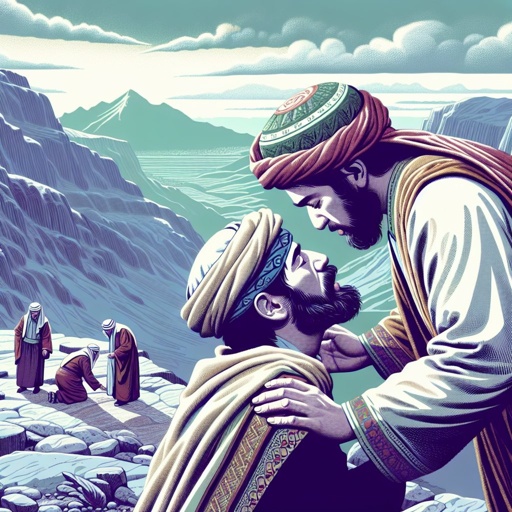
1 Samuel 20:41 - "¶ And as soon as the lad was gone, David arose out of a place toward the south, and fell on his face to the ground, and bowed himself three times: and they kissed one another, and wept one with another, until David exceeded."

1 Kings 20:38 - "So the prophet departed, and waited for the king by the way, and disguised himself with ashes upon his face."

"¶ And Jehoshaphat the son of Asa began to reign over Judah in the fourth year of Ahab king of Israel." - 1 Kings 22:41

Ezekiel 41:20 - "From the ground unto above the door were cherubims and palm trees made, and on the wall of the temple."

1 Kings 20:19 - "So these young men of the princes of the provinces came out of the city, and the army which followed them."