The Pursuit of Victory: Lessons from the Kings of Israel and Judah
“So the king of Israel and Jehoshaphat the king of Judah went up to Ramoth-gilead.” — 2 Chronicles 18:28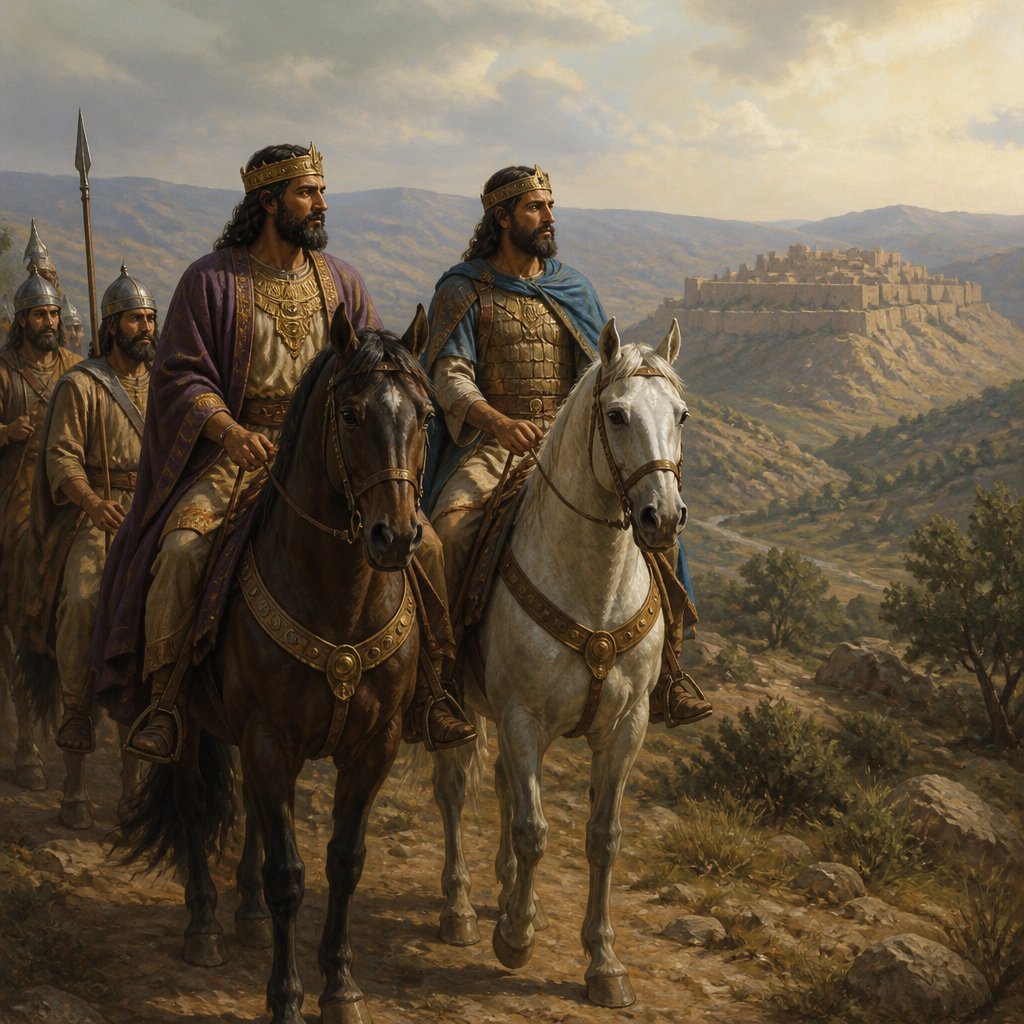
In the complex tapestry of biblical narratives, 2 Chronicles 18 provides a vivid portrayal of the intertwining destinies of King Ahab of Israel and King Jehoshaphat of Judah as they set out to recover the city of Ramoth-gilead. The verse reads: "So the king of Israel and Jehoshaphat the king of Judah went up to Ramoth-gilead" (2 Chronicles 18:28 KJV). This seemingly straightforward account marks a significant moment in their reigns and presents us with profound lessons on leadership, faith, and the consequences of compromise.
To fully grasp the importance of this journey to Ramoth-gilead, we must first understand the context of the situation. King Ahab, noted for his notorious reign marked by idol worship and moral decay, had his eyes set on reclaiming a strategic territory held by the Arameans. Jehoshaphat, on the other hand, was a king who sought to follow the ways of the Lord. His partnership with Ahab raises immediate concerns—how could a king devoted to God align himself with one who blatantly disobeyed divine commands? Jehoshaphat’s willingness to join forces with Ahab can serve as a cautionary tale for us today.
Throughout this narrative, we find an essential truth: our alliances matter.
As they embarked on their military campaign, Jehoshaphat suggested that they first seek counsel from God. This reflects a vital principle for us: any expedition in our lives should begin with an earnest seeking of God’s will. In today’s fast-paced world, we often hurriedly make decisions without pausing to tap into divine wisdom. Jehoshaphat’s instinct to pray first is a profound reminder that even when we align ourselves with seemingly righteous endeavors, we must always strive to evaluate whether they align with God’s purposes. Unfortunately, Ahab’s disregard for God leads to a series of events that culminate in tragedy, showcasing the peril of ignoring godly counsel.
Moreover, the outcome of their joint venture into battle serves as an invaluable lesson on discernment. Despite Jehoshaphat’s initial desire to rally strength through partnership, he was drawn into Ahab’s deceptive practices. The prophets Ahab consulted misled him, flattered him, and presented a false sense of security. This resulted in dire consequences for both kings, with Ahab ultimately meeting his demise.
Our decisions often bear fruit long after they have been made. Thus, we must learn to discern between prophetic truth and mere flattering words. This maxim holds true not just in spiritual realms but also in our personal and professional lives. Surrounding ourselves with wise counsel and faithful friends is essential, especially when faced with critical decisions.
Another noteworthy aspect of this narrative is the stark contrast between the characters of Ahab and Jehoshaphat. Ahab embodies pride, distrust, and disobedience. His choices stem from self-absorption and a desire to control outcomes on his terms. In contrast, Jehoshaphat shows humility and a willingness to submit to God’s authority. Choosing humility over pride not only defines our relationship with God but also impacts how we influence those around us. In moments of conflict or challenge, we are often faced with the choice to act according to our flesh, like Ahab, or to reflect the heart of a servant, as seen in Jehoshaphat.
As we reflect on this passage, we are invited to consider our own lives. Are we engaging in relationships and commitments that draw us closer to God, or do they lead us away? Are we quick to seek God before we act, or do we tend to forge ahead with our agendas? Each day we are given choices—let us choose wisely, seeking to honor God in our pursuits.
May we learn from the kings’ journey to Ramoth-gilead and commit ourselves to seeking God’s guidance. In doing so, we position ourselves for not just victory, but a victory imbued with His purpose and glory.
Get our apps


Artwork for 2 Chronicles 18:28

2 Chronicles 18:28 - "So the king of Israel and Jehoshaphat the king of Judah went up to Ramoth-gilead."

"So the king of Israel and Jehoshaphat the king of Judah went up to Ramoth-gilead." - 2 Chronicles 18:28

2 Chronicles 28:18 - "The Philistines also had invaded the cities of the low country, and of the south of Judah, and had taken Beth-shemesh, and Ajalon, and Gederoth, and Shocho with the villages thereof, and Timnah with the villages thereof, Gimzo also and the villages thereof: and they dwelt there."

2 Chronicles 28:3

2 Chronicles 20:28

2 Chronicles 18:9

2 Chronicles 18:9

2 Chronicles 28:2 - "For he walked in the ways of the kings of Israel, and made also molten images for Baalim."

1 Chronicles 28:18 - "And for the altar of incense refined gold by weight; and gold for the pattern of the chariot of the cherubims, that spread out their wings, and covered the ark of the covenant of the LORD."

2 Chronicles 20:18

2 Chronicles 20:28 - "And they came to Jerusalem with psalteries and harps and trumpets unto the house of the LORD."

2 Chronicles 9:28 - "And they brought unto Solomon horses out of Egypt, and out of all lands."

1 Chronicles 2:28 - "And the sons of Onam were, Shammai, and Jada. And the sons of Shammai; Nadab, and Abishur."

2 Chronicles 28:17 - "For again the Edomites had come and smitten Judah, and carried away captives."

2 Chronicles 28:14 - "So the armed men left the captives and the spoil before the princes and all the congregation."

2 Chronicles 28:16 - "¶ At that time did king Ahaz send unto the kings of Assyria to help him."

2 Chronicles 25:28 - "And they brought him upon horses, and buried him with his fathers in the city of Judah."

2 Chronicles 28:20 - "And Tilgath-pilneser king of Assyria came unto him, and distressed him, but strengthened him not."

2 Chronicles 28:22 - "¶ And in the time of his distress did he trespass yet more against the LORD: this is that king Ahaz."

2 Chronicles 28:4 - "He sacrificed also and burnt incense in the high places, and on the hills, and under every green tree."

2 Kings 23:28 - "Now the rest of the acts of Josiah, and all that he did, are they not written in the book of the chronicles of the kings of Judah?"

2 Chronicles 32:28 - "Storehouses also for the increase of corn, and wine, and oil; and stalls for all manner of beasts, and cotes for flocks."

2 Kings 14:18 - "And the rest of the acts of Amaziah, are they not written in the book of the chronicles of the kings of Judah?"

2 Chronicles 29:28 - "And all the congregation worshipped, and the singers sang, and the trumpeters sounded: and all this continued until the burnt offering was finished."

2 Chronicles 28:7 - "And Zichri, a mighty man of Ephraim, slew Maaseiah the king's son, and Azrikam the governor of the house, and Elkanah that was next to the king."

2 Chronicles 21:18 - "¶ And after all this the LORD smote him in his bowels with an incurable disease."

2 Chronicles 18:1 - "Now Jehoshaphat had riches and honour in abundance, and joined affinity with Ahab."

1 Chronicles 18:2 - "And he smote Moab; and the Moabites became David's servants, and brought gifts."

2 Chronicles 28:26 - "¶ Now the rest of his acts and of all his ways, first and last, behold, they are written in the book of the kings of Judah and Israel."

2 Chronicles 17:18 - "And next him was Jehozabad, and with him an hundred and fourscore thousand ready prepared for the war."