The Altar of Sacrifice: A Heart of Worship
“And Solomon went up thither to the brasen altar before the LORD, which was at the tabernacle of the congregation, and offered a thousand burnt offerings upon it.” — 2 Chronicles 1:6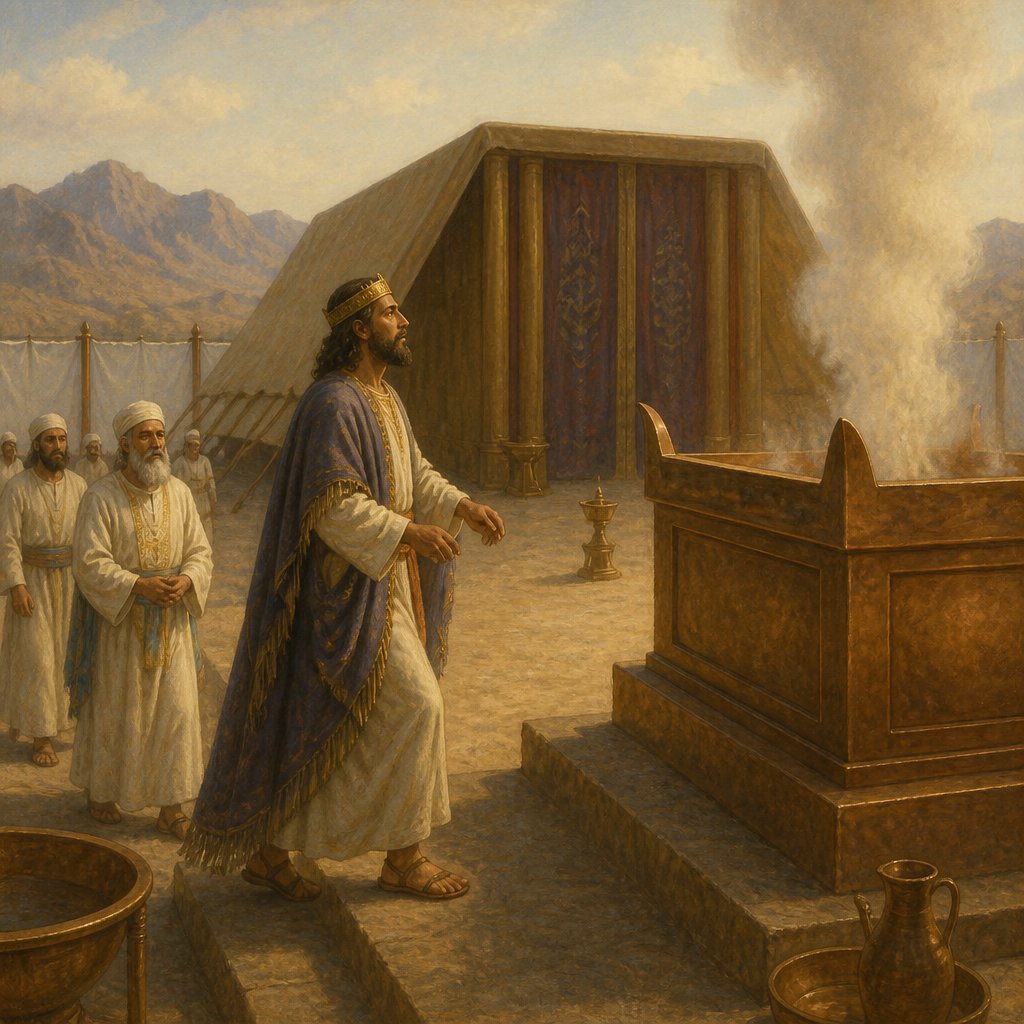
In 2 Chronicles 1:6, we encounter a profound moment in the life of Solomon, the son of David, as he ascends to the brasen altar before the LORD, located at the Tabernacle of the congregation. The verse reads: "And Solomon went up thither to the brasen altar before the LORD, which was at the tabernacle of the congregation, and offered a thousand burnt offerings upon it." At first glance, this singular act of worship and sacrifice might seem to be merely a historical account devoid of immediate relevance to our daily lives. However, as we delve deeper into the significance of Solomon’s actions, we discover timeless principles of worship, reverence, and dedication that resonate powerfully with our own spiritual journeys.
Solomon’s ascension to the brasen altar symbolizes more than a physical journey; it represents a spiritual posture of humility and reverence before God. Throughout the Bible, altars serve as sacred places where humanity meets divinity, where offerings are laid down in acknowledgment of God’s sovereignty and grace. This wasn’t a mere ritual for Solomon; it was an act driven by deep gratitude and recognition of God’s faithfulness to David, his father. As he approached the altar, he embodied a heart that desired to honor the Almighty, recognizing that all blessings stem from His gracious hand.
When Solomon offered a thousand burnt offerings, we may wonder about the significance of such a lavish display. Burnt offerings, in the Ancient Near East, represented complete consecration and surrender. The entire animal was consumed by fire, symbolizing a total offering to God. By offering a thousand, Solomon was not merely fulfilling a duty; he was demonstrating the depth of his commitment, his desire to seek God earnestly and unreservedly. In a modern context, this challenges us to examine the nature of our own sacrifices and the quality of our worship. Are we offering God our best, or are we holding back portions of ourselves?
Furthermore, this passage invites reflection on the place of sacrifice in our lives. The brasen altar is constructed of bronze, a metal associated with strength and durability, symbolizing the steadfastness of God’s nature. When we approach the altar of our lives today, what offerings do we bring forth? It may not always be a physical sacrifice, but the principle remains, that our lives should reflect a continual offering of worship—be it in our time, talents, resources, or relationships. The act of offering is intrinsically linked to our attentiveness to God’s presence. We often seek Him in our need, but how often do we approach Him merely to worship and express gratitude?
Moreover, Solomon’s decision to offer such an extraordinary number of burnt offerings speaks to his understanding of God's worthiness and the urgency of seeking divine guidance. Following this act of worship, we see how God responded to Solomon’s heart, granting him unparalleled wisdom. This illustrates a profound truth: our closeness to God directly correlates with our willingness to seek Him. Prayer and worship open avenues for divine interaction; through sacrifice, we acknowledge God’s place in our lives, allowing us to experience His fullness.
As we meditate on this scripture, we are encouraged to cultivate a lifestyle of sacrificial worship. What does it mean for you to offer your life as a living sacrifice? Romans 12:1 calls us to present our bodies as living sacrifices, holy and acceptable unto God. This holistic offering screams of love and devotion.
In essence, let us aspire to follow in Solomon’s footsteps—approaching God with our heart wide open, ready to lay our lives down in an act of surrender. Let the brasen altar be a reminder that true worship transforms us, leading to a life aligned with God’s purpose and filled with His wisdom. In every moment of sacrifice, may we echo Solomon’s heart that earnestly seeks not just the gifts of God, but rather His very presence.
Get our apps


Artwork for 2 Chronicles 1:6

2 Chronicles 1:6 - "And Solomon went up thither to the brasen altar before the LORD, which was at the tabernacle of the congregation, and offered a thousand burnt offerings upon it."
"And Solomon went up thither to the brasen altar before the LORD, which was at the tabernacle of the congregation, and offered a thousand burnt offerings upon it." - 2 Chronicles 1:6

1 Chronicles 6:2 - "And the sons of Kohath; Amram, Izhar, and Hebron, and Uzziel."

1 Chronicles 2:6 - "And the sons of Zerah; Zimri, and Ethan, and Heman, and Calcol, and Dara: five of them in all."

2 Chronicles 6:1 - "Then said Solomon, The LORD hath said that he would dwell in the thick darkness."

1 Chronicles 1:6 - "And the sons of Gomer; Ashchenaz, and Riphath, and Togarmah."

"And the sons of Kohath; Amram, Izhar, and Hebron, and Uzziel." - 1 Chronicles 6:2

"And the sons of Gomer; Ashchenaz, and Riphath, and Togarmah." - 1 Chronicles 1:6

1 Chronicles 6:6 - "And Uzzi begat Zerahiah, and Zerahiah begat Meraioth,"

2 Chronicles 6:13

1 Chronicles 6:1 - "The sons of Levi; Gershon, Kohath, and Merari."

1 Chronicles 14:6 - "And Nogah, and Nepheg, and Japhia,"

2 Chronicles 6:2 - "But I have built an house of habitation for thee, and a place for thy dwelling for ever."

1 Chronicles 3:6 - "Ibhar also, and Elishama, and Eliphelet,"

1 Chronicles 6:25 - "And the sons of Elkanah; Amasai, and Ahimoth."

1 Chronicles 6:16 - "¶ The sons of Levi; Gershom, Kohath, and Merari."

1 Chronicles 6:17 - "And these be the names of the sons of Gershom; Libni, and Shimei."

2 Chronicles 6:6 - "But I have chosen Jerusalem, that my name might be there; and have chosen David to be over my people Israel."

2 Chronicles 11:6 - "He built even Beth-lehem, and Etam, and Tekoa,"

1 Chronicles 6:28 - "And the sons of Samuel; the firstborn Vashni, and Abiah."

"Then said Solomon, The LORD hath said that he would dwell in the thick darkness." - 2 Chronicles 6:1

"And the sons of Zerah; Zimri, and Ethan, and Heman, and Calcol, and Dara: five of them in all." - 1 Chronicles 2:6

2 Chronicles 6:35 - "Then hear thou from the heavens their prayer and their supplication, and maintain their cause."

1 Chronicles 6:58 - "And Hilen with her suburbs, Debir with her suburbs,"

1 Chronicles 6:12 - "And Ahitub begat Zadok, and Zadok begat Shallum,"

1 Chronicles 6:45 - "The son of Hashabiah, the son of Amaziah, the son of Hilkiah,"

1 Chronicles 6:11 - "And Azariah begat Amariah, and Amariah begat Ahitub,"

1 Chronicles 6:14 - "And Azariah begat Seraiah, and Seraiah begat Jehozadak,"

1 Chronicles 7:6 - "¶ The sons of Benjamin; Bela, and Becher, and Jediael, three."

1 Chronicles 6:53 - "Zadok his son, Ahimaaz his son."