Order in Worship: The Heart of Hezekiah's Reforms
“And Hezekiah appointed the courses of the priests and the Levites after their courses, every man according to his service, the priests and Levites for burnt offerings and for peace offerings, to minister, and to give thanks, and to praise in the gates of the tents of the LORD.” — 2 Chronicles 31:2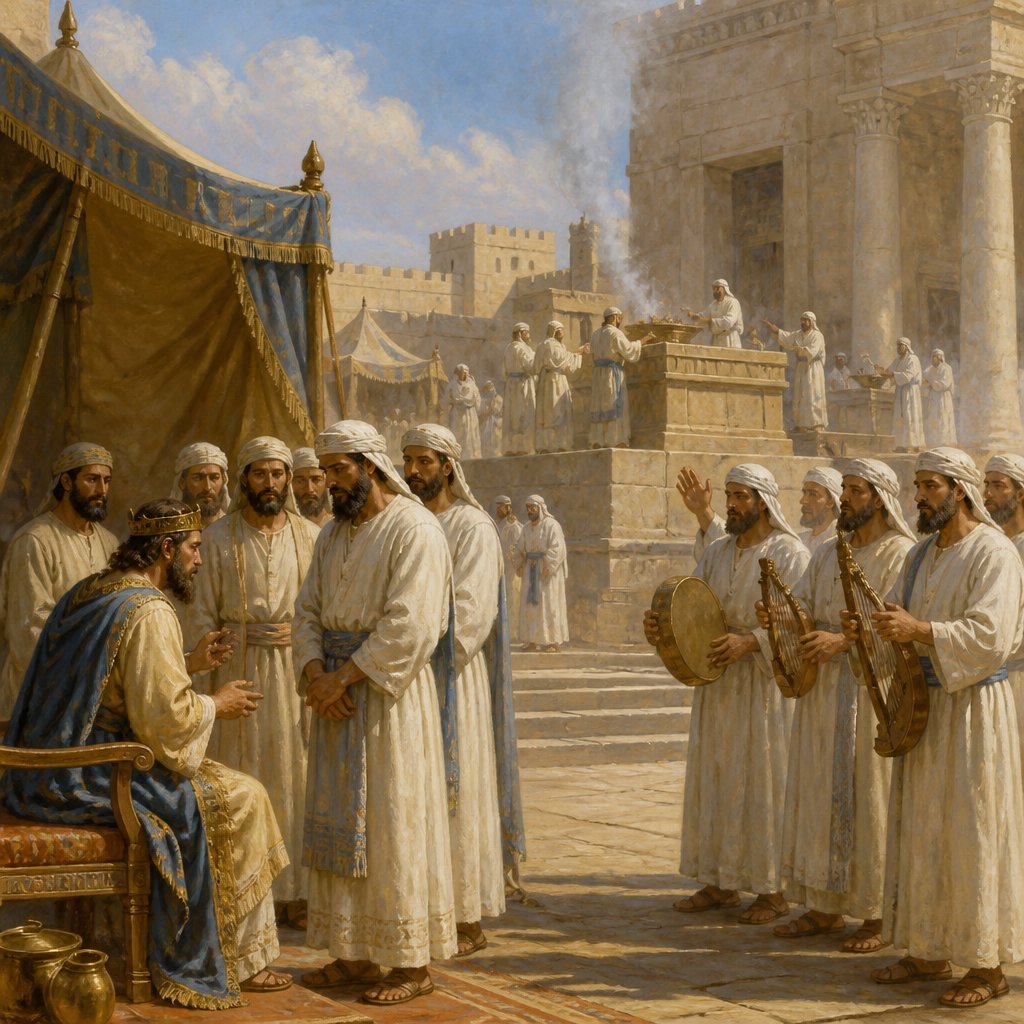
In 2 Chronicles 31:2, we read, "And Hezekiah appointed the courses of the priests and the Levites after their courses, every man according to his service, the priests and Levites for burnt offerings and for peace offerings, to minister, and to give thanks, and to praise in the gates of the tents of the LORD." This verse, though nestled in the historical record of Judah's chronological narrative, is profound in its implications for worship, leadership, and community life among God’s people.
### The Context of Worship
To understand the significance of this appointment by King Hezekiah, we must first remind ourselves of the context in which it occurs. Hezekiah ascended to the throne during a time of great spiritual decline, where idol worship and neglect of God's laws had permeated Judah. Previous kings had forsaken their covenant obligations, leading the nation astray. In the reign of Hezekiah, we witness a remarkable revival, a revival rooted in the restoration of proper worship and the reestablishment of the Levitical order.
Hezekiah recognized that the restoration of the temple worship was not merely a ceremonial act but a pivotal turning back to God. The meticulous organization of the priests and Levites signifies a revival movement aimed at reinstating the proper worship protocol according to the Law of Moses. Worship was to be conducted decently and in order, reflecting the holiness of God.
### Ordering Our Service
Hezekiah’s appointment of priests and Levites “after their courses” reminds us that God values order within His worship. Each priest was given specific duties according to their assigned roles, underscoring that worship is not a chaotic affair but rather a divinely orchestrated activity where every member has a part to play. This structuring of service invites all to participate, ensuring that the worship community is engaged, and every gift has a place.
In our communities today, it challenges us to reflect on how we order our worship. Are our churches organized in a way that allows spiritual gifts to flourish? Do we appoint our leaders, our teachers, and our servants in a manner that honors their God-given roles? Worship thrives where everyone understands their part, serving one another and the congregation as a whole.
### A Call to Active Participation
Furthermore, the text specifies the roles of the priests and Levites: they were to provide burnt offerings, peace offerings, and were to minister, give thanks, and praise. Each action has a purpose—offering burnt sacrifices symbolizes total surrender and devotion; peace offerings signify fellowship with God and community; while ministering, giving thanks, and praising represent the continual acknowledgment of God’s goodness.
In our personal lives, this lays a blueprint of how we should approach our relationship with God. Are we actively engaging with God in our worship, offering ourselves wholly, sharing in fellowship with each other, and actively participating in thanksgiving and praise? Our worship should not be limited to prescribed rituals but should encompass our entire lives—our decisions, our relationships, our work, and our rest.
### Impact on the Community
Moreover, King Hezekiah’s reforms also highlight the importance of communal worship. The priests and Levites praised God in “the gates of the tents of the LORD,” which denotes that worship was collective. There is a significant biblical emphasis on communal worship, indicating that God calls His people not only to individual devotion but also to gather together in unity to proclaim His praises.
In a world that often prioritizes personal spirituality over communal engagement, we are reminded that our faith is not just personal but communal. The corporate gatherings of prayer, worship, and service are vital for spiritual nourishment and encouragement. How can we support one another in worship? How can we gather together to glorify God and build up the community of faith?
### Conclusion
Hezekiah's commitment to restoring proper worship serves as both an example and a challenge. As we reflect on 2 Chronicles 31:2, let us seek to align our own lives and communities with God’s order. Let us serve God with the dedication of His priests and Levites, offering our lives as living sacrifices, engaging actively in worship, and fostering a vibrant community of faith.
May our lives and congregations exemplify the spirit of thanksgiving, praise, and ordered service to our Lord, as we gather in His presence and fulfill our roles in the sacred story of His people.
Get our apps


Artwork for 2 Chronicles 31:2

2 Chronicles 31:2 - "¶ And Hezekiah appointed the courses of the priests and the Levites after their courses, every man according to his service, the priests and Levites for burnt offerings and for peace offerings, to minister, and to give thanks, and to praise in the gates of the tents of the LORD."
"¶ And Hezekiah appointed the courses of the priests and the Levites after their courses, every man according to his service, the priests and Levites for burnt offerings and for peace offerings, to minister, and to give thanks, and to praise in the gates of the tents of the LORD." - 2 Chronicles 31:2
2 Chronicles 31:1

2 Chronicles 31:1

2 Chronicles 31:9 - "Then Hezekiah questioned with the priests and the Levites concerning the heaps."

2 Chronicles 31:11 - "¶ Then Hezekiah commanded to prepare chambers in the house of the LORD; and they prepared them,"

1 Chronicles 2:31 - "And the sons of Appaim; Ishi. And the sons of Ishi; Sheshan. And the children of Sheshan; Ahlai."

2 Chronicles 31:7 - "In the third month they began to lay the foundation of the heaps, and finished them in the seventh month."

2 Chronicles 31:8 - "And when Hezekiah and the princes came and saw the heaps, they blessed the LORD, and his people Israel."

2 Kings 15:31 - "And the rest of the acts of Pekah, and all that he did, behold, they are written in the book of the chronicles of the kings of Israel."

2 Chronicles 31:17 - "Both to the genealogy of the priests by the house of their fathers, and the Levites from twenty years old and upward, in their charges by their courses;"

2 Chronicles 31:4 - "Moreover he commanded the people that dwelt in Jerusalem to give the portion of the priests and the Levites, that they might be encouraged in the law of the LORD."

2 Chronicles 31:18 - "And to the genealogy of all their little ones, their wives, and their sons, and their daughters, through all the congregation: for in their set office they sanctified themselves in holiness:"

2 Chronicles 31:12 - "And brought in the offerings and the tithes and the dedicated things faithfully: over which Cononiah the Levite was ruler, and Shimei his brother was the next."

2 Chronicles 31:20 - "¶ And thus did Hezekiah throughout all Judah, and wrought that which was good and right and truth before the LORD his God."

"Then Hezekiah questioned with the priests and the Levites concerning the heaps." - 2 Chronicles 31:9

2 Chronicles 6:31 - "That they may fear thee, to walk in thy ways, so long as they live in the land which thou gavest unto our fathers."

2 Chronicles 9:31 - "And Solomon slept with his fathers, and he was buried in the city of David his father: and Rehoboam his son reigned in his stead."

2 Chronicles 31:14 - "And Kore the son of Imnah the Levite, the porter toward the east, was over the freewill offerings of God, to distribute the oblations of the LORD, and the most holy things."

2 Chronicles 31:21 - "And in every work that he began in the service of the house of God, and in the law, and in the commandments, to seek his God, he did it with all his heart, and prospered."

2 Chronicles 31:15 - "And next him were Eden, and Miniamin, and Jeshua, and Shemaiah, Amariah, and Shecaniah, in the cities of the priests, in their set office, to give to their brethren by courses, as well to the great as to the small:"

"¶ Then Hezekiah commanded to prepare chambers in the house of the LORD; and they prepared them," - 2 Chronicles 31:11

2 Chronicles 31:5 - "¶ And as soon as the commandment came abroad, the children of Israel brought in abundance the firstfruits of corn, wine, and oil, and honey, and of all the increase of the field; and the tithe of all things brought they in abundantly."

2 Chronicles 31:16 - "Beside their genealogy of males, from three years old and upward, even unto every one that entereth into the house of the LORD, his daily portion for their service in their charges according to their courses;"

"And the sons of Appaim; Ishi. And the sons of Ishi; Sheshan. And the children of Sheshan; Ahlai." - 1 Chronicles 2:31

2 Chronicles 32:31 - "¶ Howbeit in the business of the ambassadors of the princes of Babylon, who sent unto him to enquire of the wonder that was done in the land, God left him, to try him, that he might know all that was in his heart."

2 Chronicles 31:3 - "He appointed also the king's portion of his substance for the burnt offerings, to wit, for the morning and evening burnt offerings, and the burnt offerings for the sabbaths, and for the new moons, and for the set feasts, as it is written in the law of the LORD."

2 Chronicles 31:6 - "And concerning the children of Israel and Judah, that dwelt in the cities of Judah, they also brought in the tithe of oxen and sheep, and the tithe of holy things which were consecrated unto the LORD their God, and laid them by heaps."

"In the third month they began to lay the foundation of the heaps, and finished them in the seventh month." - 2 Chronicles 31:7
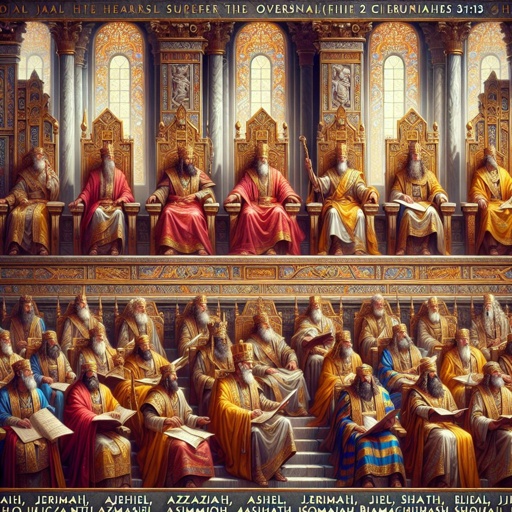
2 Chronicles 31:13 - "And Jehiel, and Azaziah, and Nahath, and Asahel, and Jerimoth, and Jozabad, and Eliel, and Ismachiah, and Mahath, and Benaiah, were overseers under the hand of Cononiah and Shimei his brother, at the commandment of Hezekiah the king, and Azariah the ruler of the house of God."