Purification in the Presence of God
“He made also ten lavers, and put five on the right hand, and five on the left, to wash in them: such things as they offered for the burnt offering they washed in them; but the sea was for the priests to wash in.” — 2 Chronicles 4:6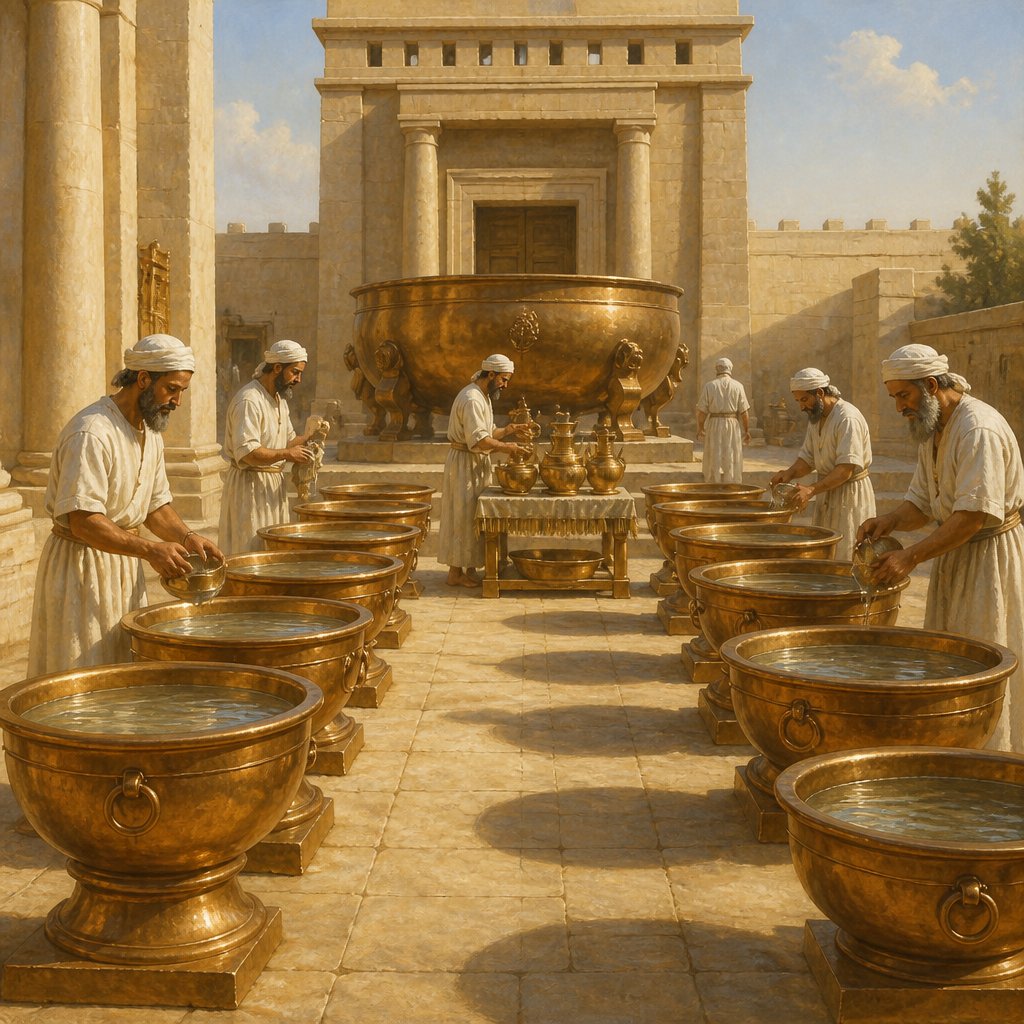
In 2 Chronicles 4:6 (KJV), we find a detailed account of King Solomon's preparations for the grand temple of the Lord. The text states, "He made also ten lavers, and put five on the right hand, and five on the left, to wash in them: such things as they offered for the burnt offering they washed in them; but the sea was for the priests to wash in." This verse is rich with spiritual significance, illustrating the themes of purification, service, and the holiness of God.
Solomon's lavers, essentially large basins, were pivotal elements in the temple's ceremonial practices. Their primary purpose was to provide water for the priests to wash their offerings, ensuring that everything presented to God was cleansed. The act of washing signifies a deeper biblical truth about the necessity of purification. In the temple, the lavers were indeed physical instruments for cleanliness, yet they also symbolize the spiritual readiness and purity required to approach the holy presence of God.
In our contemporary walk with Christ, we must grapple with the same reality—the call to be cleansed and purified in the sight of our Holy God. In Ephesians 5:26, it tells us that Christ "might sanctify and cleanse it with the washing of water by the word." Just as the offerings had to be washed, our lives need to be continually refined through the holy Scriptures. The laver represents our need for routine renewal, a reminder that we are to come before the Lord in a state of spiritual cleanliness. This entails laying aside our sins, seeking forgiveness, and allowing the Word of God to wash over us like the water in those lavers.
Moreover, the placement of the ten lavers—five on the right and five on the left—holds significant meaning. This arrangement could symbolize balance and order in our worship. Even in our approach to serving God, we are called to be organized, mindful of how we present ourselves to Him. This right and left hand placement could also signify the dual aspects of our faith—serving God while also being mindful of our community. Jesus emphasized that true worship must encompass loving God wholeheartedly and loving our neighbors as ourself (Matthew 22:37-39). As we offer our gifts and service to God, we ought to consider how we can also wash away the burdens of those around us, providing them with support and love.
The verse concludes by distinguishing between the lavers and the ‘sea,’ which was a massive basin used specifically for the priests’ own cleansing. This points to the privileged role of the priests under the Old Covenant, who could approach God more closely than the average worshiper. In a New Covenant sense, it reminds us that through Jesus Christ, the ultimate High Priest, we have open access to God. We no longer need to depend solely on the priests for cleansing; instead, we, too, have the privilege to come before God, made clean through the blood of Christ. His sacrifice ensures that we can approach the throne of grace boldly, bringing our lives, just as our offerings, to Him in a state of purity.
As we reflect upon this verse, let it be a call to ensure that our lives are daily washed in God’s grace. Just as the priests used the lavers before performing their sacred duties, let us intentionally take time each day in prayer and Scripture to cleanse ourselves spiritually. In all that we do, let us strive to be vessels of honor, prepared for every good work (2 Timothy 2:21). May we always remember that we serve a Holy God who desires not only our sacrifices but our purified hearts in worship.
Get our apps


Artwork for 2 Chronicles 4:6

2 Chronicles 4:6 - "¶ He made also ten lavers, and put five on the right hand, and five on the left, to wash in them: such things as they offered for the burnt offering they washed in them; but the sea was for the priests to wash in."
"¶ He made also ten lavers, and put five on the right hand, and five on the left, to wash in them: such things as they offered for the burnt offering they washed in them; but the sea was for the priests to wash in." - 2 Chronicles 4:6

2 Chronicles 6:4 - "And he said, Blessed be the LORD God of Israel, who hath with his hands fulfilled that which he spake with his mouth to my father David, saying,"

2 Chronicles 4:22

1 Chronicles 6:4 - "¶ Eleazar begat Phinehas, Phinehas begat Abishua,"

1 Chronicles 4:6 - "And Naarah bare him Ahuzam, and Hepher, and Temeni, and Haahashtari. These were the sons of Naarah."

2 Chronicles 6:13

2 Corinthians 4:6

2 Corinthians 4:6

2 Corinthians 4:6

2 Corinthians 4:6

2 Corinthians 4:6

2 Corinthians 4:6

2 Corinthians 4:6

2 Corinthians 4:6

2 Corinthians 4:6

2 Corinthians 4:6

2 Corinthians 4:6

2 Corinthians 4:6

2 Corinthians 4:6

2 Corinthians 4:6

2 Corinthians 4:6

2 Chronicles 6:2 - "But I have built an house of habitation for thee, and a place for thy dwelling for ever."

1 Chronicles 6:2 - "And the sons of Kohath; Amram, Izhar, and Hebron, and Uzziel."

2 Chronicles 4:15 - "One sea, and twelve oxen under it."

2 Chronicles 30:4 - "And the thing pleased the king and all the congregation."

2 Chronicles 6:6 - "But I have chosen Jerusalem, that my name might be there; and have chosen David to be over my people Israel."

2 Chronicles 11:6 - "He built even Beth-lehem, and Etam, and Tekoa,"

2 Chronicles 6:35 - "Then hear thou from the heavens their prayer and their supplication, and maintain their cause."

2 Chronicles 7:4 - "¶ Then the king and all the people offered sacrifices before the LORD."