The Authority of God's Messenger
“Then the king sent unto him a captain of fifty with his fifty. And he went up to him: and, behold, he sat on the top of an hill. And he spake unto him, Thou man of God, the king hath said, Come down.” — 2 Kings 1:9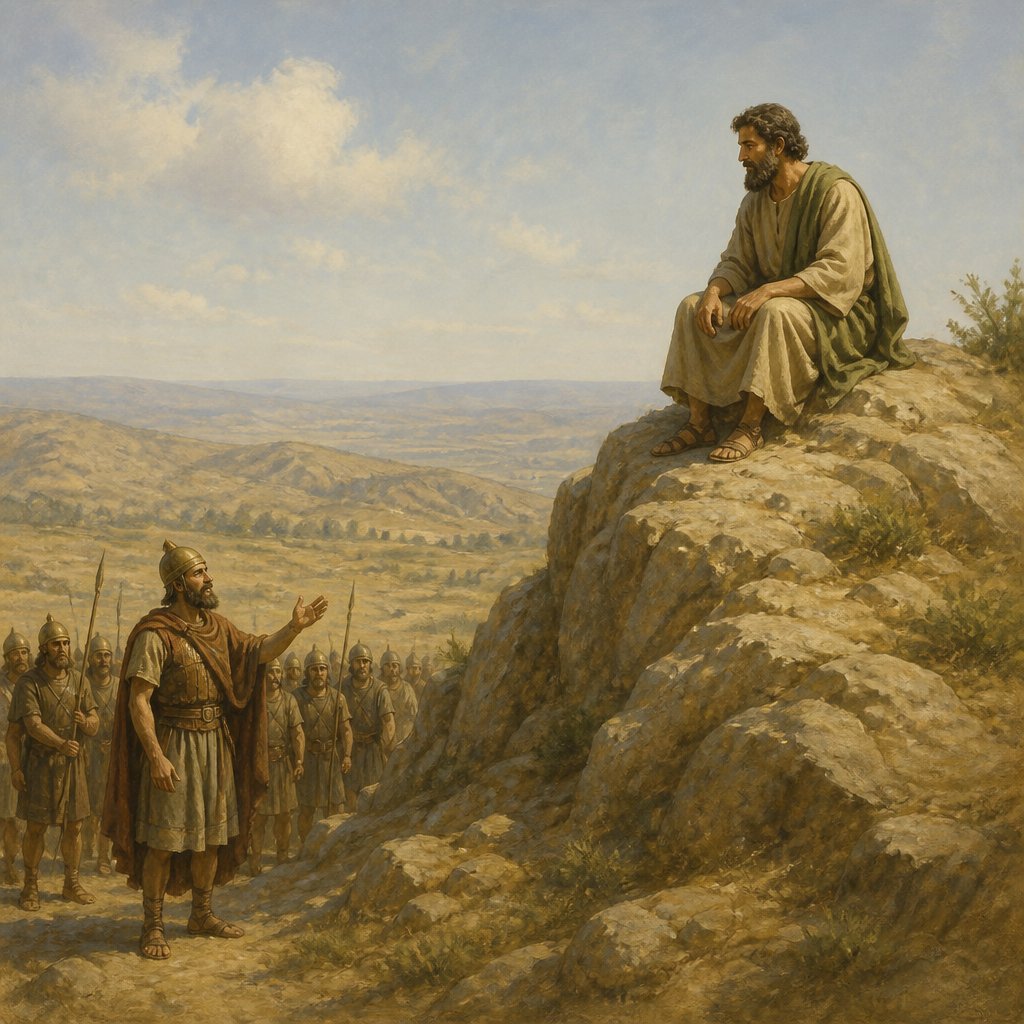
In 2 Kings 1:9, we encounter a powerful and intriguing narrative that reveals not only the authority of God's messenger but also the complex dynamics of authority, faith, and obedience. The verse states, "Then the king sent unto him a captain of fifty with his fifty. And he went up to him: and, behold, he sat on the top of an hill. And he spake unto him, Thou man of God, the king hath said, Come down."
Here, we find the king of Israel, Ahaziah, sending a captain with fifty men to summon Elijah, the prophet of God. This was not merely a polite request but a royal command backed by military force. It sets the stage for an exploration of how earthly authority often clashes with divine authority. The scene is potent; Elijah is found sitting on the top of a hill, a symbol of spiritual elevation and divine perspective, while the captain and his men, representing human authority and power, approach him with a demand.
The king's directive to Elijah, "Come down," indicates a desire for Elijah to submit to human authority. However, the context reveals that Ahaziah is insecure about matters of health and divine judgment, having fallen through a lattice and seeking counsel from Baal-zebub, the god of Ekron, instead of turning towards the living God. His command to Elijah is one of arrogance, expecting the prophet to comply without regard for the higher authority he represents.
Elijah, in his response to the captain, reveals the deeper truth of standing in God’s authority, as he responds not to the mandate of the king but to the Word of God. Remember that in earlier parts of his ministry, Elijah had already been marked as the 'man of God.' His identity and mission are not defined by human recognition or approval but by his relationship with God. As we reflect on our own lives, we should ask ourselves: Who or what defines our identity? Are we shaped by the expectations of those around us, or do we find our worth in our standing as children of the Most High?
The confrontation between the earthly captain and the prophet Elijah starkly illustrates the clash between temporal power and divine authority. The captain’s call is a command, but Elijah’s response is predicated on the authority of God, which he confirms by sending fire from heaven to consume the soldiers who come to anoint him against God’s will. This moment reveals that while kings and authority figures might hold power on earth, they are ultimately subordinate to the power of God.
As believers, we are called to navigate our lives recognizing the supremacy of God over all earthly powers. In our society, we are often presented with situations that demand our compliance or obedience to human authority. But Elijah teaches us that our first allegiance must always be to God. In times of conflict, uncertainty, or pressure from authority figures—be it in our workplaces, communities, or personal lives—we should seek God’s guidance before succumbing to the surface level demands placed upon us.
Elijah’s firm answer to the captain acts as a reminder to us that standing firm in our faith may evoke opposition from worldly powers. It also challenges us to consider how we respond when we are faced with directives that conflict with our faith and convictions. Would we, like Elijah, choose to stand steadfast in our submission to God’s will, or would we allow ourselves to be swayed by the temporal pressures around us?
As we meditate on this passage, let us remember that true authority is rooted in our relationship with God. Let us embrace the identity as 'children of God' which empowers us to act in faith, uphold righteousness, and honor God’s commands above all. May we find courage to stand our ground, just as Elijah did, and trust in the God who fights our battles.
Get our apps


Artwork for 2 Kings 1:9

2 Kings 1:9 - "Then the king sent unto him a captain of fifty with his fifty. And he went up to him: and, behold, he sat on the top of an hill. And he spake unto him, Thou man of God, the king hath said, Come down."
"Then the king sent unto him a captain of fifty with his fifty. And he went up to him: and, behold, he sat on the top of an hill. And he spake unto him, Thou man of God, the king hath said, Come down." - 2 Kings 1:9

1 Kings 9:2 - "That the LORD appeared to Solomon the second time, as he had appeared unto him at Gibeon."

1 Kings 3:9

2 kings 9:34-36

2 Kings 9:1 - "And Elisha the prophet called one of the children of the prophets, and said unto him, Gird up thy loins, and take this box of oil in thine hand, and go to Ramoth-gilead:"

1 Kings 9:18 - "And Baalath, and Tadmor in the wilderness, in the land,"

2 Chronicles 9:22 - "And king Solomon passed all the kings of the earth in riches and wisdom."

1 Kings 9:14 - "And Hiram sent to the king sixscore talents of gold."

2 Kings 9:9 - "And I will make the house of Ahab like the house of Jeroboam the son of Nebat, and like the house of Baasha the son of Ahijah:"

1 Kings 2:9 - "Now therefore hold him not guiltless: for thou art a wise man, and knowest what thou oughtest to do unto him; but his hoar head bring thou down to the grave with blood."

1 Kings 9:17 - "And Solomon built Gezer, and Beth-horon the nether,"

2 Kings 1:1 - "Then Moab rebelled against Israel after the death of Ahab."

2 Kings 19:2

2 Kings 19:2

"That the LORD appeared to Solomon the second time, as he had appeared unto him at Gibeon." - 1 Kings 9:2

2 Kings 19:2

1 Kings 15:9 - "¶ And in the twentieth year of Jeroboam king of Israel reigned Asa over Judah."

1 Kings 1:9 - "And Adonijah slew sheep and oxen and fat cattle by the stone of Zoheleth, which is by En-rogel, and called all his brethren the king's sons, and all the men of Judah the king's servants:"

2 Kings 9:4 - "¶ So the young man, even the young man the prophet, went to Ramoth-gilead."

2 Kings 9:23 - "And Joram turned his hands, and fled, and said to Ahaziah, There is treachery, O Ahaziah."

2 Kings 9:29 - "And in the eleventh year of Joram the son of Ahab began Ahaziah to reign over Judah."

1 Kings 22:9 - "Then the king of Israel called an officer, and said, Hasten hither Micaiah the son of Imlah."

2 Kings 5:9 - "So Naaman came with his horses and with his chariot, and stood at the door of the house of Elisha."

1 Kings 4:9 - "The son of Dekar, in Makaz, and in Shaalbim, and Beth-shemesh, and Elon-beth-hanan:"

2 Peter 2:9

2 Peter 2:9

2 Kings 24:9 - "And he did that which was evil in the sight of the LORD, according to all that his father had done."

2 Kings 9:31 - "And as Jehu entered in at the gate, she said, Had Zimri peace, who slew his master?"

2 Kings 9:35 - "And they went to bury her: but they found no more of her than the skull, and the feet, and the palms of her hands."