Destruction and Restoration: A Reflection on Spiritual Warfare
“And they beat down the cities, and on every good piece of land cast every man his stone, and filled it; and they stopped all the wells of water, and felled all the good trees: only in Kir-haraseth left they the stones thereof; howbeit the slingers went about it, and smote it.” — 2 Kings 3:25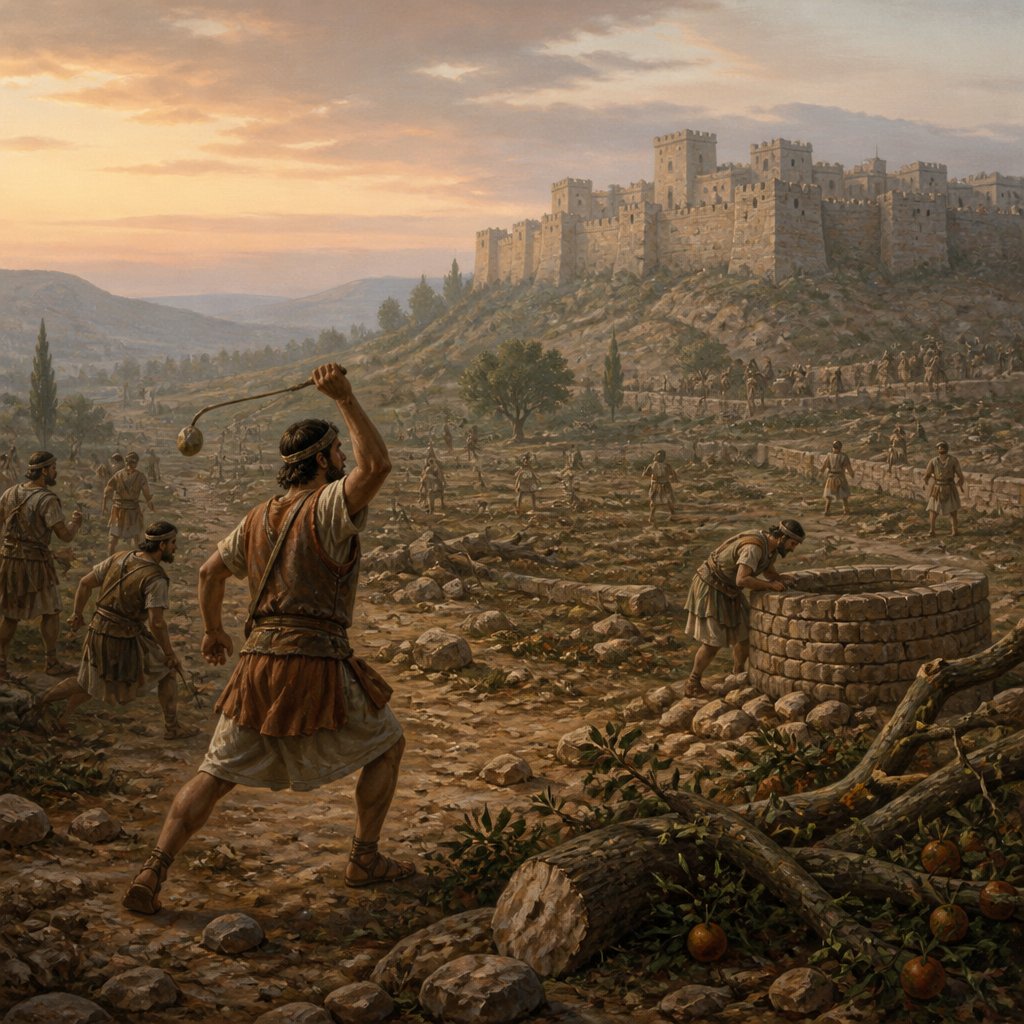
In the passage of 2 Kings 3:25, we are presented with a vivid image of destruction and conquest. The verse states, "And they beat down the cities, and on every good piece of land cast every man his stone, and filled it; and they stopped all the wells of water, and felled all the good trees: only in Kir-haraseth left they the stones thereof; howbeit the slingers went about it, and smote it." This portrayal of utter devastation offers a polarizing reflection on our spiritual battles and the effects of sin and rebellion against God. Here, we delve deeper into what this scripture conveys about destruction, perseverance, and the possibility of restoration.
Firstly, the backdrop of this scene is one of conflict between Israel and Moab. King Jehoram of Israel, along with King Jehoshaphat of Judah, undertakes military action against Moab. Their intention is clear: to regain control and dominance over lands that have slipped from their grasp. However, what emerges from this battle is not merely the physical destruction of cities and resources but a deeper symbolic act of judgment. The enemy’s actions—"they beat down the cities, and on every good piece of land cast every man his stone"—represent the obsession with eradicating the blessings that God has bestowed upon His people. Each stone hurled onto valuable ground signifies the deliberate act of undoing the good that has been established.
As we apply this time-honored truth to our lives, we must consider the spiritual ramifications of allowing sin to invade our hearts and minds. Just as the armies of Moab sought to demolish every good aspect of their surroundings, when we neglect our relationship with God, we become susceptible to external forces that seek to undermine our spiritual well-being. Spiritual apathy and rebellion can be likened to these stones thrown upon the land; they obstruct the flow of God’s living water and block our ability to bear fruit in our lives, much like the wells of water that were stopped in the passage. Without the living water of Christ, we wither.
Moreover, the image of felled trees in this passage speaks volumes about the natural resources God provides that sustain and nourish us. Trees often symbolize life, strength, and stability. When we allow conflict and rebellion to dictate our lives, we find that our strength is stripped away, and we may find ourselves lost in distractions and disobedience. The bitterness of rejection from God, akin to the felled trees, leaves us exposed and vulnerable to the rigors of life without the protection of His grace.
However, amidst these dire actions there is a profound lesson to be learned about resilience and the spirit of perseverance. "Only in Kir-haraseth left they the stones thereof," signifies that even in a situation of severe ravaging, there remained a stronghold. Kir-haraseth served as a remnant—a place where hope and potential for restoration were not entirely extinguished. Just as God preserved this city, He too provides us a refuge and a path for redemption amidst our trials and tribulations.
Paul reminds us in Romans 8:28 that God works all things together for good to them that love Him. No matter how overwhelming our circumstances may appear, there exists in God’s design a capacity for hope. Even when all seems lost, and we find ourselves like Kir-haraseth, enveloped in the chaos of our failures, God invites us to call out to Him in our lowly state. By His mercy, He can restore and uplift that which seems irreparably damaged.
As we reflect on 2 Kings 3:25, let us consider the areas of our lives where we have allowed stones of sin and conflict to mar the landscape of our spirits. With every tree that has fallen, let us seek God's grace to plant anew, to sow seeds of righteousness that yield fruit in abundance. And just as Jehovah preserves remnants within devastation, trust that He is actively working to restore you, reminding us that even in conflict, there is an invitation to transformation.
Get our apps


Artwork for 2 Kings 3:25

2 Kings 3:25 - "And they beat down the cities, and on every good piece of land cast every man his stone, and filled it; and they stopped all the wells of water, and felled all the good trees: only in Kir-haraseth left they the stones thereof; howbeit the slingers went about it, and smote it."
"And they beat down the cities, and on every good piece of land cast every man his stone, and filled it; and they stopped all the wells of water, and felled all the good trees: only in Kir-haraseth left they the stones thereof; howbeit the slingers went about it, and smote it." - 2 Kings 3:25

2 Kings 25:3 - "And on the ninth day of the fourth month the famine prevailed in the city, and there was no bread for the people of the land."

1 Kings 3:25 - "And the king said, Divide the living child in two, and give half to the one, and half to the other."

Proverbs 25:3 - "The heaven for height, and the earth for depth, and the heart of kings is unsearchable."

2 Kings 25:2 - "And the city was besieged unto the eleventh year of king Zedekiah."

"And on the ninth day of the fourth month the famine prevailed in the city, and there was no bread for the people of the land." - 2 Kings 25:3

2 Kings 3:15

2 Kings 3:15

2 Kings 3:15

2 Kings 21:25 - "Now the rest of the acts of Amon which he did, are they not written in the book of the chronicles of the kings of Judah?"

2 Kings 3:16-19

2 Kings 25:28 - "And he spake kindly to him, and set his throne above the throne of the kings that were with him in Babylon;"

2 Kings 2:25 - "And he went from thence to mount Carmel, and from thence he returned to Samaria."

2 Kings 25:12 - "But the captain of the guard left of the poor of the land to be vinedressers and husbandmen."

Proverbs 25:2 - "It is the glory of God to conceal a thing: but the honour of kings is to search out a matter."

2 Kings 25:20 - "And Nebuzar-adan captain of the guard took these, and brought them to the king of Babylon to Riblah:"

Jeremiah 25:25 - "And all the kings of Zimri, and all the kings of Elam, and all the kings of the Medes,"

"The heaven for height, and the earth for depth, and the heart of kings is unsearchable." - Proverbs 25:3

"And the city was besieged unto the eleventh year of king Zedekiah." - 2 Kings 25:2

2 Kings 25:6 - "So they took the king, and brought him up to the king of Babylon to Riblah; and they gave judgment upon him."

2 Kings 25:14 - "And the pots, and the shovels, and the snuffers, and the spoons, and all the vessels of brass wherewith they ministered, took they away."

2 Kings 25:1 show King Nebuchadnezzar in war zone

2 Kings 25:1 show King Nebuchadnezzar and the army and the Temple

1 Kings 2:25 - "And king Solomon sent by the hand of Benaiah the son of Jehoiada; and he fell upon him that he died."

2 Kings 25:10 - "And all the army of the Chaldees, that were with the captain of the guard, brake down the walls of Jerusalem round about."

2 Kings 25:18 - "¶ And the captain of the guard took Seraiah the chief priest, and Zephaniah the second priest, and the three keepers of the door:"

2 Chronicles 25:26 - "Now the rest of the acts of Amaziah, first and last, behold, are they not written in the book of the kings of Judah and Israel?"

2 Kings 25:15 - "And the firepans, and the bowls, and such things as were of gold, in gold, and of silver, in silver, the captain of the guard took away."

Jehoiachin is released from Babylonian jail 2 kings 25: 27