Restoration Through Repentance: The Lesson of Nathan’s Parable
“And he shall restore the lamb fourfold, because he did this thing, and because he had no pity.” — 2 Samuel 12:6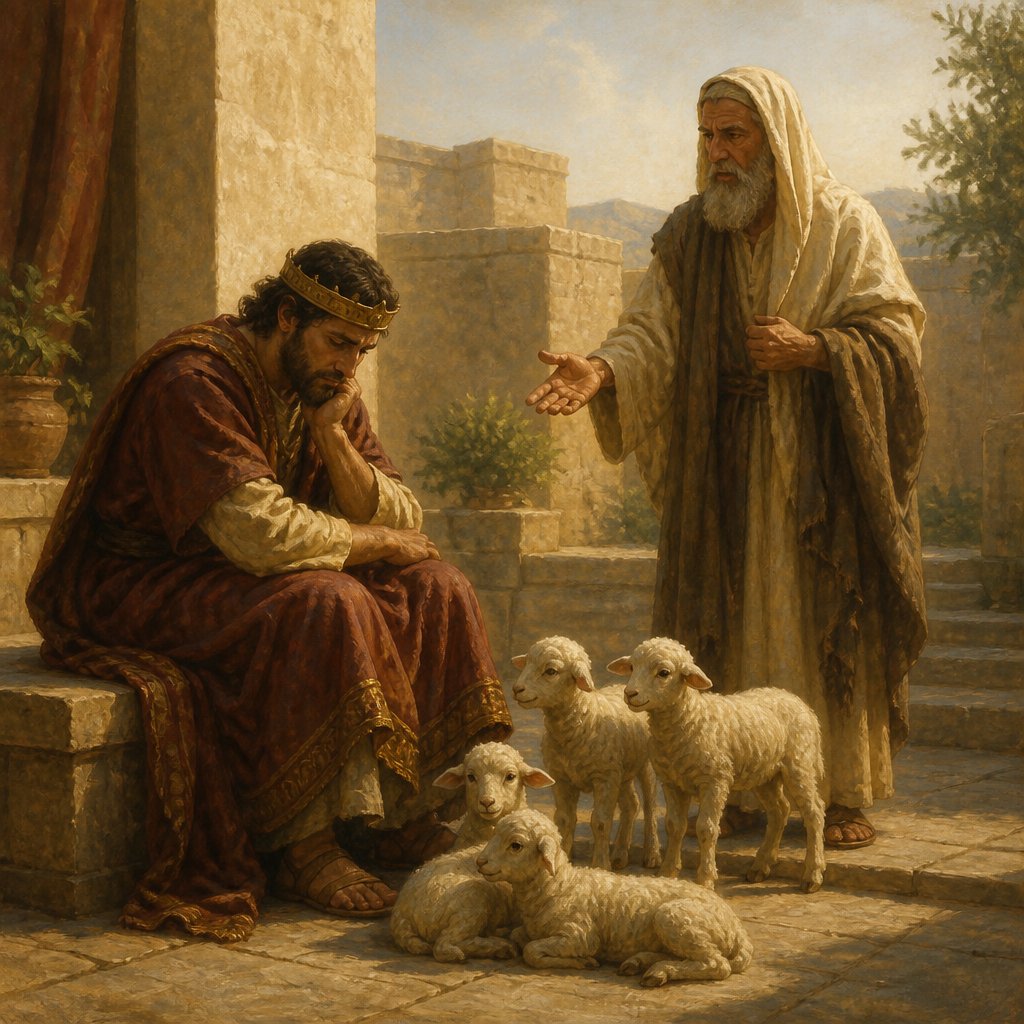
In the depths of King David's soul, a profound lesson emerged following his grave misdeeds, as recounted in 2 Samuel 12:6: "And he shall restore the lamb fourfold, because he did this thing, and because he had no pity." This Scripture provides a pivotal moment not only in David's life but also in our understanding of God's justice, mercy, and the far-reaching effects of our actions.
The context of this verse is crucial. Nathan the prophet confronted David after his adultery with Bathsheba and the orchestrated murder of her husband, Uriah. David, in his arrogance and sin, failed to recognize the weight of his decisions. Nathan’s parable of the rich man who stole the poor man’s single lamb struck David’s heart. Initially, David’s anger flared at the injustice within the parable, prompting him to pronounce judgment against the rich man, unknowingly condemning himself in the process. When Nathan declared, "Thou art the man" (2 Samuel 12:7), David was faced with the painful reality of his sin. The gravity of this confrontation was about to unveil a profound truth about sin and restoration.
The phrase "he shall restore the lamb fourfold" speaks about restitution. In the Mosaic Law, the principle of restitution for theft was clearly established. For instance, in Exodus 22:1, it is stated that a thief must pay back double the value of what was stolen, but if the stolen animal was not found alive, the restitution was to be fourfold. Nathan's statement implies that David's crimes were grievous and deserving of severe consequences, highlighting that moral failures often require more than mere acknowledgment; they require acts of true repentance and restitution.
A careful study of this verse indicates that God is serious about justice. There is a cost to sin. Not only must David confront the consequences of his actions, but he must also bear the burden of restoring what he has taken. This involves a personal transformation where the sinner recognizes their faults and seeks to mend the relationships shattered by their actions. Human relationships often suffer from the fallout of sin, necessitating not just a passive apology but an active restoration process.
As we reflect on our lives through this lens, we may see parallels with our own moral failures. Sin may not always manifest in grand gestures but may occur in the subtleties of envy, gossip, or pride. Every action against another is an offense that stirs the heart of God. The call for repentance arises when we acknowledge that there are consequences to every wrong decision.
However, the hope in this narrative is God’s capacity for mercy. After Nathan's confrontation, David's heart broke, and he penned Psalm 51—a beautiful model of confession and repentance. He understood the weight of his actions and turned back to God, pleading for a clean heart. Restoration did not diminish the effects of his sin, but rather it opened the door for God’s redemptive work in his life. The road to restoration often involves deep sorrow over our sins, but it is through this sorrow that we experience profound healing.
Moreover, the concept of restoration is not merely about what one owes but speaks to the essence of God’s covenant love. David's experience exemplifies God's understanding and forgiveness, rooting deep into His heart of compassion. Our God not only desires justice but yearns for reconciliation—He wants to restore us to Himself and align our hearts with His.
In conclusion, as we meditate on 2 Samuel 12:6, let us embrace the dual aspects of justice and mercy. Let us recognize what we owe both in earthly terms and within our relationship with God. True restoration demands repentance—not just in words but through actions. God calls us to rise from sin, make amends where we can, and pursue a life reflecting His mercy. May we strive to live with the understanding that in humility and repentance, we can be restored, not only fourfold but infinitely, by the grace of God.
Get our apps


Artwork for 2 Samuel 12:6

2 Samuel 12:6 - "And he shall restore the lamb fourfold, because he did this thing, and because he had no pity."
"And he shall restore the lamb fourfold, because he did this thing, and because he had no pity." - 2 Samuel 12:6

1 Samuel 12:6 - "¶ And Samuel said unto the people, It is the LORD that advanced Moses and Aaron, and that brought your fathers up out of the land of Egypt."

2 Samuel 5:12

1 Samuel 2:12

2 Samuel 12:2 - "The rich man had exceeding many flocks and herds:"

2 Samuel 6:14

2 Samuel 12:12 - "For thou didst it secretly: but I will do this thing before all Israel, and before the sun."

2 Samuel 6:14–22

2 Samuel 6:12 - "¶ And it was told king David, saying, The LORD hath blessed the house of Obed-edom, and all that pertaineth unto him, because of the ark of God. So David went and brought up the ark of God from the house of Obed-edom into the city of David with gladness."

2 Samuel 2:12 - "¶ And Abner the son of Ner, and the servants of Ish-bosheth the son of Saul, went out from Mahanaim to Gibeon."

Isaiah 12:2-6

Isaiah 12:2-6

Isaiah 12:2-6

ecclesiastes 12:2-6

Isaiah 12:2-6

Isaiah 12:2-6

Isaiah 12:2-6

1 Samuel 2:12 - "¶ Now the sons of Eli were sons of Belial; they knew not the LORD."

2 Samuel 12:26 - "And Joab fought against Rabbah of the children of Ammon, and took the royal city."

2 Samuel 6:6 - "¶ And when they came to Nachon's threshingfloor, Uzzah put forth his hand to the ark of God, and took hold of it; for the oxen shook it."

2 Samuel 6:23 - "Therefore Michal the daughter of Saul had no child unto the day of her death."

2 Samuel 12:29 - "And David gathered all the people together, and went to Rabbah, and fought against it, and took it."

2 Samuel 22:6 - "The sorrows of hell compassed me about; the snares of death prevented me;"

2 Samuel 23:12 - "But he stood in the midst of the ground, and defended it, and slew the Philistines: and the LORD wrought a great victory."

2 Samuel 6:1 - "Again, David gathered together all the chosen men of Israel, thirty thousand."

2 Samuel 18:6 - "¶ So the people went out into the field against Israel: and the battle was in the wood of Ephraim;"

1 Samuel 2:6 - "The LORD killeth, and maketh alive: he bringeth down to the grave, and bringeth up."

2 Samuel 24:6 - "Then they came to Gilead, and to the land of Tahtim-hodshi; and they came to Dan-jaan, and about to Zidon,"

2 Samuel 8:12 - "Of Syria, and of Moab, and of the children of Ammon, and of the Philistines, and of Amalek, and of the spoil of Hadadezer, son of Rehob, king of Zobah."