Dividing Blessings: The King’s Wisdom in Times of Conflict
“And the king said unto him, Why speakest thou any more of thy matters? I have said, Thou and Ziba divide the land.” — 2 Samuel 19:29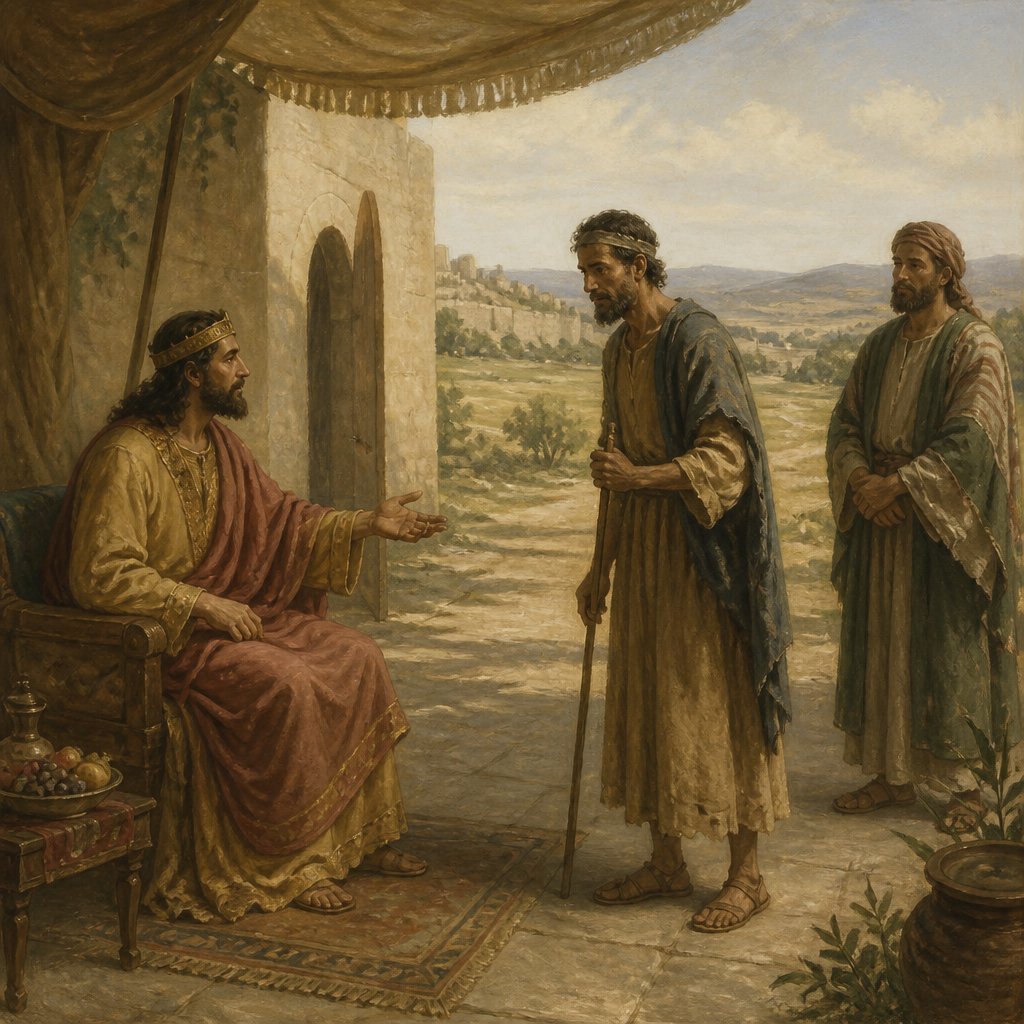
In the midst of complex narratives brimming with human emotions, power struggles, and raw vulnerability, the story of King David and Ziba beautifully encapsulates themes of justice, forgiveness, and the complexities of human relationships. We find ourselves drawn to 2 Samuel 19:29, where David, addressing Ziba, responds with a decisive proclamation that carries profound implications: "And the king said unto him, Why speakest thou any more of thy matters? I have said, Thou and Ziba divide the land." (KJV)
To understand the depth of this verse, we must delve into the surrounding context. David had just returned to Jerusalem following his flight from Absalom, his son who had instigated a rebellion. Ziba, the servant of Mephibosheth — Jonathan’s son and David’s friend — had come to David while he was in exile, presenting himself as a loyal subject and bringing supplies that were meant to support the king. However, there’s a twist: Ziba had slandered Mephibosheth, claiming he had remained in Jerusalem, waiting to claim the throne for himself.
Upon David’s return, Mephibosheth comes to meet him, looking disheveled and sorrowful, begging for an audience and defending his loyalty. However, overwhelmed by Ziba’s earlier account, David quickly makes a judgment; hence this command to divide the land. This decision, seemingly simple, opens a wellspring of reflections on justice, mercy, and the human condition.
As we contemplate David’s statement, one can sense the king’s weariness from the burdens of leadership. He faced betrayal from within his own family. He had fought battles both external and internal, and now, here amid the political intrigue, David chose a path that avoided unnecessary conflict. His command, directed to Ziba, signifies a ruling to quell a dispute instead of allowing bitterness to fester. It implicitly acknowledges the nature of human frailty — that both allegiance and treachery can often share the same space.
In our daily lives, conflicts arise. Relationships can be tested by misunderstandings, jealousies, or competition, much like Ziba and Mephibosheth’s. When faced with such scenarios, how often do we, instead of seeking reconciliation, divide further and deepen wounds? David’s action of division — offering a solution rather than imposing judgment — prompts us to consider how we react in times of personal conflict.
There’s profound grace in David’s response. He accepts that he might not know the whole truth, and rather than seek to punish or reward, he opts for a shared blessing, allowing both parties to benefit. This leads us to reflect on our own judgments; we must guard against hasty conclusions based on incomplete narratives. We must endeavor to ask for God’s discernment in our interactions.
Moreover, David's leadership encapsulated a divine wisdom that invites us to lead with humility and generosity. In moments of uncertainty and potential division, as we sit in the chair of judgment or authority, we are reminded of the call to err on the side of grace. This passage beckons us not only to seek fair resolutions but also to foster a spirit of togetherness, echoing the prayers of John 17:21, where Jesus expressed His desire for unity among His followers.
In the collision of Ziba’s accusations and Mephibosheth’s pleas, we learn a lesson in sharing abundance and the call to uplift rather than tear down. In every division in our lives, be it personal, communal, or even church-related, may we strive to partake in God’s greater plan of reconciliation. As we ponder 2 Samuel 19:29, let us ask ourselves: Are we divisive, or do we bring people together? In a world quick to foster discord, may we be called to divide our blessings generously, rather than our strife.
In conclusion, as we engage with this story of King David, Ziba, and Mephibosheth, let’s seek to embody the wisdom and grace illustrated within this encounter. May the Lord grant us the peace to settle disputes with equity and the courage to foster unity amidst conflict. Amen.
Get our apps


Artwork for 2 Samuel 19:29

2 Samuel 19:29 - "And the king said unto him, Why speakest thou any more of thy matters? I have said, Thou and Ziba divide the land."
"And the king said unto him, Why speakest thou any more of thy matters? I have said, Thou and Ziba divide the land." - 2 Samuel 19:29

2 Samuel 7:1–29

2 Samuel 19:8

2 Samuel 19:8

2 Samuel 19:8

2 Samuel 19:8

2 Samuel 19:24

2 Samuel 15:29 - "Zadok therefore and Abiathar carried the ark of God again to Jerusalem: and they tarried there."

2 Samuel 22:29 - "For thou art my lamp, O LORD: and the LORD will lighten my darkness."

2 Samuel 12:29 - "And David gathered all the people together, and went to Rabbah, and fought against it, and took it."

2 Samuel 23:29 - "Heleb the son of Baanah, a Netophathite, Ittai the son of Ribai out of Gibeah of the children of Benjamin,"

1 Samuel 29:2 - "And the lords of the Philistines passed on by hundreds, and by thousands: but David and his men passed on in the rereward with Achish."

2 Samuel 2:29 - "And Abner and his men walked all that night through the plain, and passed over Jordan, and went through all Bithron, and they came to Mahanaim."

2 Samuel 19:1 - "And it was told Joab, Behold, the king weepeth and mourneth for Absalom."

2 Samuel 22:19 - "They prevented me in the day of my calamity: but the LORD was my stay."

2 Samuel 24:19 - "And David, according to the saying of Gad, went up as the LORD commanded."

2 Samuel 2:19 - "And Asahel pursued after Abner; and in going he turned not to the right hand nor to the left from following Abner."

2 Samuel 1:19 - "The beauty of Israel is slain upon thy high places: how are the mighty fallen!"

2 Samuel 17:29 - "And honey, and butter, and sheep, and cheese of kine, for David, and for the people that were with him, to eat: for they said, The people is hungry, and weary, and thirsty, in the wilderness."

2 Samuel 19:2 - "And the victory that day was turned into mourning unto all the people: for the people heard say that day how the king was grieved for his son."

2 Samuel 19:23 - "Therefore the king said unto Shimei, Thou shalt not die. And the king sware unto him."

2 Samuel 11:19 - "And charged the messenger, saying, When thou hast made an end of telling the matters of the war unto the king,"

2 Samuel 23:19 - "Was he not most honourable of three? therefore he was their captain: howbeit he attained not unto the first three."

2 Samuel 17:19 - "And the woman took and spread a covering over the well's mouth, and spread ground corn thereon; and the thing was not known."

2 Samuel 19:33 - "And the king said unto Barzillai, Come thou over with me, and I will feed thee with me in Jerusalem."

2 Samuel 3:29 (KJVA) 29 Let it rest on the head of Joab, and on all his father's house; and let there not fail from the house of Joab one that hath an issue, or that is a leper, or that leaneth on a staff, or that falleth on the sword, or that lacketh bread.

2 Samuel 19:36 - "Thy servant will go a little way over Jordan with the king: and why should the king recompense it me with such a reward?"

2 Samuel 19:16 - "¶ And Shimei the son of Gera, a Benjamite, which was of Bahurim, hasted and came down with the men of Judah to meet king David."

Genesis 19-29