An Altar in the Threshing Floor: A Call to Sacrifice and Worship
"And Araunah said, Wherefore is my lord the king come to his servant? And David said, To buy the threshingfloor of thee, to build an altar unto the LORD, that the plague may be stayed from the people." - 2 Samuel 24:21
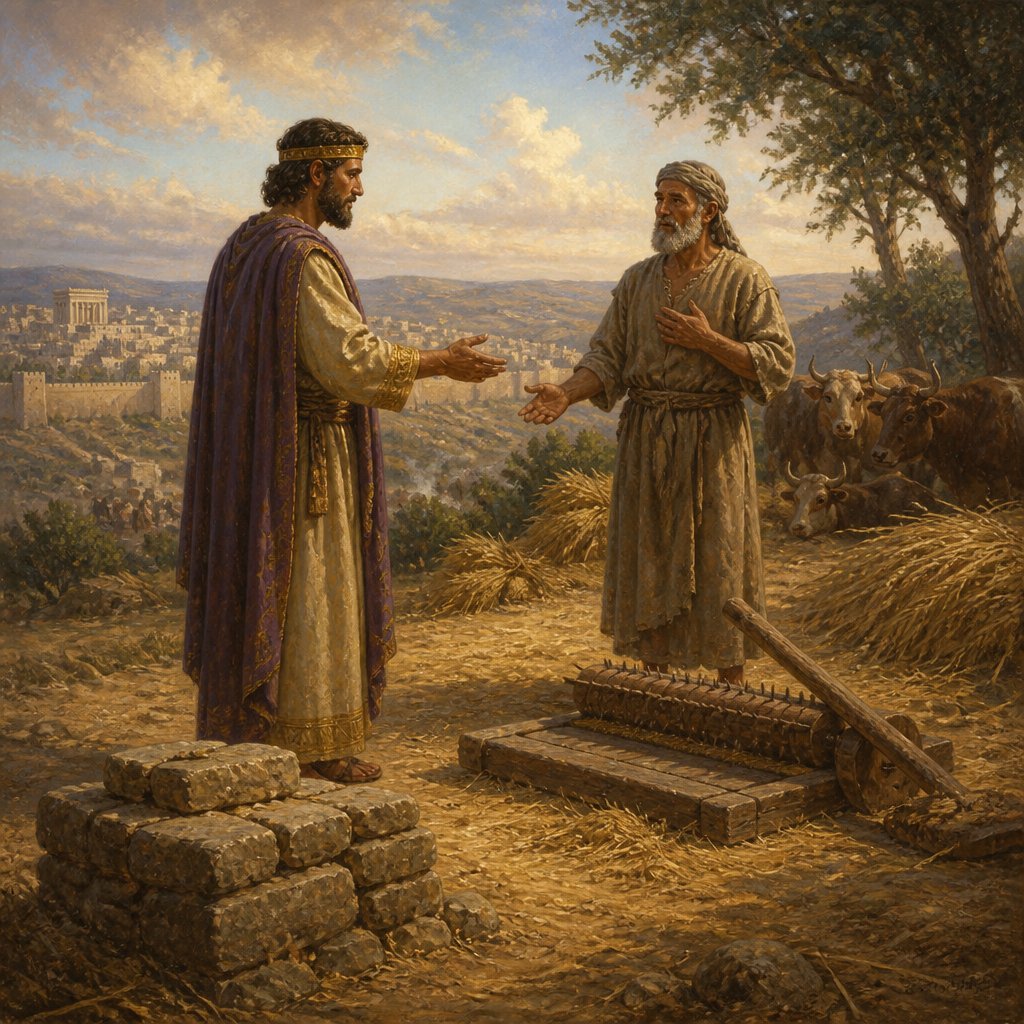
The story depicted in 2 Samuel 24:21 is a poignant illustration of the relationship between sacrifice, worship, and God’s mercy. It captures a critical moment in Israel’s history when King David, moved by a plague that had ravaged the people, sought to offer a sacrifice to the Lord in hopes of stopping the judgment. David’s conversation with Araunah, the Jebusite, reveals profound truths about the nature of worship and the attitude required when approaching God.
The verse states, "And Araunah said, Wherefore is my lord the king come to his servant? And David said, To buy the threshingfloor of thee, to build an altar unto the LORD, that the plague may be stayed from the people." At first glance, this may appear as a mere transaction for land, but it transcends into a deeper spiritual engagement for both individuals involved.
David’s determination to construct an altar reflects his heart posture. He understood the gravity of sin and its consequences – the plague was not merely an unfortunate event; it was God's righteous response to the people's transgressions. By seeking to buy Araunah’s threshing floor, David acknowledges the need for a holy space where repentance could be actively engaged. An altar signifies a meeting place between the divine and humanity, a sacred space where sacrifices are made to atone for sin. In a culture where quick fixes and superficial remedies are common, David exhibited the essence of true worship – he sought an altar, not a temporary escape.
Araunah, in his humility and reverence for the king, offers to gift the threshing floor and oxen for the sacrifice. However, David’s response is telling of his understanding of genuine worship. He refuses the offer, stating, "Nay; but I will verily buy it of thee at a price: neither will I offer burnt offerings unto the LORD my God of that which doth cost me nothing" (2 Samuel 24:24). This verse compels us to reflect on the true nature of our offerings to God. David recognized that to truly honor God, his offerings must come at a personal cost. It wasn’t enough to just present an altar; it had to represent a true sacrifice, which demonstrates not only reverence but also a tangible expression of our devotion.
In our modern Christian practice, the notion of sacrifice has taken on various forms. However, the essence remains the same: worship is often birthed out of a place of humility, recognition of our own failings, and a willingness to bring something of value before the Lord. When we worship God, let it come from a heart that understands the cost of grace. Are we bringing Him our leftovers, our spare time, or time that is convenient for us? Or are we truly investing ourselves in our worship – dedicating our best talents, time, and treasures to honor Him?
Moreover, in recognizing Araunah’s submission and David’s determination, we see two attitudes in the act of worship: servanthood and leadership. As believers, we are called to serve one another while leading by example, demonstrating how genuine worship connects us with God and with each other. David’s choice to purchase the threshing floor instead of receiving it freely illustrates his desire to take responsibility for his actions and to lead by making a sacrifice.
Finally, in our pursuit of restoring the relationship with God, we must remember that prayers and sacrifices should not be viewed merely as transactional elements of spirituality. They stem from a deep yearning to draw near to God and to align ourselves with His will. As David built that altar, he did so knowing that it would not only be for his benefit but also for the people of Israel. Our worship, too, impacts those around us, as it demonstrates God’s power to heal and restore...
As you meditate on this verse today, ask yourself: What sacrifices are you bringing to your altar? Are you approaching God in true reverence, recognizing the cost of His grace? Are you willing to give your best in worship? In doing so, we position ourselves at the threshing floor of heaven, ready to experience the transformative power of God’s mercy as He stays the plagues in our lives.
Want to reflect more on 2 Samuel 24:21?
Continue your spiritual journey with Bible Chat — an AI-powered tool for exploring God's Word through conversation. Ask questions, discover connections, and deepen your understanding.
Get Our Apps


2 Samuel 24:21 Artwork

2 Samuel 24:21 - "And Araunah said, Wherefore is my lord the king come to his servant? And David said, To buy the threshingfloor of thee, to build an altar unto the LORD, that the plague may be stayed from the people."
"And Araunah said, Wherefore is my lord the king come to his servant? And David said, To buy the threshingfloor of thee, to build an altar unto the LORD, that the plague may be stayed from the people." - 2 Samuel 24:21

2 Samuel 24:22

2 Samuel 24:22

2 Samuel 24:22

2 Samuel 19:24

2 Samuel 21:21 - "And when he defied Israel, Jonathan the son of Shimea the brother of David slew him."

2 samuel 23:8-21

2 Samuel 20:24 - "And Adoram was over the tribute: and Jehoshaphat the son of Ahilud was recorder:"

2 Samuel 24:19 - "And David, according to the saying of Gad, went up as the LORD commanded."

2 Samuel 5:21 - "And there they left their images, and David and his men burned them."

1 Samuel 2:21 - "And the LORD visited Hannah, so that she conceived, and bare three sons and two daughters. And the child Samuel grew before the LORD."

2 Samuel 24:6 - "Then they came to Gilead, and to the land of Tahtim-hodshi; and they came to Dan-jaan, and about to Zidon,"

2 Samuel 23:24 - "Asahel the brother of Joab was one of the thirty; Elhanan the son of Dodo of Beth-lehem,"

2 Samuel 21:11 - "And it was told David what Rizpah the daughter of Aiah, the concubine of Saul, had done."

2 Samuel 13:21 - "¶ But when king David heard of all these things, he was very wroth."

2 Samuel 22:24 - "I was also upright before him, and have kept myself from mine iniquity."

1 Samuel 24:21 - "Swear now therefore unto me by the LORD, that thou wilt not cut off my seed after me, and that thou wilt not destroy my name out of my father's house."

2 Chronicles 24:21 - "And they conspired against him, and stoned him with stones at the commandment of the king in the court of the house of the LORD."

2 Samuel 17:24 - "Then David came to Mahanaim. And Absalom passed over Jordan, he and all the men of Israel with him."

1 Samuel 2:24 - "Nay, my sons; for it is no good report that I hear: ye make the LORD'S people to transgress."

2 Samuel 21:22 - "These four were born to the giant in Gath, and fell by the hand of David, and by the hand of his servants."

2 Samuel 24:11 - "For when David was up in the morning, the word of the LORD came unto the prophet Gad, David's seer, saying,"

2 Samuel 24:5 - "¶ And they passed over Jordan, and pitched in Aroer, on the right side of the city that lieth in the midst of the river of Gad, and toward Jazer:"

2 Samuel 24:8 - "So when they had gone through all the land, they came to Jerusalem at the end of nine months and twenty days."

2 Samuel 2:24 - "Joab also and Abishai pursued after Abner: and the sun went down when they were come to the hill of Ammah, that lieth before Giah by the way of the wilderness of Gibeon."

2 Samuel 24:7 - "And came to the strong hold of Tyre, and to all the cities of the Hivites, and of the Canaanites: and they went out to the south of Judah, even to Beer-sheba."

2 Samuel 7:24 - "For thou hast confirmed to thyself thy people Israel to be a people unto thee for ever: and thou, LORD, art become their God."

2 Samuel 24:18 - "And Gad came that day to David, and said unto him, Go up, rear an altar unto the LORD in the threshingfloor of Araunah the Jebusite."

2 Samuel 22:21 - "The LORD rewarded me according to my righteousness: according to the cleanness of my hands hath he recompensed me."