The Cost of Vengeance: Reflections on Joab and Abner
"And when Abner was returned to Hebron, Joab took him aside in the gate to speak with him quietly, and smote him there under the fifth rib, that he died, for the blood of Asahel his brother." - 2 Samuel 3:27
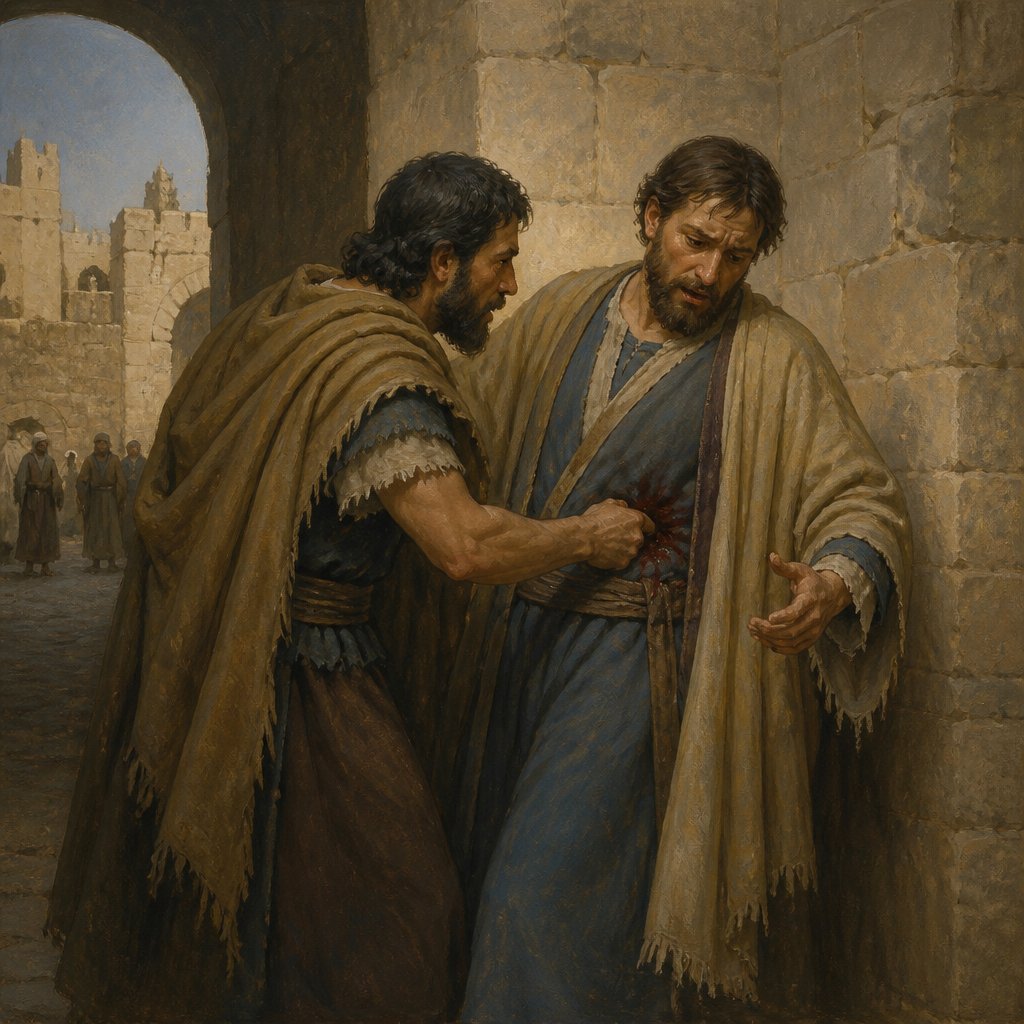
In the complex tapestry of human relationships documented in the Bible, the story of Joab and Abner resonates powerfully with themes of betrayal, vengeance, and the consequences of unresolved conflict. The verse from 2 Samuel 3:27 (KJV) reads, "And when Abner was returned to Hebron, Joab took him aside in the gate to speak with him quietly, and smote him there under the fifth rib, that he died, for the blood of Asahel his brother." Here, we witness not just a murder but a tragic culmination of personal vendetta and the failings of human emotion.
To understand this verse, we must first look at the broader context in which it occurs. Abner was the commander of Saul's army, and after Saul's death, he took on a significant role in trying to unite Israel under Ishbosheth, Saul's son. Joab, on the other hand, was David's nephew and commander of David's forces. The history between these two men is marked by tension; Abner had killed Joab's brother Asahel in battle, and the weight of that brotherly loss lay heavily on Joab’s heart.
This moment of confrontation at the gate of Hebron symbolizes not just a physical meeting but the deep turmoil within Joab’s soul. On the surface, Joab approached Abner with an air of civility, intending to "speak with him quietly," suggesting a façade of reconciliation. However, beneath this calm exterior lay a heart consumed by rage and a desire for retribution. In killing Abner, Joab acted not just as a soldier but as a man driven by revenge.
Let us reflect on the nature of vengeance. In our lives, how often do we feel justified in wanting to repay someone for a wrong done against us? Joab’s actions represent the logical culmination of unchecked emotions and desires to rectify personal grievances. Yet, the sword he wielded carried with it severe consequences. While Joab may have believed he was avenging his brother's death, he did so by taking another life, ultimately plunging himself deeper into a cycle of violence and conflict.
Vengeance may seem righteous in the moment, but it often clouds our judgment. In Romans 12:19 (KJV), we are reminded, "Dearly beloved, avenge not yourselves, but rather give place unto wrath: for it is written, Vengeance is mine; I will repay, saith the Lord." When we take justice into our own hands, we usurp the role of the divine and risk perpetuating a cycle of violence that can span generations. This act of killing Abner sparked further conflict within the nation of Israel and complicated David’s rule. The ramifications of Joab’s decision extended far beyond his intent; it contributed to a rift that would later affect the entire kingdom.
In examining Joab’s action, we recognize that hidden within conflicts are often misunderstandings or unresolved feelings that can lead us to harmful actions. Joab’s inability to forgive Abner, to allow for the possibility of peace, led not only to Abner’s death but also to the tarnishing of Joab’s character and his standing within David’s court.
As we meditate on this scripture, we are called to acknowledge our struggles with forgiveness. Perhaps there are moments in our lives where we feel we have been wronged, where we wrestle with feelings of anger and frustration are misdirected toward others. Instead of seeking vengeance, let us seek to understand and heal, to seek reconciliation rather than conflict.
Ultimately, the story of Joab and Abner is a cautionary tale reminding us of the emotional toll of unresolved conflict and the tragic consequences of vengeance. It invites us to turn to God as our source of justice and peace, urging us to pursue relationships grounded in forgiveness and grace, for it is only through His strength that we can overcome the desire for revenge and extend the hand of reconciliation. May we learn from this episode and endeavor to break the cycle of vengeance in our lives, embodying the principles of love and forgiveness that Christ so beautifully exemplifies.
Want to reflect more on 2 Samuel 3:27?
Continue your spiritual journey with Bible Chat — an AI-powered tool for exploring God's Word through conversation. Ask questions, discover connections, and deepen your understanding.
Get Our Apps


2 Samuel 3:27 Artwork

2 Samuel 3:27 - "And when Abner was returned to Hebron, Joab took him aside in the gate to speak with him quietly, and smote him there under the fifth rib, that he died, for the blood of Asahel his brother."
"And when Abner was returned to Hebron, Joab took him aside in the gate to speak with him quietly, and smote him there under the fifth rib, that he died, for the blood of Asahel his brother." - 2 Samuel 3:27

2 Samuel 23:27 - "Abiezer the Anethothite, Mebunnai the Hushathite,"

2 Samuel 1. 17-27

2 Samuel 1:27 - "How are the mighty fallen, and the weapons of war perished!"

Psalm 27:2-3

2 Samuel 13:27 - "But Absalom pressed him, that he let Amnon and all the king's sons go with him."

"Abiezer the Anethothite, Mebunnai the Hushathite," - 2 Samuel 23:27

2 Samuel 22:27 - "With the pure thou wilt shew thyself pure; and with the froward thou wilt shew thyself unsavoury."

2 Samuel 12:27 - "And Joab sent messengers to David, and said, I have fought against Rabbah, and have taken the city of waters."

2 Samuel 2:27 - "And Joab said, As God liveth, unless thou hadst spoken, surely then in the morning the people had gone up every one from following his brother."

2 Samuel 14:27 - "And unto Absalom there were born three sons, and one daughter, whose name was Tamar: she was a woman of a fair countenance."

"How are the mighty fallen, and the weapons of war perished!" - 2 Samuel 1:27

1 Samuel 27:2 - "And David arose, and he passed over with the six hundred men that were with him unto Achish, the son of Maoch, king of Gath."

2 Samuel 3:2 - "¶ And unto David were sons born in Hebron: and his firstborn was Amnon, of Ahinoam the Jezreelitess;"

1 Samuel 27:3 - "And David dwelt with Achish at Gath, he and his men, every man with his household, even David with his two wives, Ahinoam the Jezreelitess, and Abigail the Carmelitess, Nabal's wife."

2 Samuel 4:3 - "And the Beerothites fled to Gittaim, and were sojourners there until this day.)"

2 Samuel 3:4 - "And the fourth, Adonijah the son of Haggith; and the fifth, Shephatiah the son of Abital;"

2 Samuel 3:3 - "And his second, Chileab, of Abigail the wife of Nabal the Carmelite; and the third, Absalom the son of Maacah the daughter of Talmai king of Geshur;"

2 Chronicles 27:3 - "He built the high gate of the house of the LORD, and on the wall of Ophel he built much."

2 Samuel 3:11 - "And he could not answer Abner a word again, because he feared him."

2 Samuel 18:27 - "And the watchman said, Me thinketh the running of the foremost is like the running of Ahimaaz the son of Zadok. And the king said, He is a good man, and cometh with good tidings."

2 Samuel 3:33 - "And the king lamented over Abner, and said, Died Abner as a fool dieth?"

2 Samuel 3:5 - "And the sixth, Ithream, by Eglah David's wife. These were born to David in Hebron."

2 Samuel 19:27 - "And he hath slandered thy servant unto my lord the king; but my lord the king is as an angel of God: do therefore what is good in thine eyes."

2 Samuel 2:3 - "And his men that were with him did David bring up, every man with his household: and they dwelt in the cities of Hebron."

2 Samuel 17:27 - "¶ And it came to pass, when David was come to Mahanaim, that Shobi the son of Nahash of Rabbah of the children of Ammon, and Machir the son of Ammiel of Lo-debar, and Barzillai the Gileadite of Rogelim,"

2 Samuel 7:3 - "And Nathan said to the king, Go, do all that is in thine heart; for the LORD is with thee."

2 Samuel 3:37 - "For all the people and all Israel understood that day that it was not of the king to slay Abner the son of Ner."

2 Samuel 11:27 - "And when the mourning was past, David sent and fetched her to his house, and she became his wife, and bare him a son. But the thing that David had done displeased the LORD."