Appealing to Higher Authority: Understanding Paul’s Courage and Commitment
“But when the Jews spake against it, I was constrained to appeal unto Cæsar; not that I had ought to accuse my nation of.” — Acts 28:19
In Acts 28:19, we are taken into the depths of a profound moment in the apostle Paul's journey. The verse states, "But when the Jews spake against it, I was constrained to appeal unto Caesar; not that I had ought to accuse my nation of." This passage reflects a pivotal moment of tension, courage, and a resolute commitment to truth that carries significant lessons for our lives today.
Let us first set the scene. Paul, a devout Jew turned fervent follower of Christ, finds himself in the heart of conflict. After a series of trials and tribulations, including imprisonment and shipwreck, he arrives at Rome, where he is keen to testify about the Gospel. However, he encounters strong opposition from the very people who once shared his heritage—the Jews. They reject his message of Jesus as the Messiah, leading to Paul feeling 'constrained' to take a stand. What a powerful word that is: constrained. It denotes a strong motivation or compulsion, signifying that Paul’s decision to appeal to Caesar was not made lightly or without thought.
Paul's appeal to Caesar is emblematic of his relentless quest for justice and truth. It illustrates a believer's response in the face of adversity and discrimination. The Jews opposed him not merely as a political figure but also as a threat to their religious identity and beliefs. Yet, Paul does not retaliate with accusations against his nation; instead, he shows grace in his plea. He states, "not that I had ought to accuse my nation of." This is a radical display of love and forgiveness—a reminder that even when we are wronged or misunderstood, our responsibility is to maintain the higher ground of integrity and grace.
In this world where division often leads to shouting and accusations, Paul exemplifies an approach relying on higher authority rather than on human confrontation. His appeal to Caesar reflects a belief in a system that allows for justice—a recognition that while he faces opposition, there is a greater authority to which he can turn. This is a lesson we, too, can adopt in our struggles, whether personal or communal. How often do we feel constrained to respond to hostility with more hostility? Paul reminds us that our faith calls us to appeal to the highest authority, to our rightful place in God, who upholds justice; thus, we need not lower ourselves to the fight.
Moreover, Paul's journey teaches us about purpose and perseverance. He was a man on a mission, committed to spreading the Gospel despite the resistance he faced from his own. He did not waver in his faith even when subjected to hardship. As believers, we are called to this same kind of durability and to endure through our trials, knowing that each challenge serves a purpose in God’s grand design. Paul saw the opposition not as something that could undermine his mission but as an opportunity to further proclaim Christ, even before the very leaders of the Roman Empire. Are there ‘Caesars’ in your life—places of influence or authority where you feel called to make a stand for truth and faith?
Finally, consider the virtue of humility that Paul demonstrates through this verse. Rather than casting blame or accusations, he remains focused on his mission. In our own lives, humility can be a potent weapon against division. When we choose to lend an ear rather than shout accusations, we open the door for understanding and reconciliation.
As we meditate on Acts 28:19, let us ask: Who are we appealing to in moments of conflict? Are we holding onto grudges and accusations, or are we willing to present our cases before God, asking for divine intervention? Paul’s example encourages us to remain steadfast in our faith, appeal to higher authority, and respond to opposition with grace, humility, and a commitment to truth. May we all find the strength to appeal to our own "Caesar"—trusting that in every conflict, God is our ultimate advocate.
Get our apps


Artwork for Acts 28:19

Acts 28:19 - "But when the Jews spake against it, I was constrained to appeal unto Caesar; not that I had ought to accuse my nation of."

"But when the Jews spake against it, I was constrained to appeal unto Caesar; not that I had ought to accuse my nation of." - Acts 28:19

Acts 19:28 - "And when they heard these sayings, they were full of wrath, and cried out, saying, Great is Diana of the Ephesians."
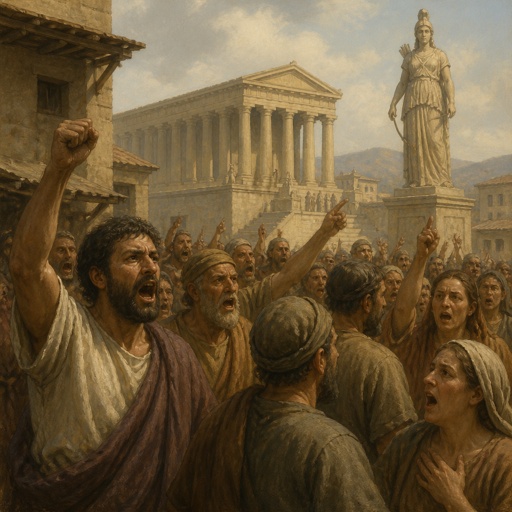
"And when they heard these sayings, they were full of wrath, and cried out, saying, Great is Diana of the Ephesians." - Acts 19:28

Acts 28:12

Acts 28:28 - "Be it known therefore unto you, that the salvation of God is sent unto the Gentiles, and that they will hear it."

Ezekiel 28:11-19

Ezekiel 28:11-19

Acts 14:28 - "And there they abode long time with the disciples."

Ezekiel 28:11-19

Ezekiel 28:11-19

Ezekiel 28:11-19

Ezekiel 28:11-19

matthew 28:19

Genesis 28-19

matthew 28:19

Genesis 19-28

Luke 19:28

Acts 28:12 - "And landing at Syracuse, we tarried there three days."

Acts 9:28 - "And he was with them coming in and going out at Jerusalem."

Acts 19: 11

Acts 19:11

Acts 28:1 - "And when they were escaped, then they knew that the island was called Melita."

Matthew 28:19-20

Acts 28:5 - "And he shook off the beast into the fire, and felt no harm."

Acts 8:28 - "Was returning, and sitting in his chariot read Esaias the prophet."

Matthew 28:19-20

Matthew 28: 19-20

Matthew 28:19-20

Acts 28:24 - "And some believed the things which were spoken, and some believed not."