The Voice in the Fire: Hearing God Amidst the Chaos
“And the LORD spake unto you out of the midst of the fire: ye heard the voice of the words, but saw no similitude; only ye heard a voice.” — Deuteronomy 4:12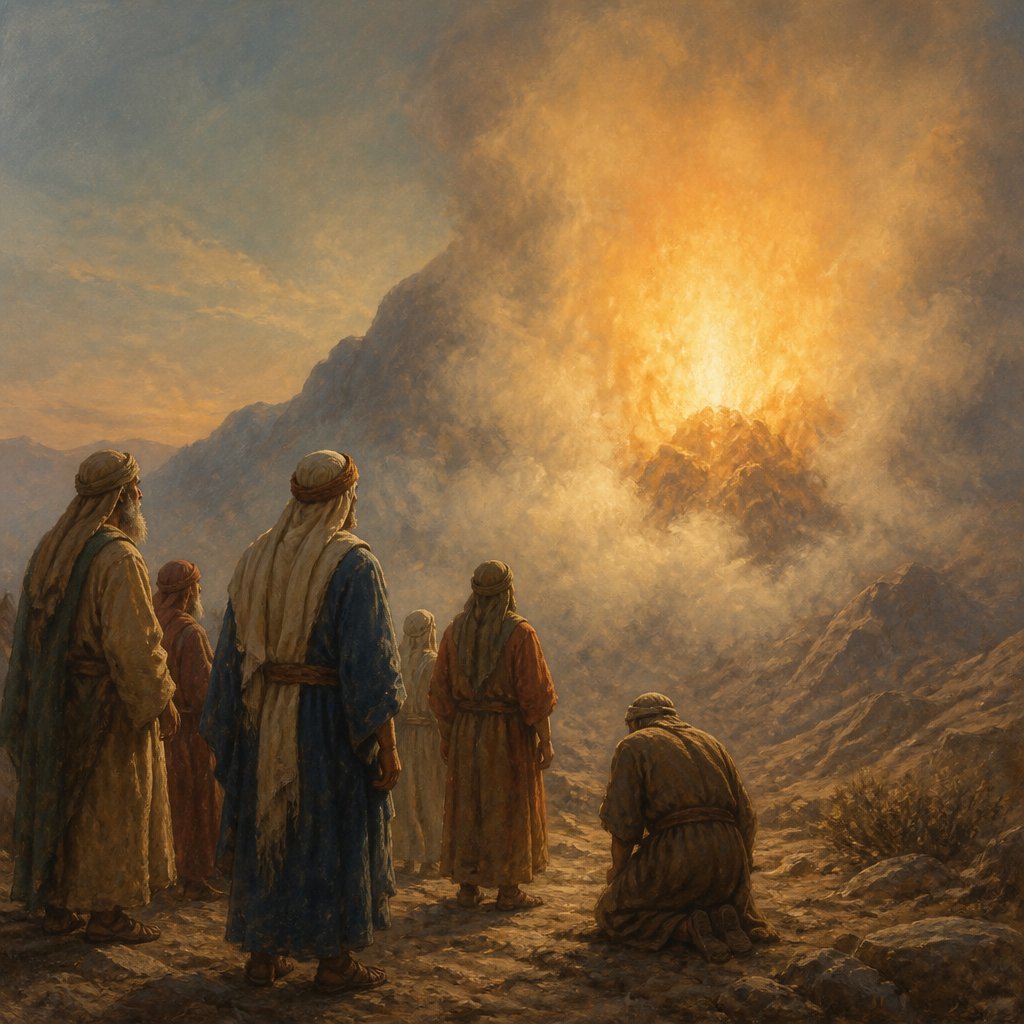
As we journey through life, we are often confronted with chaos and distractions that hinder our ability to hear God’s voice clearly. In Deuteronomy 4:12, we encounter a profound truth about the nature of God’s communication with His people: *"And the LORD spake unto you out of the midst of the fire: ye heard the voice of the words, but saw no similitude; only ye heard a voice."* Here we find the Israelites standing before Mount Sinai, a scene marked by awe and reverence, as God chose to reveal Himself not through a visible form, but through His voice amidst the fire or smoke. This moment serves as a powerful reminder of God’s transcendent nature and highlights the importance of transcending the visible to encounter the divine.
**God Speaks in the Midst of the Fire**
Fire is often associated with purification, intensity, and divine presence. When God spoke out of the flame, it was not merely for dramatic effect; it symbolized His holy nature. Fire burns away impurities and represents judgment, yet it also illuminates and warms. In our lives, we often face fiery trials—situations that threaten to consume us. However, it is crucial to remember that God chooses to speak in these moments of testing and difficulty. He speaks not through the comfort of familiarity but in the unsettling yet formative experiences of life. Even when we find ourselves surrounded by flames—whether they be trials of health, finances, relationships, or faith—we can trust that God has a message for us, desiring to guide and shape us through the process.
**The Emphasis on Hearing**
The second part of the verse emphasizes that the Israelites *"heard the voice of the words, but saw no similitude; only ye heard a voice."* This distinction is vital. In a world inundated with visual stimulation, we often prioritize what we see over what we hear. Our physical eyes may feast on the abundance of this world, from social media to news headlines, but God calls us into a different space—the ability to perceive His voice even in silence. God has often communicated His will and His heart through whispers, subtle promptings, or the stillness within us. We have to cultivate the practice of listening, learning to tune out the numerous distractions and instead focus on the essence of His voice speaking through Scripture, prayer, and the impressions in our hearts.
**Seeing No Similitude**
The lack of similitude in God's revelation challenges our tendency to box Him into human understanding. As humans, we find comfort in the tangible, the recognizable. Yet God invites us into a deeper relationship, one that requires faith even when we cannot see Him. Hebrews 11:1 reminds us that *"faith is the substance of things hoped for, the evidence of things not seen."* God’s very nature is not confined to our experiences and perceptions. Instead, He often reveals Himself in ways that transcend our understanding, connecting to our spirit rather than our senses. Our faith grows in these moments of mystery, where we cling to His voice amidst the uncertainty.
**Responding to His Voice**
As we meditate on this verse, let us ask ourselves how we can be more attuned to God’s voice. Are we willing to sit in silence? Do we allow God's Word to penetrate our hearts and reshape our understanding, or are we quick to distract ourselves with the noise around us? Unlike the Israelites who physically stood before the mountain, we too stand before the presence of God, invited to listen closely and respond with open hearts. Getting alone with God, seeking His guidance amid our personal "fires", and building anticipation for His voice can lead us to a place of profound peace, directing our steps and affirming His will in our lives.
**Conclusion**
In conclusion, Deuteronomy 4:12 paints a picture of God’s desire to communicate with us. It calls us to recognize and value the profound way in which He chooses to reveal Himself—not through spectacle, but through the powerful simplicity of His voice. In every season, especially amid trials represented by fire, may we deepen our commitment to listen, trust, and respond to God as He speaks to us in the stillness, guiding us towards the fulfillment of His purpose for us.
Get our apps


Artwork for Deuteronomy 4:12

Deuteronomy 4:12 - "And the LORD spake unto you out of the midst of the fire: ye heard the voice of the words, but saw no similitude; only ye heard a voice."

"And the LORD spake unto you out of the midst of the fire: ye heard the voice of the words, but saw no similitude; only ye heard a voice." - Deuteronomy 4:12

Deuteronomy 12:4 - "Ye shall not do so unto the LORD your God."

"Ye shall not do so unto the LORD your God." - Deuteronomy 12:4

Deuteronomy 26:4-10

Deuteronomy 26:4-10

Deuteronomy 14:12 - "But these are they of which ye shall not eat: the eagle, and the ossifrage, and the ospray,"

Deuteronomy 24:12 - "And if the man be poor, thou shalt not sleep with his pledge:"

Deuteronomy 4:4 - "But ye that did cleave unto the LORD your God are alive every one of you this day."

Deuteronomy 12:24 - "Thou shalt not eat it; thou shalt pour it upon the earth as water."

Deuteronomy 32:12 - "So the LORD alone did lead him, and there was no strange god with him."

Deuteronomy 5:12 - "Keep the sabbath day to sanctify it, as the LORD thy God hath commanded thee."

Deuteronomy 34:1-4 – Moses views the Promised Land from Mount Nebo.

Deuteronomy 34:1-4 – Moses views the Promised Land from Mount Nebo.

Deuteronomy 34:1-4 – Moses views the Promised Land from Mount Nebo.

Deuteronomy 20:12 - "And if it will make no peace with thee, but will make war against thee, then thou shalt besiege it:"

Deuteronomy 4:44 - "¶ And this is the law which Moses set before the children of Israel:"

Deuteronomy 12:9 - "For ye are not as yet come to the rest and to the inheritance, which the LORD your God giveth you."

Deuteronomy 33:4 - "Moses commanded us a law, even the inheritance of the congregation of Jacob."

Deuteronomy 34:1-4 – Moses views the Promised Land from Mount Nebo.

Deuteronomy 34:1-4 – Moses views the Promised Land from Mount Nebo.

Deuteronomy 6:4 - "Hear, O Israel: The LORD our God is one LORD:"

Deuteronomy 12:19 - "Take heed to thyself that thou forsake not the Levite as long as thou livest upon the earth."

Deuteronomy 12:16 - "Only ye shall not eat the blood; ye shall pour it upon the earth as water."

Deuteronomy 4:24 - "For the LORD thy God is a consuming fire, even a jealous God."

Deuteronomy 34:1-4 – Moses views the Promised Land from Mount Nebo.

Deuteronomy 34:1-4 – Moses views the Promised Land from Mount Nebo.

Deuteronomy 4:41 - "¶ Then Moses severed three cities on this side Jordan toward the sunrising;"

Deuteronomy 14:4 - "These are the beasts which ye shall eat: the ox, the sheep, and the goat,"

Deuteronomy 16:12 - "And thou shalt remember that thou wast a bondman in Egypt: and thou shalt observe and do these statutes."