The Human Condition: A Reflection on Ecclesiastes 3:18
"I said in mine heart concerning the estate of the sons of men, that God might manifest them, and that they might see that they themselves are beasts." - Ecclesiastes 3:18
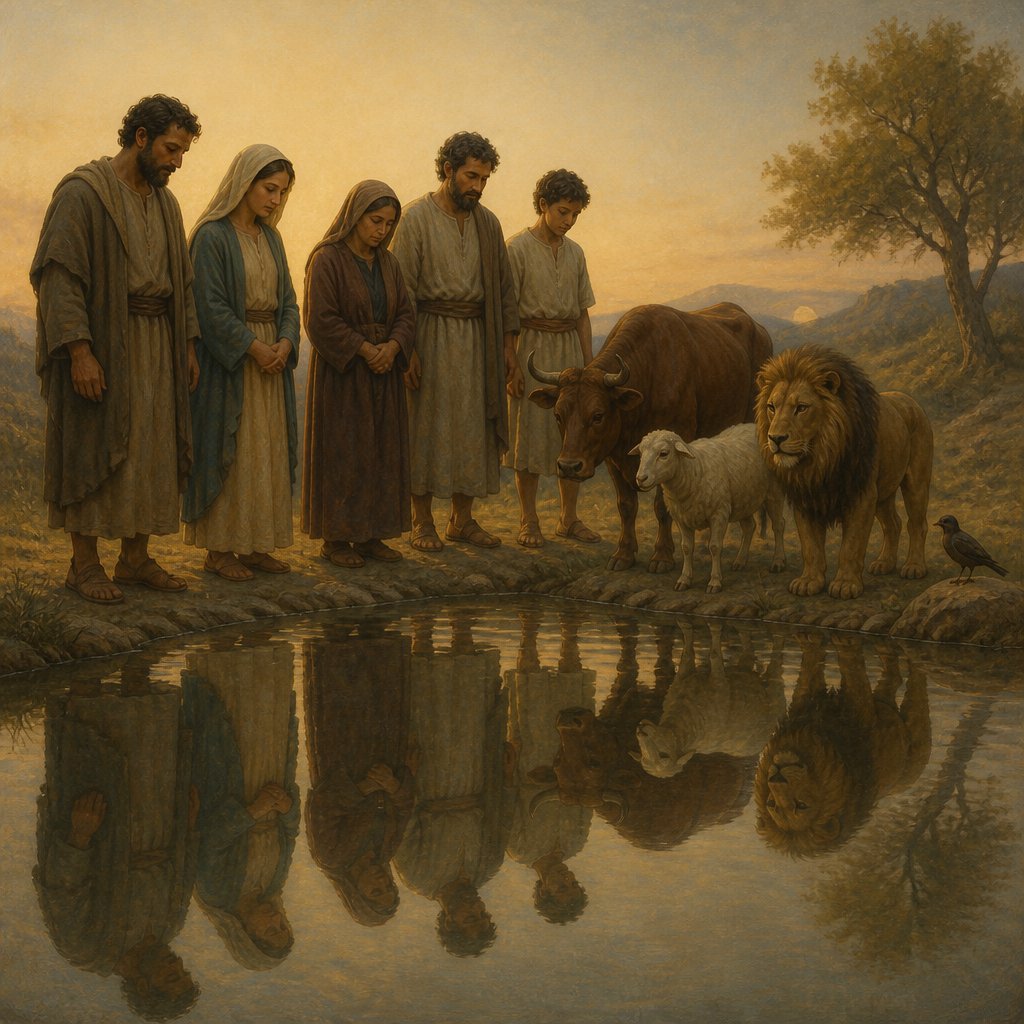
Ecclesiastes 3:18 (KJV) states, "I said in mine heart concerning the estate of the sons of men, that God might manifest them, and that they might see that they themselves are beasts." This profound verse serves as a poignant reminder of our humanity and the divine perspective on our existence. As we delve into this scripture, let us find grounding for our spiritual lives and understand the implications of what it means to be human in the sight of God.
Solomon, traditionally believed to be the author of Ecclesiastes, writes these lines with a heart that is reflective and burdened by observations of life’s futility. Throughout the book, he grapples with the meaning of life, the inevitability of death, and the sometimes depressing reality of the human condition. The term "beasts" in this verse can feel jarring, yet it heralds an important exploration of self-awareness and humility in our spiritual journey.
At first glance, comparing humanity to beasts might seem pessimistic, casting a shadow over our dignity and worth. However, a deeper interaction with the text reveals that Solomon is not outright denouncing the value of human life but is instead drawing attention to our often ungoverned impulses and carnal nature. Animals operate based on instinct, and therein lies the comparison. In many ways, we too can be prone to acting on our base desires – anger, greed, lust, and hastiness. Without the guiding light of God’s truth and the discipline of the Holy Spirit, we may find that our actions resemble more of the animalistic behaviors seen in the natural world.
In this light, Solomon’s statement invites us to reflect soberly on ourselves. In various psalms, we find the psalmist often questioning God about the worth of human beings in contrast to the vastness of creation: "What is man, that thou art mindful of him?" (Psalm 8:4). This thought is profound; it encapsulates a mystery of our existence. God’s attention and love for humanity is unfathomable given our flawed nature. It serves to remind us that while we may share indiscriminately with the beasts of the field in our instincts and flaws, we are also bestowed with the remarkable power of free will and the divine breath of life.
The verse also points towards a revelation — God might manifest us. The work of God in revealing our true nature and condition becomes a sacred journey into understanding not just who we are but who we are called to be. In walking with God, we discover that we are not just beasts. We are loved, redeemed, and called to a higher purpose. God desires for us to realize our potential as image-bearers and agents of His will on earth. Reflecting on our nature leads us to acknowledge our weaknesses; this, in turn, opens the door to seeking help, forgiveness, and a deeper relationship with Christ.
Consider how Jesus embodied the fullness of humanity while living a sinless life. He teaches us grace and provides a perfect model of how to rise above our beastly tendencies. The law does not solely hang on our physical behaviors but on the condition of our hearts. As we learn to capture our thoughts, desires, and actions, we start to reflect Christ more profoundly and, in doing so, reveal the divine nature imprinted on our souls.
In closing, Ecclesiastes 3:18 serves as an exhortation to take an honest inventory of our lives. Are we living as beasts, ruled by instinct, or are we striving for the grace to transcend our lower natures and reflect the divine character of love, kindness, and righteousness? God's desire is for us to possess an awareness of our humanity while also embracing the calling to which He has entrusted us. May this verse inspire humility, reflection, and ultimately, transformation as we engage with the beautiful complexity of our existence as beings created in the image of God.
Want to reflect more on Ecclesiastes 3:18?
Continue your spiritual journey with Bible Chat — an AI-powered tool for exploring God's Word through conversation. Ask questions, discover connections, and deepen your understanding.
Get Our Apps


Ecclesiastes 3:18 Artwork

Ecclesiastes 3:18 - "I said in mine heart concerning the estate of the sons of men, that God might manifest them, and that they might see that they themselves are beasts."
"I said in mine heart concerning the estate of the sons of men, that God might manifest them, and that they might see that they themselves are beasts." - Ecclesiastes 3:18

"1 There is a time for everything, and a season for every activity under the heavens: 2 a time to be born and a time to die, a time to plant and a time to uproot, 3 a time to kill and a time to heal, a time to tear down and a time to build, 4 a time to weep and a time to laugh, a time to mourn and a time to dance, 5 a time to scatter stones and a time to gather them, a time to embrace and a time to refrain from embracing, 6 a time to search and a time to give up, a time to keep and a time to throw away, 7 a time to tear and a time to mend, a time to be silent and a time to speak, 8 a time to love and a time to hate, a time for war and a time for peace." - Ecclesiastes 3:1-8

Ecclesiastes 3:1

Ecclesiastes 3:3 - "A time to kill, and a time to heal; a time to break down, and a time to build up;"

Ecclesiastes 3:7-8

Ecclesiastes 1:18 - "For in much wisdom is much grief: and he that increaseth knowledge increaseth sorrow."

Ecclesiastes 10:18 - "¶ By much slothfulness the building decayeth; and through idleness of the hands the house droppeth through."

Ecclesiastes 9:18 - "Wisdom is better than weapons of war: but one sinner destroyeth much good."

Ecclesiastes 3:1 – "There is a time for everything, and a season for every activity under the heavens."

Ecclesiastes 3:1 - "To every thing there is a season, and a time to every purpose under the heaven:"

Ecclesiastes 3:9 - "What profit hath he that worketh in that wherein he laboureth?"

Ecclesiastes 3:4 - "A time to weep, and a time to laugh; a time to mourn, and a time to dance;"

Ecclesiastes 3:8 - "A time to love, and a time to hate; a time of war, and a time of peace."

Ecclesiastes 3:6 - "A time to get, and a time to lose; a time to keep, and a time to cast away;"

Ecclesiastes 7:3 - "Sorrow is better than laughter: for by the sadness of the countenance the heart is made better."

Ecclesiastes 3:7 - "A time to rend, and a time to sew; a time to keep silence, and a time to speak;"

Ecclesiastes 3:21 - "Who knoweth the spirit of man that goeth upward, and the spirit of the beast that goeth downward to the earth?"

Ecclesiastes 3:2 - "A time to be born, and a time to die; a time to plant, and a time to pluck up that which is planted;"

Ecclesiastes 3:16 - "¶ And moreover I saw under the sun the place of judgment, that wickedness was there; and the place of righteousness, that iniquity was there."

Ecclesiastes 3:20 - "All go unto one place; all are of the dust, and all turn to dust again."

Ecclesiastes 3:12 - "I know that there is no good in them, but for a man to rejoice, and to do good in his life."

Ecclesiastes 5:3 - "For a dream cometh through the multitude of business; and a fool's voice is known by multitude of words."

Ecclesiastes 1:3 - "What profit hath a man of all his labour which he taketh under the sun?"

Ecclesiastes 3:15 - "That which hath been is now; and that which is to be hath already been; and God requireth that which is past."

Ecclesiastes 3:10 - "I have seen the travail, which God hath given to the sons of men to be exercised in it."

Ecclesiastes 3:13 - "And also that every man should eat and drink, and enjoy the good of all his labour, it is the gift of God."

Ecclesiastes 3:1 – "There is a time for everything, and a season for every activity under the heavens." r

Ecclesiastes 7:18 - "It is good that thou shouldest take hold of this; yea, also from this withdraw not thine hand: for he that feareth God shall come forth of them all."

Ecclesiastes 3:17 - "I said in mine heart, God shall judge the righteous and the wicked: for there is a time there for every purpose and for every work."