Embracing the Uncontrollable: Finding Peace in Ecclesiastes 8:8
"There is no man that hath power over the spirit to retain the spirit; neither hath he power in the day of death: and there is no discharge in that war; neither shall wickedness deliver those that are given to it." - Ecclesiastes 8:8

Ecclesiastes 8:8 states, "There is no man that hath power over the spirit to retain the spirit; neither hath he power in the day of death: and there is no discharge in that war; neither shall wickedness deliver those that are given to it." This scripture presents profound insights about the human condition, the inevitability of death, and the nature of divine sovereignty over life itself.
As we delve into this verse, we must first recognize the vivid imagery that King Solomon employs. The term "spirit" often signifies life itself, the animating force bestowed by God. Solomon, in his wisdom, appropriately points out the limitations faced by every individual. Despite our striving for control and influence in various aspects of our lives—career, relationships, financial stability—the truth remains: we are ultimately powerless over the spirit and the timing of our deaths. We exist within the bounds of time and the created order established by God.
In a world that continually emphasizes control, success, and achievement, this verse serves as a stark reminder of our vulnerabilities. The inevitable truth is that no human has the authority to command life or death; our days are numbered according to God’s perfect plan. In this acknowledgment lies the essential foundation of faith—understanding that God is sovereign. Despite our best efforts to navigate through life's joys and sorrows, we must find solace in the fact that He holds the key to eternity.
The phrase "neither hath he power in the day of death" resonates with a simple yet sobering realization: death is both a certainty and a mystery. It calls into question the eternal trajectory of our lives. How poignant it is that no matter the wealth one accumulates or the power one exerts, death remains an unscalable wall that will eventually meet us all. This reality should prompt a reflective examination of how we spend the life that is given to us.
As we draw closer to the inevitability of death in our reflections, it is crucial that we address Solomon's declaration that “there is no discharge in that war.” Life, with all its afflictions and struggles, resembles a soldier engaged in a combat that admits no retreat or ceasefire. We are in a constant battle against sin, against our mortality, and against the temptations to control our lives through means other than godly submission. In this light, we understand that the call is not to avoid the battles of life, but to engage them with faith, knowing that they are transient compared to the eternal life promised through Christ.
Furthermore, Solomon adds that “wickedness shall not deliver those that are given to it.” This clarion call helps us grasp the futility of searching for refuge in sin or deceitful pursuits. The allure of wickedness might promise respite or an escape from the harsh realities of life, yet they ultimately lead to destruction and despair. As believers, we are reminded that deliverance comes not from misaligned decisions, but rather through reliance on God and His grace through Jesus Christ, who offers us salvation and a living hope beyond the grave.
In our day-to-day journeys, may we embrace the limitations of our control and yield our lives to the One who knows every hair on our heads and has numbered our days. Let us cultivate a spirit of humility, seeking God’s guidance in our battles both large and small. As we confront the uncertainties of life, may we be assured that our fate rests not in the fallacies of wickedness, but in the steadfast promises of our Creator.
In conclusion, let the words of Ecclesiastes 8:8 guide you toward an attitude of trust and submission. Find your peace in the knowledge that while we may not have power over life’s greatest uncertainties, we are held in the loving embrace of a God who is eternal, all-powerful, and ever-present. Let faith lead you, and let hope anchor your spirit amidst the realities of both life and death.
Want to reflect more on Ecclesiastes 8:8?
Continue your spiritual journey with Bible Chat — an AI-powered tool for exploring God's Word through conversation. Ask questions, discover connections, and deepen your understanding.
Get Our Apps


Ecclesiastes 8:8 Artwork

Ecclesiastes 8:8 - "There is no man that hath power over the spirit to retain the spirit; neither hath he power in the day of death: and there is no discharge in that war; neither shall wickedness deliver those that are given to it."
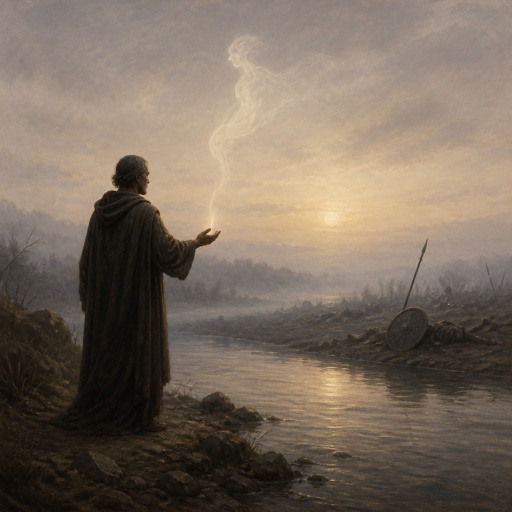
"There is no man that hath power over the spirit to retain the spirit; neither hath he power in the day of death: and there is no discharge in that war; neither shall wickedness deliver those that are given to it." - Ecclesiastes 8:8

ecclesiastes 12:1-8

ecclesiastes 12:1-8

ecclesiastes 12:1-8

ecclesiastes 12:1-8

Ecclesiastes 3:7-8

ecclesiastes 12:1-8

Ecclesiastes 12:8 - "¶ Vanity of vanities, saith the preacher; all is vanity."

Ecclesiastes 3:8 - "A time to love, and a time to hate; a time of war, and a time of peace."

Ecclesiastes 8:2 - "I counsel thee to keep the king's commandment, and that in regard of the oath of God."

Ecclesiastes 8:7 - "For he knoweth not that which shall be: for who can tell him when it shall be?"

Ecclesiastes 8:6 - "¶ Because to every purpose there is time and judgment, therefore the misery of man is great upon him."

Ecclesiastes 9:8 - "Let thy garments be always white; and let thy head lack no ointment."

Ecclesiastes 8:4 - "Where the word of a king is, there is power: and who may say unto him, What doest thou?"

Ecclesiastes 7:8 - "Better is the end of a thing than the beginning thereof: and the patient in spirit is better than the proud in spirit."

Ecclesiastes 10:8 - "He that diggeth a pit shall fall into it; and whoso breaketh an hedge, a serpent shall bite him."

Ecclesiastes 1:8 - "All things are full of labour; man cannot utter it: the eye is not satisfied with seeing, nor the ear filled with hearing."

Ecclesiastes 8:5 - "Whoso keepeth the commandment shall feel no evil thing: and a wise man's heart discerneth both time and judgment."

Ecclesiastes 8:3 - "Be not hasty to go out of his sight: stand not in an evil thing; for he doeth whatsoever pleaseth him."

Ecclesiastes 6:8 - "For what hath the wise more than the fool? what hath the poor, that knoweth to walk before the living?"

"¶ Vanity of vanities, saith the preacher; all is vanity." - Ecclesiastes 12:8

Ecclesiastes 8:13 - "But it shall not be well with the wicked, neither shall he prolong his days, which are as a shadow; because he feareth not before God."

Ecclesiastes 8:11 - "Because sentence against an evil work is not executed speedily, therefore the heart of the sons of men is fully set in them to do evil."
Ecclesiastes 5:8 - "¶ If thou seest the oppression of the poor, and violent perverting of judgment and justice in a province, marvel not at the matter: for he that is higher than the highest regardeth; and there be higher than they."

Ecclesiastes 8:1 - "Who is as the wise man? and who knoweth the interpretation of a thing? a man's wisdom maketh his face to shine, and the boldness of his face shall be changed."

Ecclesiastes 11:8 - "But if a man live many years, and rejoice in them all; yet let him remember the days of darkness; for they shall be many. All that cometh is vanity."

"A time to love, and a time to hate; a time of war, and a time of peace." - Ecclesiastes 3:8

"I counsel thee to keep the king's commandment, and that in regard of the oath of God." - Ecclesiastes 8:2

Ecclesiastes 8:12 - "¶ Though a sinner do evil an hundred times, and his days be prolonged, yet surely I know that it shall be well with them that fear God, which fear before him:"