Inheritance and the Consequences of Disobedience
“For this ye know, that no whoremonger, nor unclean person, nor covetous man, who is an idolater, hath any inheritance in the kingdom of Christ and of God. Let no man deceive you with vain words: for because of these things cometh the wrath of God upon the children of disobedience.” — Ephesians 5:5-6
Ephesians 5:5-6 (KJV) states, "For this ye know, that no whoremonger, nor unclean person, nor covetous man, who is an idolater, hath any inheritance in the kingdom of Christ and of God. Let no man deceive you with vain words: for because of these things cometh the wrath of God upon the children of disobedience."
In this powerful passage, the Apostle Paul lays bare a crucial truth for all believers: our conduct and the choices we make in this life have profound implications on our spiritual inheritance. It serves as both a warning and a reminder of the high moral standards expected of us as children of God. As we dive deeper into these words, let us explore its meaning and the call to live a life reflective of our faith.
First, we must understand the term "inheritance" as used in the Scriptures. In the context of the Christian faith, inheritance refers not only to eternal life with Christ but also the blessings, promises, and rights we possess as sons and daughters of God. It is a profound relationship solidified by grace through faith. However, Paul draws a clear line; specific behaviors, namely that of a whoremonger, an unclean person, and a covetous man, disqualify individuals from this inheritance.
The term "whoremonger" encapsulates a broad range of immoral sexual behavior that defies the divine design for relationships established by God. The term “unclean person” extends beyond physical purity to encompass spiritual cleanliness, suggesting a lifestyle devoid of holiness and righteousness. A “covetous man,” one who relishes in greed, idolizes possessions over God, and places material gain above spiritual integrity, also finds no welcome in God’s kingdom. Each of these descriptions signifies actions that express disobedience to God’s commands and reflect a heart turned away from Him.
Paul’s warning serves as both a diagnosis and a directive. In a world saturated with relativism—where the definition of right and wrong often shifts like the sands of the seashore—Paul reminds us to anchor our moral compass. In a culture that often trivializes or normalizes sinful behaviors, it is crucial not to allow ourselves to be deceived by "vain words." The allure of worldly wisdom and acceptance can be powerful, but it ultimately leads to disobedience and separation from God’s grace. The phrase "let no man deceive you with vain words" serves as a clarion call for vigilance. We must continually assess the voices we listen to and the ideologies we embrace; are they in harmony with the truth of God’s Word?
Moreover, the "wrath of God" mentioned in this passage is not simply an abstract theological concept; it represents the just response to human sinfulness. God’s wrath is never capricious but rooted in His perfect nature and righteousness. As a loving Father, He longs for us to turn from disobedience and toward Him, as our contrition leads to mercy and grace. This motif of disobedience and its consequences is a recurring theme throughout Scripture, reflecting the need for repentance and restoration in our walk with God.
In light of Ephesians 5:5-6, we are called to examine our lives. Are there areas of compromise? Have we allowed secular ideologies to dilute our faith? The pursuit of holiness should awaken in us a desire to forsake all that contradicts God’s Word. Remember that we are not alone in this pursuit; the Holy Spirit empowers us to live for God’s glory, guiding us toward righteousness.
In conclusion, Ephesians 5:5-6 embodies a clear call to reflection and repentance. It encourages us to live in a manner worthy of our calling, fully aware of the implications our choices have on our spiritual inheritance. May we heed the warning of the Apostle Paul, allowing the truth of God’s Word to transform our hearts and actions, ensuring that we not only inherit the kingdom of Christ and of God but also reflect His love and righteousness to a world desperately in need of His truth. Amen.
Get our apps


Artwork for Ephesians 5:5-6
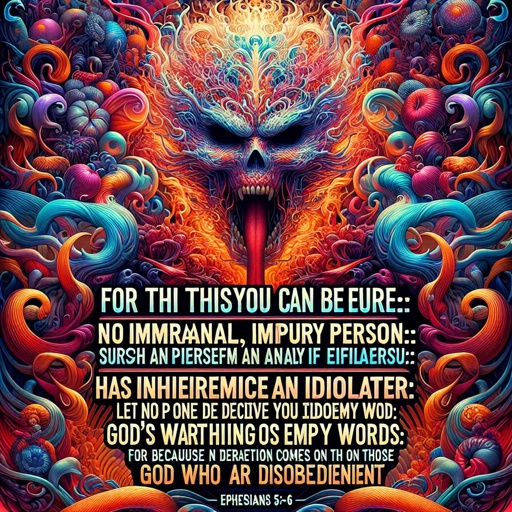
Ephesians 5:5-6 - "For of this you can be sure: No immoral, impure or greedy person—such a person is an idolater—has any inheritance in the kingdom of Christ and of God. Let no one deceive you with empty words, for because of such things God’s wrath comes on those who are disobedient."

"For of this you can be sure: No immoral, impure or greedy person—such a person is an idolater—has any inheritance in the kingdom of Christ and of God. Let no one deceive you with empty words, for because of such things God’s wrath comes on those who are disobedient." - Ephesians 5:5-6
Ephesians 5:6 - "Let no man deceive you with vain words: for because of these things cometh the wrath of God upon the children of disobedience."

Ephesians 6:5 - "Servants, be obedient to them that are your masters according to the flesh, with fear and trembling, in singleness of your heart, as unto Christ;"

Ephesians 5:21

Ephesians 4:1-5

Ephesians 4:1-5

Ephesians 4:1-5

Ephesians 4:1-5

Ephesians 4:1-5

Ephesians 4:1-5

Ephesians 4:1-5

Ephesians 4:1-5

Ephesians 4:1-5

Ephesians 4:1-5

Ephesians 4:1-5

Ephesians 4:1-5

Ephesians 4:1-5

Ephesians 4:1-5

Ephesians 4:1-5

Ephesians 4:1-5

Ephesians 4:1-5

Ephesians 4:1-5

Ephesians 4:1-5

Ephesians 4:4-5

Ephesians 4:1-5

Ephesians 4:1-5

Ephesians 4:1-5

Ephesians 4:1-5

Ephesians 4:1-5