Standing Firm in Faith Amidst Opposition
“Now it came to pass, when they spake daily unto him, and he hearkened not unto them, that they told Haman, to see whether Mordecai’s matters would stand: for he had told them that he was a Jew.” — Esther 3:4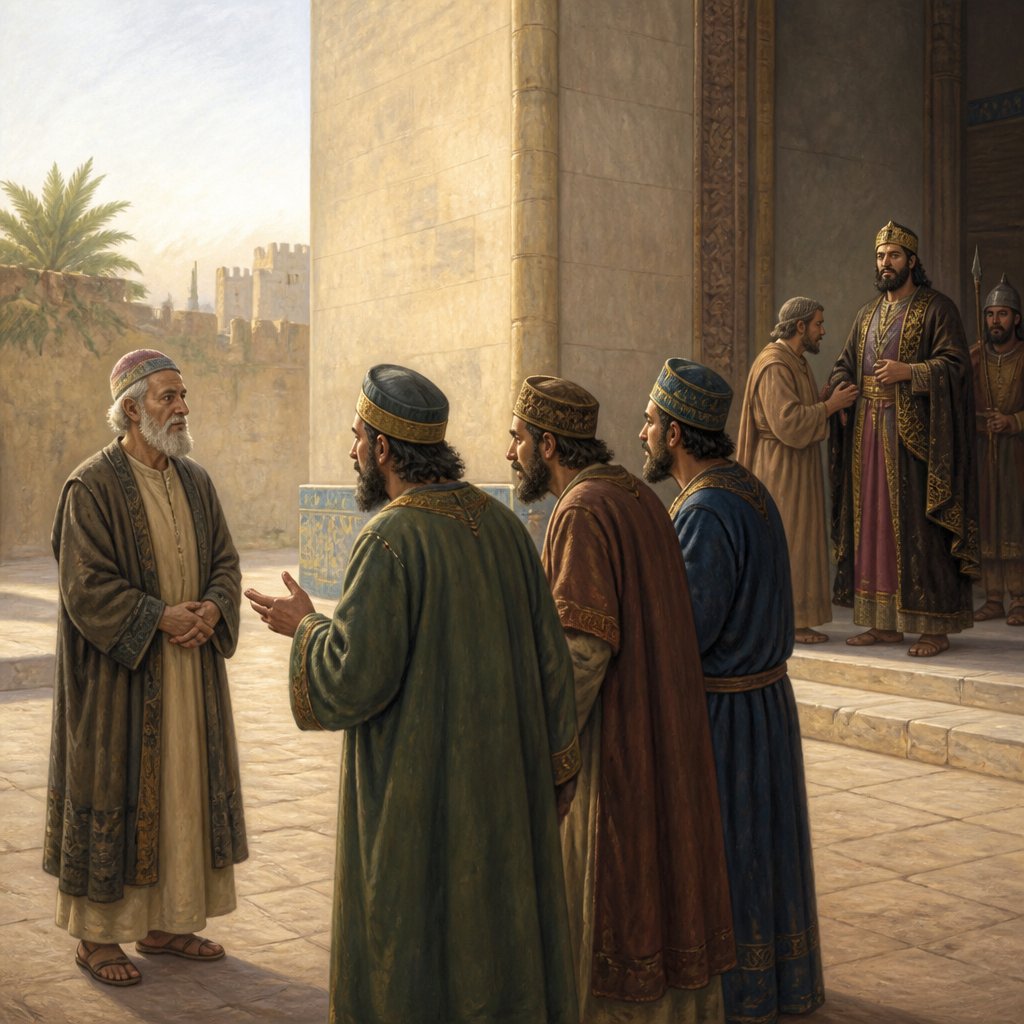
The book of Esther is rich with lessons on perseverance, courage, and God's providence. In Esther 3:4, we encounter a poignant moment within the narrative that illustrates the conflict between loyalty and societal expectation, where the tension is palpable—"Now it came to pass, when they spake daily unto him, and he hearkened not unto them, that they told Haman, to see whether Mordecai's matters would stand: for he had told them that he was a Jew."
This verse illustrates a pivotal scene concerning Mordecai, a steadfast Jew in a foreign land, whose commitment to his identity is tested amid the pressures of the world around him. The phrase "when they spake daily unto him" reveals a relentless pursuit by those who surround Mordecai, attempting to sway him from his steadfastness. It illustrates a real-life dynamic where community influence, peer pressure, and societal norms converge to challenge one's values and beliefs. How often do we, too, face similar pressures in our own lives?
Mordecai’s refusal to bow to Haman represents more than mere disobedience; it embodies a profound allegiance to his heritage, his faith, and his God. When the people around him—most likely filled with fear of Haman's power—approach him with their demands, he stands firm. His identity informs his actions, compelling him to prioritize his spiritual commitments over worldly expectations. This moment beckons us to reflect: what do we allow to influence our faith? Do we remain steadfast in our identity as children of God, or do we bend under the weight of societal demands?
Haman, representing the power structures of the day, is emblematic of arrogance and hostility toward those who would stand apart. His wrath is fueled not just by Mordecai’s refusal to bow but also by the knowledge of Mordecai’s Jewish identity, which could be perceived as a rejection of the authority Haman was wielding. The hostility that arises from this exercise of power is a reminder to us that standing for our faith may often lead us into conflict with the prevailing culture.
In our contemporary context, the pressures that Mordecai faced can transcend culture and time. Every day we navigate environments—be they at work, school, or social gatherings—where standing firm as Christians might invite ridicule, contempt, or alienation. Yet, Mordecai offers an example of resilience and integrity; he does not yield to the pressures, instead, he remains true to his identity even when it means standing alone. We must ask ourselves if we can emulate this spirit.
Moreover, this passage calls us to think about the choices we make when faced with opposition. There is an inspiring courage in Mordecai's actions—an unwavering belief in God’s sovereignty. He doesn’t seek to create a spectacle or attract undue attention, but rather quietly resolute, he makes the choice to honor God above the whims of man. Our faith is more than just personal; it extends to how we navigate our relationships and engagements with those who may not understand our convictions.
We should also recognize that this resistance to worldly pressures does not occur in a vacuum but rather is part of a divine narrative. God was orchestrating events—not in the absence of opposition but through it. Each moment of trials and tribulations serves a purpose in His grand design. As we reckon with our own voices in a world that may mock our faith, let us trust that our standing firm might not only encourage those around us but also position us where God’s providence can work through us.
Let Mordecai’s story be a reminder that while we may encounter trials, we also have the assurance of God's support. We can stand firm in our beliefs, knowing that we are defined not by our circumstances, but by our identity as followers of Christ. In doing so, let us encourage one another to hold fast to our convictions in a world that often seeks to silence our voices or pressure us into conformity. May we find strength in knowing that in standing for God, we are never truly alone.
Get our apps


Artwork for Esther 3:4

Esther 3:4 - "Now it came to pass, when they spake daily unto him, and he hearkened not unto them, that they told Haman, to see whether Mordecai's matters would stand: for he had told them that he was a Jew."
"Now it came to pass, when they spake daily unto him, and he hearkened not unto them, that they told Haman, to see whether Mordecai's matters would stand: for he had told them that he was a Jew." - Esther 3:4

Esther 8:4 - "Then the king held out the golden sceptre toward Esther. So Esther arose, and stood before the king,"

Esther 4:15 - "¶ Then Esther bade them return Mordecai this answer,"

Esther 4:9 - "And Hatach came and told Esther the words of Mordecai."

Esther 4:3 - "And in every province, whithersoever the king's commandment and his decree came, there was great mourning among the Jews, and fasting, and weeping, and wailing; and many lay in sackcloth and ashes."

Esther 4:10 - "¶ Again Esther spake unto Hatach, and gave him commandment unto Mordecai;"

Esther 4:17 - "So Mordecai went his way, and did according to all that Esther had commanded him."

Esther 8:4

Esther 4:12 - "And they told to Mordecai Esther's words."

"And Hatach came and told Esther the words of Mordecai." - Esther 4:9

"¶ Then Esther bade them return Mordecai this answer," - Esther 4:15

Esther 4:13 - "Then Mordecai commanded to answer Esther, Think not with thyself that thou shalt escape in the king's house, more than all the Jews."

Esther 5:4 - "And Esther answered, If it seem good unto the king, let the king and Haman come this day unto the banquet that I have prepared for him."

Esther 5:3 - "Then said the king unto her, What wilt thou, queen Esther? and what is thy request? it shall be even given thee to the half of the kingdom."

"Then the king held out the golden sceptre toward Esther. So Esther arose, and stood before the king," - Esther 8:4

Esther 4:5 - "Then called Esther for Hatach, one of the king's chamberlains, whom he had appointed to attend upon her, and gave him a commandment to Mordecai, to know what it was, and why it was."
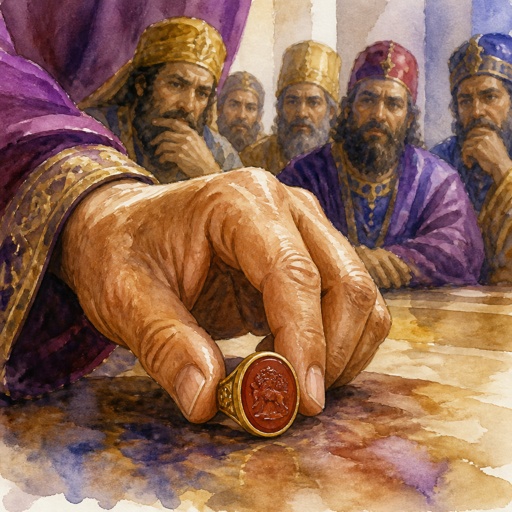
Esther 3:10 focus on ring

"¶ Again Esther spake unto Hatach, and gave him commandment unto Mordecai;" - Esther 4:10
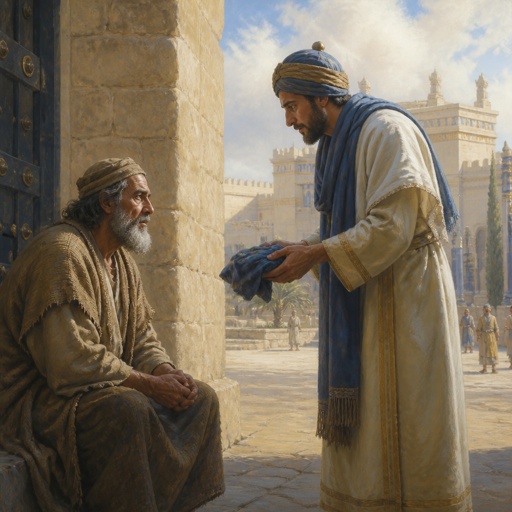
"And they told to Mordecai Esther's words." - Esther 4:12

Esther 3:3 - "Then the king's servants, which were in the king's gate, said unto Mordecai, Why transgressest thou the king's commandment?"

Esther 8:3 - "¶ And Esther spake yet again before the king, and fell down at his feet, and besought him with tears to put away the mischief of Haman the Agagite, and his device that he had devised against the Jews."

Esther 7:3 - "Then Esther the queen answered and said, If I have found favour in thy sight, O king, and if it please the king, let my life be given me at my petition, and my people at my request:"

"So Mordecai went his way, and did according to all that Esther had commanded him." - Esther 4:17
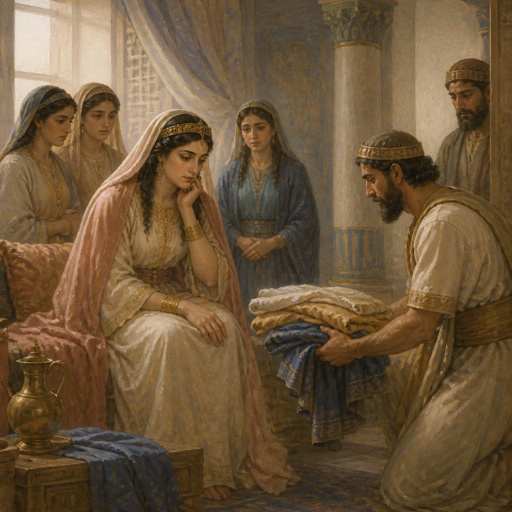
"¶ So Esther's maids and her chamberlains came and told it her. Then was the queen exceedingly grieved; and she sent raiment to clothe Mordecai, and to take away his sackcloth from him: but he received it not." - Esther 4:4

Esther 3:5 - "And when Haman saw that Mordecai bowed not, nor did him reverence, then was Haman full of wrath."

Esther 4:6 - "So Hatach went forth to Mordecai unto the street of the city, which was before the king's gate."

Esther 4:4 - "¶ So Esther's maids and her chamberlains came and told it her. Then was the queen exceedingly grieved; and she sent raiment to clothe Mordecai, and to take away his sackcloth from him: but he received it not."

Esther 4:2 - "And came even before the king's gate: for none might enter into the king's gate clothed with sackcloth."

Esther 4:8 - "Also he gave him the copy of the writing of the decree that was given at Shushan to destroy them, to shew it unto Esther, and to declare it unto her, and to charge her that she should go in unto the king, to make supplication unto him, and to make request before him for her people."