The Dangerous Dance of Pride and Favor
“Haman said moreover, Yea, Esther the queen did let no man come in with the king unto the banquet that she had prepared but myself; and to morrow am I invited unto her also with the king.” — Esther 5:12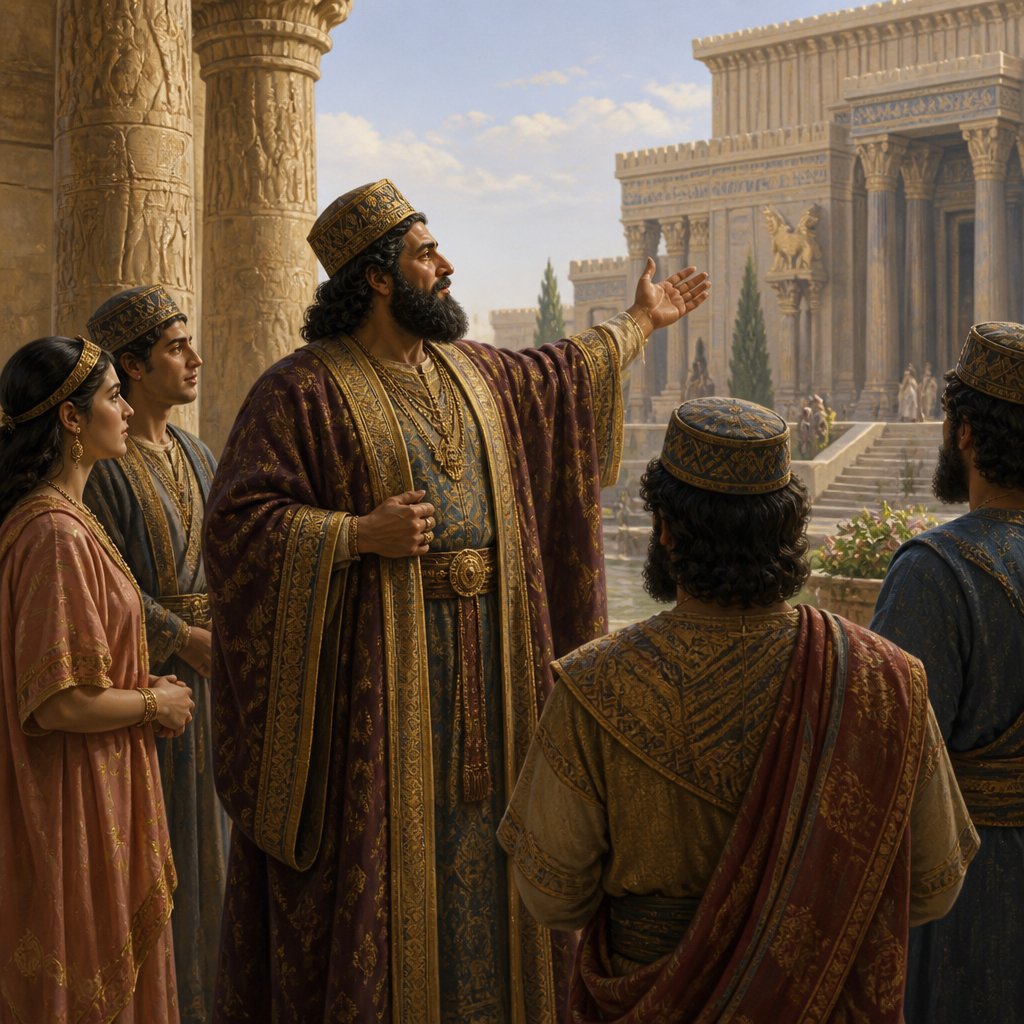
As we delve into Esther 5:12 (KJV), we encounter a pivotal moment in the story of Esther, one of the Bible's most compelling narratives. The verse reads, "Haman said moreover, Yea, Esther the queen did let no man come in with the king unto the banquet that she had prepared but myself; and to morrow am I invited unto her also with the king." At first glance, it seems to be a simple recounting of details regarding a banquet; however, it holds profound implications about pride, recognition, and the perilous path of ambition.
Haman is a man positioned at the zenith of power and influence within the Persian Empire, yet, he is blinded by his own pride. He revels in being the only one invited to dine with Queen Esther and King Ahasuerus. This moment encapsulates Haman's spiraling descent into arrogance. He perceives Esther’s invitation as a validation of his status and significance. In Haman’s mind, the exclusivity of the invitation is a reflection of his dominion, confirming his importance and influence over the kingdom’s affairs. Herein lies the first lesson: Pride can distort our perception of reality, manipulating our view of others and of our own standing.
Esther’s actions can also be interpreted as a strategic maneuver. She deliberately chooses to invite Haman alone, knowing that he represents a grave threat to her people. However, her private dinner with the king and Haman adds layers of tension to her plight. It illustrates that her situation is inherently dangerous; yet, she must navigate it with wisdom. Esther, with her keen awareness of the unfolding drama around her, uses this banquet as a platform to unveil a deeper truth about her identity and her people’s fate. Her seemingly simple act is laden with a greater significance: it is an assertion of her influence as well as a bold step toward seeking justice.
In this context, we observe the duality of ambition: on one side, Haman’s ambition is propelled by a dangerous pride that not only alienates him from those around him but also leads him into moral corruption. On the other side, Esther’s ambition is geared towards selflessness, driven out of love and concern for her people. This distinction teaches us that not all ambition is inherently negative; it tremendously depends on the motivations behind it. Are we propelled to pursue accolades for our own glory or to uplift and serve others?
Reflect on your ambitions and motivations today. Like Haman, do we sometimes desire the limelight to fulfill our egos? Or like Esther, are we seeking opportunities to advocate for those who are oppressed? Each decision we make reverberates beyond our immediate sphere of influence.
Moreover, the very nature of our conversations plays a critical role in this narrative. Haman’s boastful recounting of his invitation to the queen reveals his utter disregard for the impending realities that loom over him. He is unaware that while he is basking in the glory of his accomplishments, his fate is being sealed. In our lives, we must be mindful of how we speak; let our words reflect humility rather than haughtiness.
The banquet that Esther prepares is not merely about food and drink. It is a prophetic moment teetering on the brink of revelation. It ultimately leads to Haman’s unravelling and exemplifies how God can turn the tables of fate.
As we conclude this reflection, let us pray for wisdom as we navigate our ambitions. Let us seek humility in our victories and remain aware that our current triumphs can quickly become burdens if rooted in pride. May we emulate Esther’s courage and recognize that true favor comes not from the accolades we receive, but from the grace we extend to others. Amen.
Get our apps


Artwork for Esther 5:12

Esther 5:12 - "Haman said moreover, Yea, Esther the queen did let no man come in with the king unto the banquet that she had prepared but myself; and to morrow am I invited unto her also with the king."
"Haman said moreover, Yea, Esther the queen did let no man come in with the king unto the banquet that she had prepared but myself; and to morrow am I invited unto her also with the king." - Esther 5:12

Esther 5:5 - "Then the king said, Cause Haman to make haste, that he may do as Esther hath said. So the king and Haman came to the banquet that Esther had prepared."

Esther 5:7 - "Then answered Esther, and said, My petition and my request is;"

Esther 4:12 - "And they told to Mordecai Esther's words."

Esther 5:2

Esther 5:2 - "And it was so, when the king saw Esther the queen standing in the court, that she obtained favour in his sight: and the king held out to Esther the golden sceptre that was in his hand. So Esther drew near, and touched the top of the sceptre."

Esther 5:2

Esther 5:2

Esther 5:4 - "And Esther answered, If it seem good unto the king, let the king and Haman come this day unto the banquet that I have prepared for him."
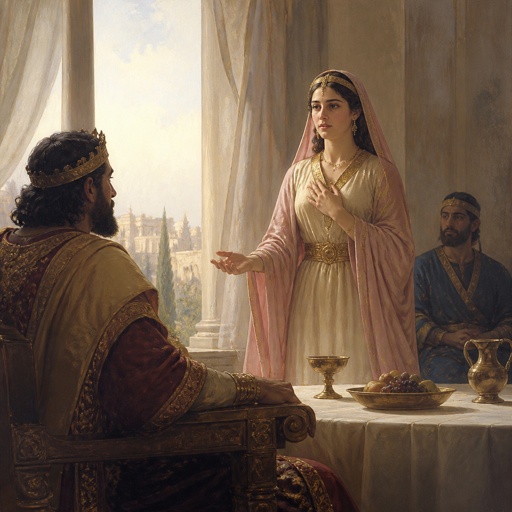
"Then answered Esther, and said, My petition and my request is;" - Esther 5:7

Esther 5:3 - "Then said the king unto her, What wilt thou, queen Esther? and what is thy request? it shall be even given thee to the half of the kingdom."

Esther 7:5 - "¶ Then the king Ahasuerus answered and said unto Esther the queen, Who is he, and where is he, that durst presume in his heart to do so?"

Esther 5:2 - "And it was so, when the king saw Esther the queen standing in the court, that she obtained favour in his sight: and the king held out to Esther the golden sceptre that was in his hand. So Esther drew near, and touched the top of the sceptre."
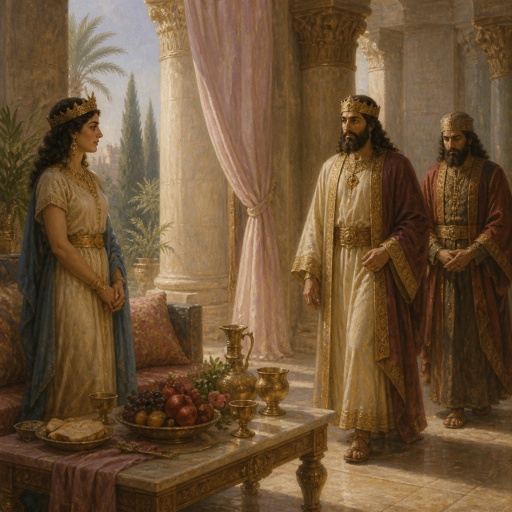
"Then the king said, Cause Haman to make haste, that he may do as Esther hath said. So the king and Haman came to the banquet that Esther had prepared." - Esther 5:5

Esther 4:5 - "Then called Esther for Hatach, one of the king's chamberlains, whom he had appointed to attend upon her, and gave him a commandment to Mordecai, to know what it was, and why it was."

Esther 5:6 - "¶ And the king said unto Esther at the banquet of wine, What is thy petition? and it shall be granted thee: and what is thy request? even to the half of the kingdom it shall be performed."
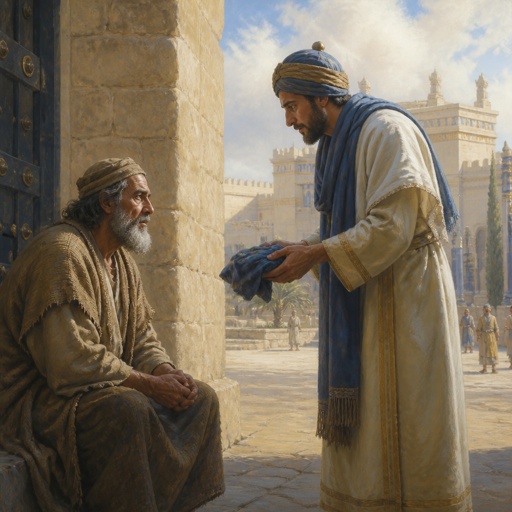
"And they told to Mordecai Esther's words." - Esther 4:12

Esther 3:5 - "And when Haman saw that Mordecai bowed not, nor did him reverence, then was Haman full of wrath."

Esther 5:1 - "Now it came to pass on the third day, that Esther put on her royal apparel, and stood in the inner court of the king's house, over against the king's house: and the king sat upon his royal throne in the royal house, over against the gate of the house."

Esther 6:12 - "¶ And Mordecai came again to the king's gate. But Haman hasted to his house mourning, and having his head covered."
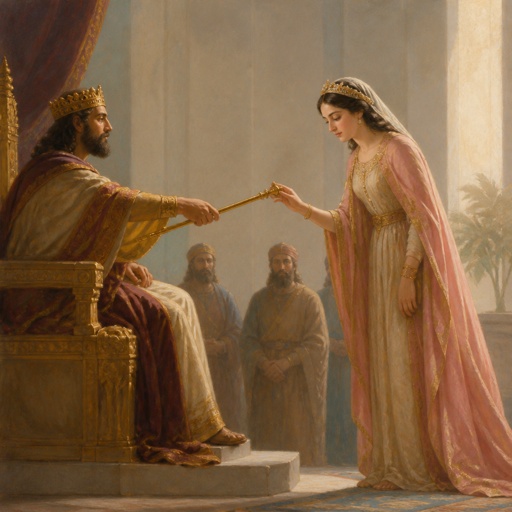
"And it was so, when the king saw Esther the queen standing in the court, that she obtained favour in his sight: and the king held out to Esther the golden sceptre that was in his hand. So Esther drew near, and touched the top of the sceptre." - Esther 5:2

Esther 6:5 - "And the king's servants said unto him, Behold, Haman standeth in the court. And the king said, Let him come in."

Esther 5:13 - "Yet all this availeth me nothing, so long as I see Mordecai the Jew sitting at the king's gate."

Esther 9:12 - "¶ And the king said unto Esther the queen, The Jews have slain and destroyed five hundred men in Shushan the palace, and the ten sons of Haman; what have they done in the rest of the king's provinces? now what is thy petition? and it shall be granted thee: or what is thy request further? and it shall be done."

Esther 2:5 - "¶ Now in Shushan the palace there was a certain Jew, whose name was Mordecai, the son of Jair, the son of Shimei, the son of Kish, a Benjamite;"

Esther 8:12 - "Upon one day in all the provinces of king Ahasuerus, namely, upon the thirteenth day of the twelfth month, which is the month Adar."

Esther 1:12 - "But the queen Vashti refused to come at the king's commandment by his chamberlains: therefore was the king very wroth, and his anger burned in him."

Esther 5:10 - "Nevertheless Haman refrained himself: and when he came home, he sent and called for his friends, and Zeresh his wife."

"¶ Then the king Ahasuerus answered and said unto Esther the queen, Who is he, and where is he, that durst presume in his heart to do so?" - Esther 7:5