The Golden Calf: A Warning Against Idolatry
"And he received them at their hand, and fashioned it with a graving tool, after he had made it a molten calf: and they said, These be thy gods, O Israel, which brought thee up out of the land of Egypt." - Exodus 32:4
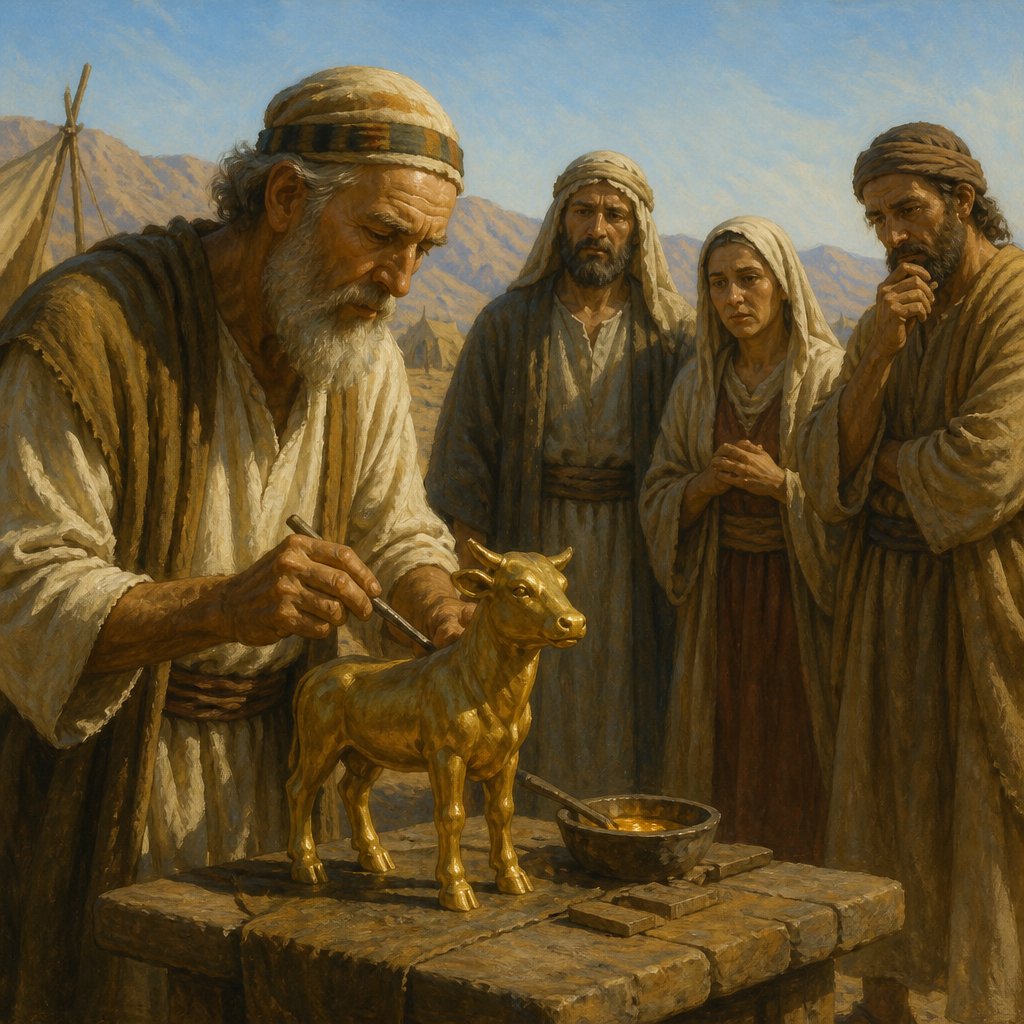
In Exodus 32:4, we encounter a pivotal moment in the narrative of the Israelites, freshly liberated from the bondage of Egypt. The King James Version states, "And he received them at their hand, and fashioned it with a graving tool, after he had made it a molten calf: and they said, These be thy gods, O Israel, which brought thee up out of the land of Egypt." This verse encapsulates the profound folly of idolatry and the human inclination to turn to tangible representations of worship rather than relying on the invisible and omnipotent God.
The context of this scene is crucial. The Israelites, having witnessed the mighty works of God—parting the Red Sea, sending manna from heaven, and guiding them by a pillar of cloud by day and a pillar of fire by night—now find themselves at the foot of Mount Sinai, waiting for Moses, their leader who is receiving the very instructions of God. However, in the absence of Moses, fear and impatience take root. Distrust in God's promise fuels their longing for a physical representation of the divine, leading them to mold a calf out of gold. The irony is striking: they created an image that became a symbol of their deliverance, yet it was a creation of their own hands—not the true God who liberated them.
This passage serves not only as a historical account but as a timeless warning against the dangers of turning to idols. The golden calf was not merely a statue; it represented a deeper spiritual crisis. The Israelites, in their despair, sought reassurance through technology and artistry rather than faith. They transformed something lifeless into an object of reverence, tragically diminishing the grandeur and holiness of the God who had delivered them. This incident highlights the common tendency of humans to seek comfort in the familiar rather than embracing the unknown path that faith in God often requires.
As we reflect on today’s society, the allure of modern-day idols can be just as insidious. Comfort, wealth, and status can become our molten calves. We may not cast imagery from gold, but we may find ourselves placing our trust in material possessions, relationships, achievements, or even ideologies over our relationship with God. The call of Christ beckons us to relinquish these distractions and refocus our attention on Him, who alone can deliver us from spiritual bondage.
The phrase, “and they said, These be thy gods, O Israel,” underscores the common human need to see and understand our faith in tangible terms. Yet, God desires to deepen our understanding beyond what we can see and touch. Faith is not gaited by sight; rather, Paul writes in 2 Corinthians 5:7 (KJV), “For we walk by faith, not by sight.” It is in the unseen where true trust in God flourishes.
Idolatry often stems from a fear of abandonment or uncertainty about the future. The Israelites feared they had been left alone in the wilderness, and thus, they sought assurance through a god they could see. This piece of scripture calls us into a profound self-examination: Where do we turn in our times of need? What becomes of our faith when circumstances challenge our beliefs?
Let us not forget, though, that God’s response to the Israelite’s failure was also marked by grace. Even in their darkest hour of rebellion, His covenant promises remain. Just as He later provided a way of reconciliation after their sin, He extends the same mercy to us today. In Christ, we find forgiveness for our moments of weakness, our wavering faith, and our idolatries.
Ultimately, Exodus 32:4 challenges us to remain vigilant in our faith journey, urging us to turn our hearts away from the golden calves of our lives and toward the living God. As we reflect on this startling moment in Israel’s history, may we embrace the truth that our faith must rest in God alone, who is our true deliverer, provider, and leader. The assurance of His presence sustains us, even when our eyes cannot perceive Him. Let prayer and scripture lead us back to steadfast adoration of our Almighty God.
Want to reflect more on Exodus 32:4?
Continue your spiritual journey with Bible Chat — an AI-powered tool for exploring God's Word through conversation. Ask questions, discover connections, and deepen your understanding.
Get Our Apps


Exodus 32:4 Artwork

Exodus 32:4 - "And he received them at their hand, and fashioned it with a graving tool, after he had made it a molten calf: and they said, These be thy gods, O Israel, which brought thee up out of the land of Egypt."
"And he received them at their hand, and fashioned it with a graving tool, after he had made it a molten calf: and they said, These be thy gods, O Israel, which brought thee up out of the land of Egypt." - Exodus 32:4

Exodus 32:28

Exodus 32:31-32 So Moses returned to the LORD and said, “Oh, what a great sin these people have committed! They have made gods of gold for themselves. / Yet now, if You would only forgive their sin.... But if not, please blot me out of the book that You have written.” Exodus 32:31-32

Exodus 32:32 - "Yet now, if thou wilt forgive their sin--; and if not, blot me, I pray thee, out of thy book which thou hast written."

Exodus 23:32 - "Thou shalt make no covenant with them, nor with their gods."

Exodus 35:32 - "And to devise curious works, to work in gold, and in silver, and in brass,"

Exodus 9:32 - "But the wheat and the rie were not smitten: for they were not grown up."

The Plague of Flies - Exodus 8:20-32

The Plague of Flies - Exodus 8:20-32.

The Plague of Flies - Exodus 8:20-32

Exodus 32:35 - "And the LORD plagued the people, because they made the calf, which Aaron made."

Exodus 32:16 - "And the tables were the work of God, and the writing was the writing of God, graven upon the tables."

Exodus 32:14 - "And the LORD repented of the evil which he thought to do unto his people."

Exodus 32:9 - "And the LORD said unto Moses, I have seen this people, and, behold, it is a stiffnecked people:"

Exodus 29:32 - "And Aaron and his sons shall eat the flesh of the ram, and the bread that is in the basket, by the door of the tabernacle of the congregation."

Exodus 8:32 - "And Pharaoh hardened his heart at this time also, neither would he let the people go."

Exodus 36:32 - "And five bars for the boards of the other side of the tabernacle, and five bars for the boards of the tabernacle for the sides westward."

Exodus 32:17 - "And when Joshua heard the noise of the people as they shouted, he said unto Moses, There is a noise of war in the camp."

Exodus 12:32 - "Also take your flocks and your herds, as ye have said, and be gone; and bless me also."

Exodus 32:28 - "And the children of Levi did according to the word of Moses: and there fell of the people that day about three thousand men."

Exodus 40:32 - "When they went into the tent of the congregation, and when they came near unto the altar, they washed; as the LORD commanded Moses."

Exodus 32:3 - "And all the people brake off the golden earrings which were in their ears, and brought them unto Aaron."

Exodus 32:22 - "And Aaron said, Let not the anger of my lord wax hot: thou knowest the people, that they are set on mischief."

Exodus 32:5 - "And when Aaron saw it, he built an altar before it; and Aaron made proclamation, and said, To morrow is a feast to the LORD."

Exodus 32:25 - "¶ And when Moses saw that the people were naked; (for Aaron had made them naked unto their shame among their enemies:)"

Exodus 32:33 - "And the LORD said unto Moses, Whosoever hath sinned against me, him will I blot out of my book."

Exodus 21:32 - "If the ox shall push a manservant or a maidservant; he shall give unto their master thirty shekels of silver, and the ox shall be stoned."

Exodus 32:31 - "And Moses returned unto the LORD, and said, Oh, this people have sinned a great sin, and have made them gods of gold."

"Thou shalt make no covenant with them, nor with their gods." - Exodus 23:32