Cleansing Before Service: The Significance of Washing
“And Moses and Aaron and his sons washed their hands and their feet thereat:” — Exodus 40:31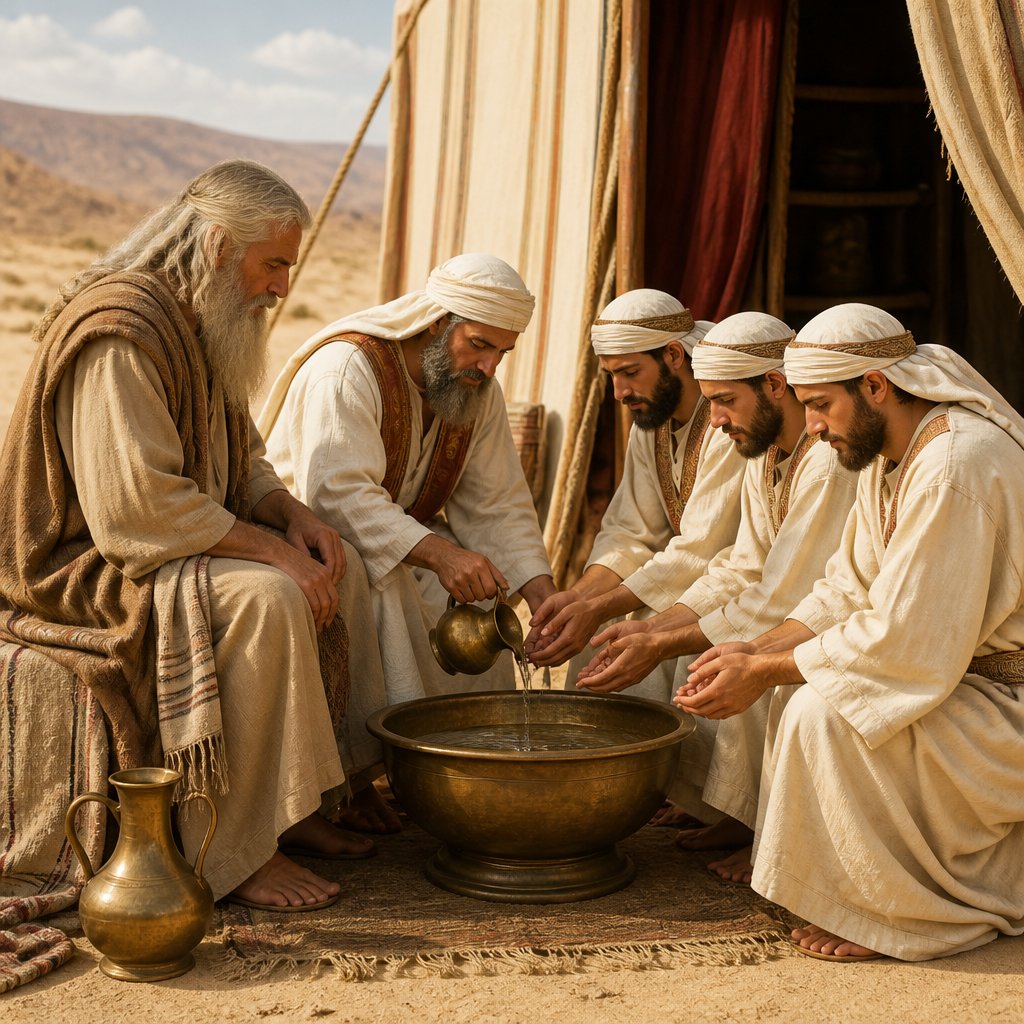
In Exodus 40:31, we find a remarkable act carried out by Moses, Aaron, and his sons: "And Moses and Aaron and his sons washed their hands and their feet thereat." This simple action, occurring in the context of God’s instructions for the tabernacle and the priestly duties, holds profound spiritual significance that is relevant not just in the ancient context but also in our modern walk of faith.
To appreciate this moment fully, we must understand the importance of purity and preparation in the sacred rituals ordained by God. The washing of hands and feet was not merely a physical cleansing; it symbolized a deeper spiritual requirement for anyone approaching the holy presence of God. In ancient Israel, where the presence of God dwelled in the tabernacle, there was an expectation that those serving Him would be clean, both outwardly and inwardly.
The act of washing is deeply metaphorical. It's an emblem of humility and recognition of one’s need for divine cleansing. In our own spiritual journey, we often carry the grime of our daily lives—our thoughts, our actions, and the distractions of the world. As Moses and Aaron engaged in this ritual of washing, they were acknowledging their need for purification before entering into service for the Lord.
This principle of cleansing before service is reiterated throughout Scripture. In Psalm 24:3-4, we read, "Who shall ascend into the hill of the Lord? or who shall stand in his holy place? He that hath clean hands and a pure heart; who hath not lifted up his soul unto vanity, nor sworn deceitfully." Here, we see that coming into God’s presence requires more than just physical actions—it necessitates a heart and mind inclined towards righteousness.
Moreover, the washing of hands and feet in Exodus also speaks to the practical realities of life. In the arid desert climate of ancient Israel, the feet would inevitably become dusty and dirty from travel. The act of washing was not only a ritual but also an act of care and practical hygiene. This illustrates how God cares not only about the spiritual state of His people but also their physical well-being. The sacred and the mundane are interwoven in our lives as servants of God; we are called to treat every aspect of our being with dignity and respect because it all reflects our relationship with our Creator.
In our lives today, we may often find ourselves in need of daily cleansing—of our emotions, our thoughts, and our actions. It’s easy to become entangled in the chaos of life, and just as easy to lose sight of our calling. Therefore, like Moses and Aaron, we ought to cultivate the discipline of washing ourselves anew, turning to prayer and Scripture as our source of renewal. Acts of confession, reflective prayer, and even intentional acts of service can serve as our spiritual washing; they prepare our hearts to serve in His kingdom.
Additionally, we cannot overlook the communal aspect of this cleansing. Moses was not alone in this act; he was joined by Aaron and his sons. Our Christian walk is not a solitary journey. Just as the priests had a collective responsibility to approach God in purity, we too should encourage one another in the faith. Accountability and fellowship create a community of believers where we support each other in seeking spiritual cleanliness.
Today, let us take a moment to reflect on our own lives. Are we coming to God’s presence with unclean hands and feet? What are the distractions or sins we need to wash away? May we embrace the practice of spiritual cleansing, reminding ourselves of the importance of preparation before we engage in God’s service. Let us wash our hands and feet, seeking purity in every aspect of our lives. Then, like Moses, Aaron, and his sons, we can stand ready to fulfill God’s call with clean hearts and dedicated spirits.
Get our apps


Artwork for Exodus 40:31

Exodus 40:31 - "And Moses and Aaron and his sons washed their hands and their feet thereat:"
"And Moses and Aaron and his sons washed their hands and their feet thereat:" - Exodus 40:31

Exodus 25:31-40 This is an oil lampstand.

Exodus 40: 34

Exodus 40:9

Exodus 40:1 - "And the LORD spake unto Moses, saying,"

Numbers 31:40 - "And the persons were sixteen thousand; of which the LORD'S tribute was thirty and two persons."

Job 31:40 - "Let thistles grow instead of wheat, and cockle instead of barley. The words of Job are ended."

Exodus 40:28 - "¶ And he set up the hanging at the door of the tabernacle."

Exodus 31: 18

Exodus 25:31

Exodus 40:11 - "And thou shalt anoint the laver and his foot, and sanctify it."

Exodus 26:31

Exodus 26:31

Exodus 26:31

Exodus 40:25 - "And he lighted the lamps before the LORD; as the LORD commanded Moses."

Exodus 40:26 - "¶ And he put the golden altar in the tent of the congregation before the vail:"

Exodus 40:34 - "¶ Then a cloud covered the tent of the congregation, and the glory of the LORD filled the tabernacle."

Exodus 40:14 - "And thou shalt bring his sons, and clothe them with coats:"

Exodus 40:27 - "And he burnt sweet incense thereon; as the LORD commanded Moses."

Genesis 31:40 - "Thus I was; in the day the drought consumed me, and the frost by night; and my sleep departed from mine eyes."

Exodus 40:3 - "And thou shalt put therein the ark of the testimony, and cover the ark with the vail."

Exodus 40:37 - "But if the cloud were not taken up, then they journeyed not till the day that it was taken up."

Exodus 28:31-43

Exodus 28:31-34

Exodus 25:40 - "And look that thou make them after their pattern, which was shewed thee in the mount."

Exodus 28:31-43

Exodus 28:31-34

Exodus 28:31-34

Exodus 26:31-33