From Doubt to Faith: Lessons from Moses’ Leprous Hand
"And the LORD said furthermore unto him, Put now thine hand into thy bosom. And he put his hand into his bosom: and when he took it out, behold, his hand was leprous as snow." - Exodus 4:6
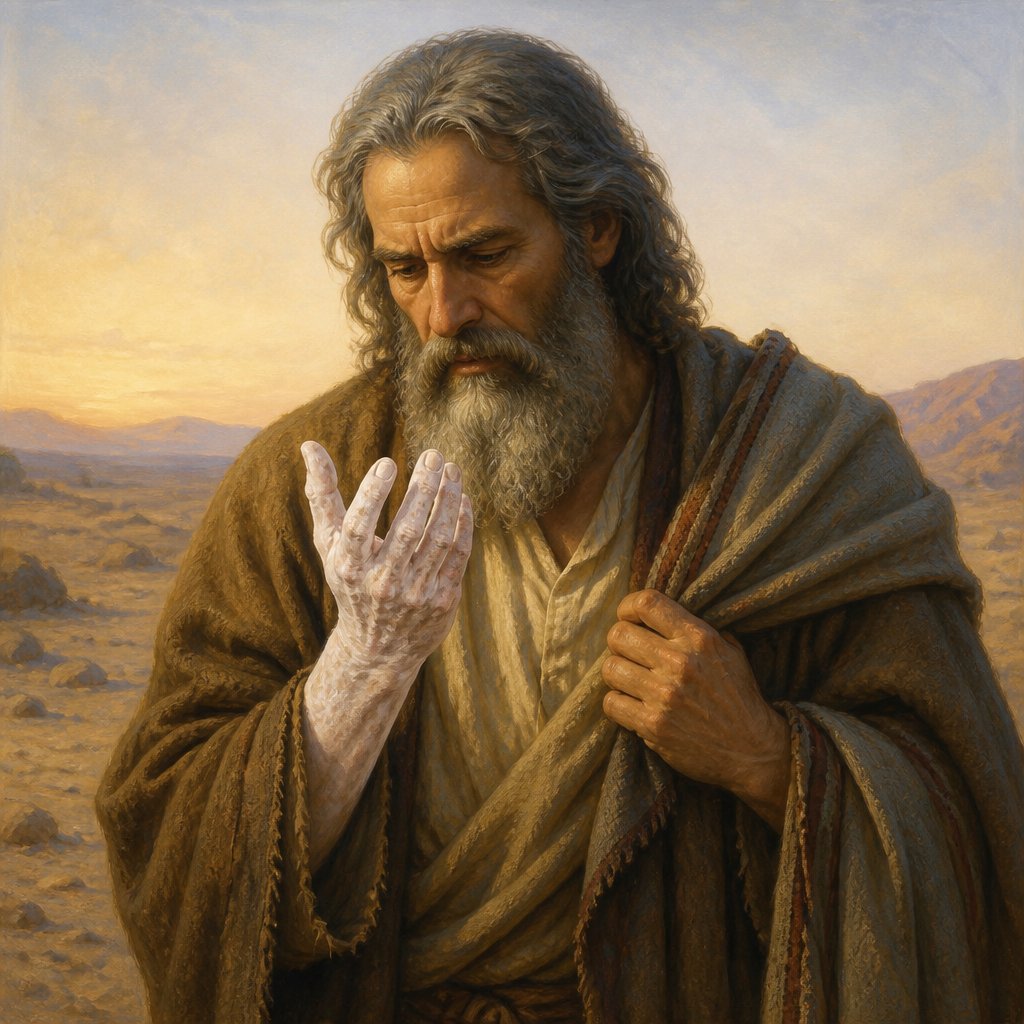
In Exodus 4:6, we encounter God speaking to Moses during a pivotal moment in his journey: "And the LORD said furthermore unto him, Put now thine hand into thy bosom. And he put his hand into his bosom: and when he took it out, behold, his hand was leprous as snow." This moment is not just about a miraculous sign but serves as a profound lesson for believers today, illustrating how God prepares and equips His chosen servants for the work ahead.
The context of this scripture is essential for understanding its significance. Moses, having encountered God at the burning bush, is grappling with self-doubt and apprehension about his ability to fulfill the divine calling to lead the Israelites out of Egypt. He questions his own worthiness, competence, and authority. In doing so, he models a common human experience: feelings of inadequacy in the face of God's call.
When God instructs Moses to put his hand into his bosom and reveals the leprous condition afterward, it symbolizes not only a miraculous demonstration of God’s power but also the reality of sin and the state of our hearts apart from Him. Leprosy, in biblical times, was a disease associated with uncleanness and isolation, making this sign incredibly powerful. God was demonstrating that Moses, like all of humanity, was unclean in his own right—potentially unworthy of the calling ahead. This leprous hand becomes a stark reminder of our limitations. However, it is not the end of the story.
In fact, just as God allowed Moses to see the leprous condition of his hand, He also desires us to see the truth about ourselves. In Psalm 139:23-24, David prays, "Search me, O God, and know my heart: try me, and know my thoughts: and see if there be any wicked way in me, and lead me in the way everlasting." Through divine self-examination, we confront our weaknesses, fears, and the weight of sin but must remember that this initial revelation is not for condemnation; rather, it is an invitation to transformation.
As Moses grapples with this frightening image of his condition, God instructs him further, revealing His power to heal and restore. The subsequent command in Exodus 4:7 echoes this hope: "And the LORD said unto Moses, Put thine hand into thy bosom again. And he put his hand into his bosom again; and plucked it out of his bosom, and behold, it was turned again as his other flesh." Here, we see God’s faithfulness—He provides both the diagnosis and the antidote. It is through God's power that what is deemed unclean can be transformed into something pure and useful.
The lesson for us is profound. Just like Moses, God does not call the qualified; He qualifies the called. He meets us in our insecurity and doubts, revealing both our limitations and His limitless power. Often, we may find ourselves reluctant to step into our God-given roles because of our perceived imperfections; however, it is essential to remember that God's grace is sufficient for us, as stated in 2 Corinthians 12:9. God used a shepherd with a stutter to lead a nation, and He can use us, too.
This passage emphasizes the importance of surrendering our inadequacies before God. When we place our lives, insecurities, and doubts into His hands, He can work miracles within and through us. It's a beautiful orchestration of grace, mercy, and empowerment. Rather than being paralyzed by fear, we are invited to embrace a life of faith, knowing that God provides all we need to accomplish His will.
In conclusion, let Moses’ experience of taking his hand out of his bosom be a reminder of the beauty of transformation that comes from God. When we confess our uncleanliness, and come before Him earnestly, He will respond by renewing us and preparing us for the tasks He has set before us. Whether it is leading, serving, or simply being a witness of His grace, trust that He can take that which is leprous and render it whole.
Want to reflect more on Exodus 4:6?
Continue your spiritual journey with Bible Chat — an AI-powered tool for exploring God's Word through conversation. Ask questions, discover connections, and deepen your understanding.
Get Our Apps


Exodus 4:6 Artwork

Exodus 4:6 - "¶ And the LORD said furthermore unto him, Put now thine hand into thy bosom. And he put his hand into his bosom: and when he took it out, behold, his hand was leprous as snow."
"¶ And the LORD said furthermore unto him, Put now thine hand into thy bosom. And he put his hand into his bosom: and when he took it out, behold, his hand was leprous as snow." - Exodus 4:6

Exodus 6:4 - "And I have also established my covenant with them, to give them the land of Canaan, the land of their pilgrimage, wherein they were strangers."

Exodus 17:6

Exodus 17:6

Exodus 17:6

Exodus 17:6

Exodus 23:4

Exodus 28:4

Exodus 28:4

Exodus 28:4

Exodus 28:4

Exodus 24:4

Exodus 23:4

Exodus 6:21 - "¶ And the sons of Izhar; Korah, and Nepheg, and Zichri."

Exodus 6:22 - "And the sons of Uzziel; Mishael, and Elzaphan, and Zithri."

Exodus 6:10 - "And the LORD spake unto Moses, saying,"
"And I have also established my covenant with them, to give them the land of Canaan, the land of their pilgrimage, wherein they were strangers." - Exodus 6:4

Exodus 4:1-5

Exodus 1:4 - "Dan, and Naphtali, Gad, and Asher."

Exodus 6:17 - "The sons of Gershon; Libni, and Shimi, according to their families."

Exodus 35:6 - "And blue, and purple, and scarlet, and fine linen, and goats' hair,"

Exodus 25:6 - "Oil for the light, spices for anointing oil, and for sweet incense,"

Exodus 1:6 - "And Joseph died, and all his brethren, and all that generation."

Exodus 33:6 - "And the children of Israel stripped themselves of their ornaments by the mount Horeb."

Exodus 6:24 - "And the sons of Korah; Assir, and Elkanah, and Abiasaph: these are the families of the Korhites."

Ephesians 4:4-6

Ephesians 4:4-6

Exodus 38:6 - "And he made the staves of shittim wood, and overlaid them with brass."

Exodus 23:6 - "Thou shalt not wrest the judgment of thy poor in his cause."