An Unbroken Lineage of Faith and Service
“The son of Abishua, the son of Phinehas, the son of Eleazar, the son of Aaron the chief priest:” — Ezra 7:5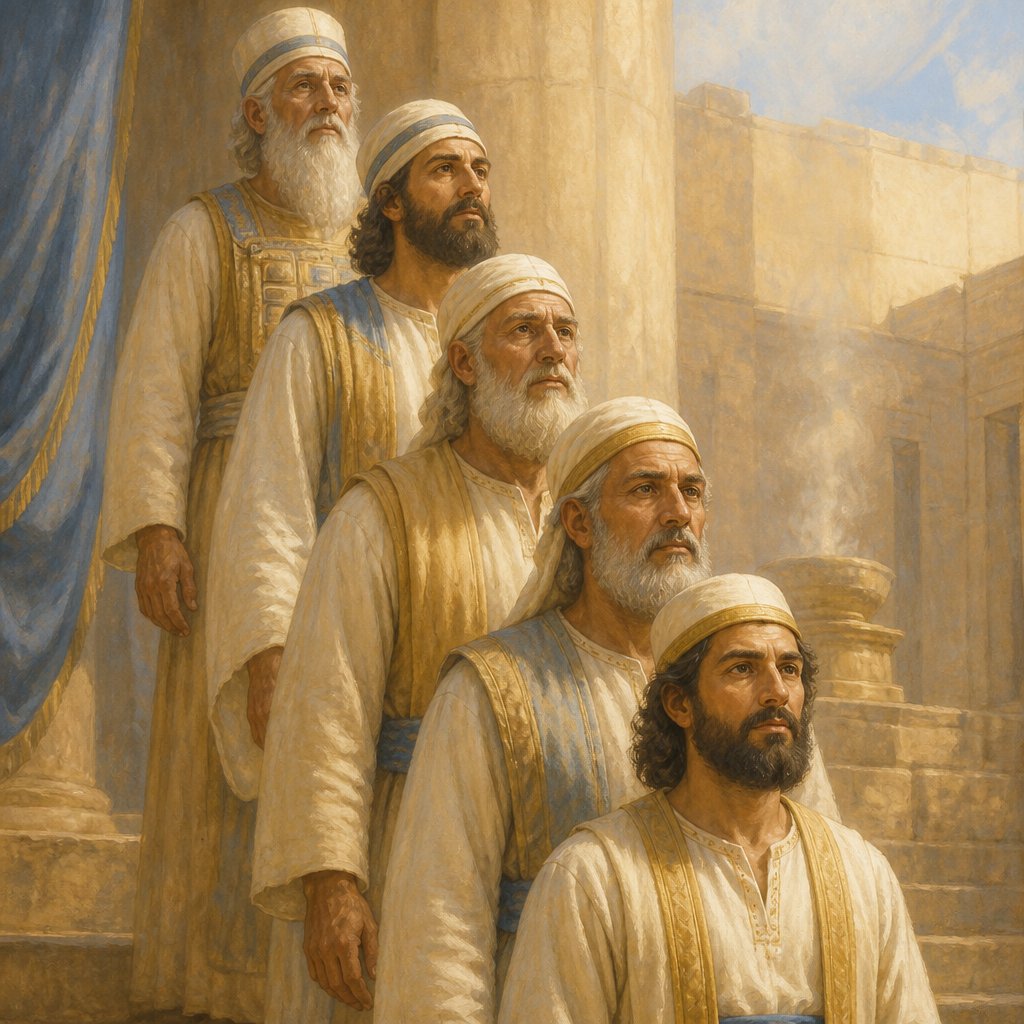
The lineage of Ezra, as presented in the brief verse of Ezra 7:5, unfolds before us a rich tapestry of faith, dedication, and divine calling: "The son of Abishua, the son of Phinehas, the son of Eleazar, the son of Aaron the chief priest." While this verse appears as a mere genealogical record, it resonates with profound truths about God's faithfulness across generations and the weight of spiritual heritage in the life of a believer.
To frame our understanding, we must acknowledge the significance of Ezra in the post-exilic period of Israel's history. Ezra, both priest and scribe, played a crucial role in re-establishing Jewish identity and worship after their return from Babylonian captivity. This was not just a practical restoration; it was a spiritual revival, one steeped in the Law of Moses, as Ezra was charged with teaching the people and ensuring their compliance with the scriptures. Thus, his lineage—traced back to Aaron himself— is not just an incidental detail; it is foundational to his authority and mission.
### The Foundations of Faith
When we speak of Ezra's ancestry, we see a direct line leading back to Aaron, the first High Priest. Each name in this lineage signifies a continuum of God's specific calling to His people, highlighting the importance of role models in faith. Abishua, Phinehas, and Eleazar held vitally important roles as priests; they were not just our ancestors but the bearers of sacred responsibilities, guidance, and faithfulness to the covenant made by God with the Israelites.
Phinehas, for instance, was known for taking a zealous stand for God’s holiness, a pivotal moment demonstrating that faith requires action—an embodiment of standing firm on God's commandments amid a wayward culture. In the face of moral decay, his fervor in following God’s laws set a precedent for faithfulness that Ezra would later inherit.
### The Weight of Legacy
As contemporary believers, this lineage serves as a powerful reminder that our faith is often built upon the sacrifices and teachings of those who came before us. Each generation lays a foundation for the next, often without even knowing the extent of its influence. This inspires us to examine our own lives—what legacy are we leaving in our faith? How may our relationship with God shape our children, friends, and community?
In addition to examining what we inherit, we must reflect on the responsibility that comes with it. The greater our heritage, the greater our obligation to honor it by living a life worthy of such a calling. Ezra certainly felt the weight of his lineage as he returned to Jerusalem to teach the Law of God. He was not merely looking to fulfill a clerical role but to embody the spiritual leadership his ancestors had modeled before him.
### A Personal Call to Action
Ezra’s story and his remarkable lineage challenge us to foster a personal relationship with God that transcends mere tradition. Each of us has ancestors—spiritual or biological—whose faith can inspire us, yet we are also called to forge our own paths of obedience and dedication. The weight of those who came before us should not be a burden but rather a call to continue their legacy with the intent to pass it on.
Therefore, as we reflect on Ezra 7:5, let us take time to pray and ask ourselves:
1. How might God be calling me to lead or serve in my community today?
2. What steps can I take to deepen my understanding of scripture, as Ezra did?
3. How can I impart the values of my faith to those coming after me, ensuring that the spiritual legacy continues?
In conclusion, Ezra’s lineage is a testimony of God’s faithfulness. It unravels the spiritual heritage that is accessible to each and every one of us, beckoning us to embrace our role in God’s ongoing story. Let us strive for faithfulness as we walk in the footprints of those who have paved the way, committing ourselves to being vessels of His grace and truth in our generation.
Get our apps


Artwork for Ezra 7:5

Ezra 7:5 - "The son of Abishua, the son of Phinehas, the son of Eleazar, the son of Aaron the chief priest:"
"The son of Abishua, the son of Phinehas, the son of Eleazar, the son of Aaron the chief priest:" - Ezra 7:5

Ezra 5:7 - "They sent a letter unto him, wherein was written thus; Unto Darius the king, all peace."

Ezra 7:12 - "Artaxerxes, king of kings, unto Ezra the priest, a scribe of the law of the God of heaven, perfect peace, and at such a time."

Ezra 10:5 - "Then arose Ezra, and made the chief priests, the Levites, and all Israel, to swear that they should do according to this word. And they sware."
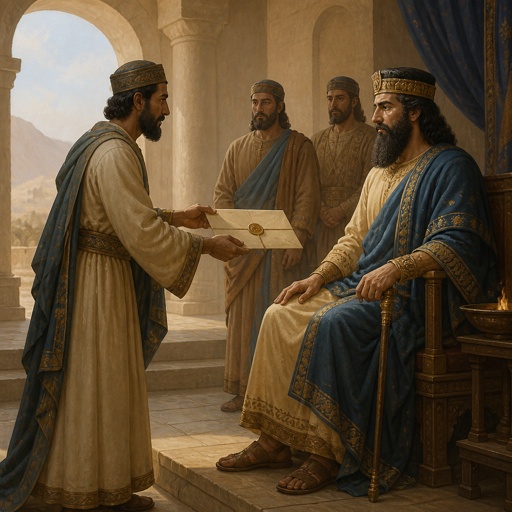
"They sent a letter unto him, wherein was written thus; Unto Darius the king, all peace." - Ezra 5:7

Ezra 7:10 - "For Ezra had prepared his heart to seek the law of the LORD, and to do it, and to teach in Israel statutes and judgments."

Zerubbabel in Ezra chapter 5

Ezra 7:1 - "Now after these things, in the reign of Artaxerxes king of Persia, Ezra the son of Seraiah, the son of Azariah, the son of Hilkiah,"

Ezra 7:11 - "¶ Now this is the copy of the letter that the king Artaxerxes gave unto Ezra the priest, the scribe, even a scribe of the words of the commandments of the LORD, and of his statutes to Israel."

Ezra 7:2 - "The son of Shallum, the son of Zadok, the son of Ahitub,"

Ezra 7:4 - "The son of Zerahiah, the son of Uzzi, the son of Bukki,"

Ezra 2:5 - "The children of Arah, seven hundred seventy and five."

Ezra 7:3 - "The son of Amariah, the son of Azariah, the son of Meraioth,"

Ezra 2:7 - "The children of Elam, a thousand two hundred fifty and four."
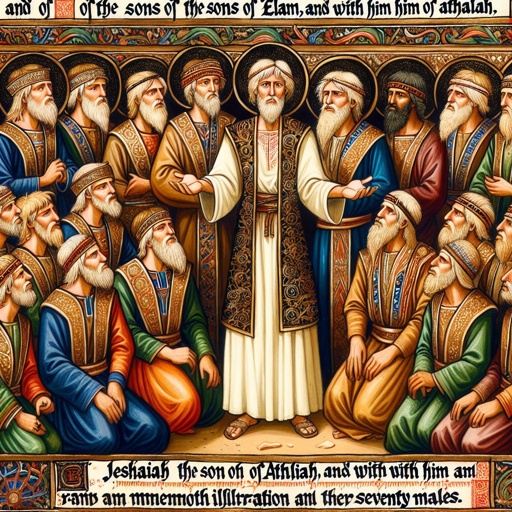
Ezra 8:7 - "And of the sons of Elam; Jeshaiah the son of Athaliah, and with him seventy males."

Zerubbabel in Ezra chapter 5 but zerubbabel is not a priest

Ezra 8:5 - "Of the sons of Shechaniah; the son of Jahaziel, and with him three hundred males."

Ezra 7:8 - "And he came to Jerusalem in the fifth month, which was in the seventh year of the king."

Ezra 7:21 - "And I, even I Artaxerxes the king, do make a decree to all the treasurers which are beyond the river, that whatsoever Ezra the priest, the scribe of the law of the God of heaven, shall require of you, it be done speedily,"

Ezra 7:7 - "And there went up some of the children of Israel, and of the priests, and the Levites, and the singers, and the porters, and the Nethinims, unto Jerusalem, in the seventh year of Artaxerxes the king."

Ezra 5:5 - "But the eye of their God was upon the elders of the Jews, that they could not cause them to cease, till the matter came to Darius: and then they returned answer by letter concerning this matter."

Ezra 7:6 - "This Ezra went up from Babylon; and he was a ready scribe in the law of Moses, which the LORD God of Israel had given: and the king granted him all his request, according to the hand of the LORD his God upon him."

Ezra 5:4 - "Then said we unto them after this manner, What are the names of the men that make this building?"

Ezra 7:25 - "And thou, Ezra, after the wisdom of thy God, that is in thine hand, set magistrates and judges, which may judge all the people that are beyond the river, all such as know the laws of thy God; and teach ye them that know them not."

Ezra 5:13 - "But in the first year of Cyrus the king of Babylon the same king Cyrus made a decree to build this house of God."

"Then arose Ezra, and made the chief priests, the Levites, and all Israel, to swear that they should do according to this word. And they sware." - Ezra 10:5

"Artaxerxes, king of kings, unto Ezra the priest, a scribe of the law of the God of heaven, perfect peace, and at such a time." - Ezra 7:12

"For Ezra had prepared his heart to seek the law of the LORD, and to do it, and to teach in Israel statutes and judgments." - Ezra 7:10

"Now after these things, in the reign of Artaxerxes king of Persia, Ezra the son of Seraiah, the son of Azariah, the son of Hilkiah," - Ezra 7:1