Divine Separation: The Calling of Jacob
"And Jacob did separate the lambs, and set the faces of the flocks toward the ringstraked, and all the brown in the flock of Laban; and he put his own flocks by themselves, and put them not unto Laban’s cattle." - Genesis 30:40
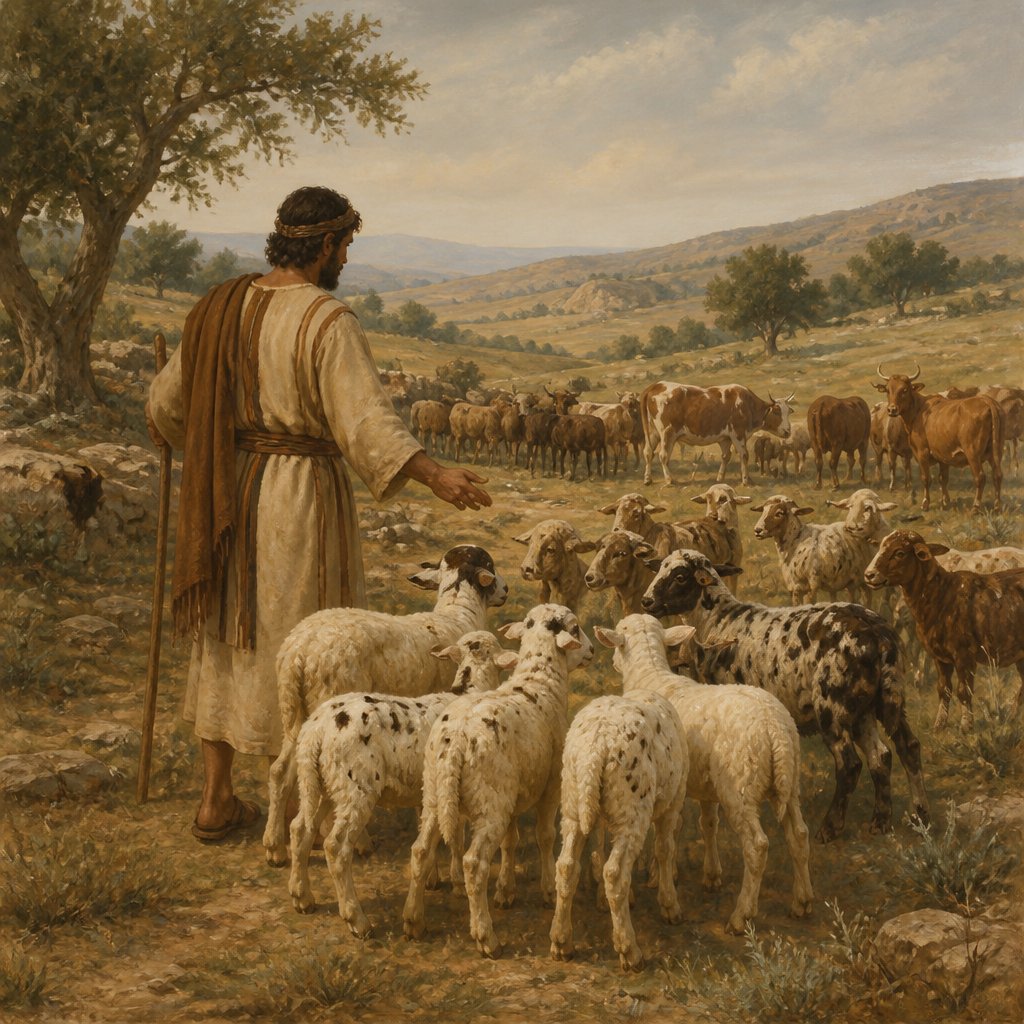
In Genesis 30:40, we witness a significant moment of strategy and divine providence in the life of Jacob. The verse reads, "And Jacob did separate the lambs, and set the faces of the flocks toward the ringstraked, and all the brown in the flock of Laban; and he put his own flocks by themselves, and put them not unto Laban's cattle." This verse is rich with lessons about faithfulness, divine separation, and the call towards our own inheritance.
Jacob’s life is marked by periods of wrestling with God — both literally and figuratively. He is a character defined by his struggles and victories and the divine promises he has received. Jacob was in Laban’s house for years, serving his uncle and enduring the challenges that came with his father-in-law's deceit. The context of Genesis 30 reflects a tense relationship between Jacob and Laban, marked by manipulation and distrust. In this particular instance, Jacob takes an inventive approach to ensure the breeding of flocks would benefit him despite Laban’s unfair treatment.
The first principle we derive from Jacob's actions is the importance of separation. Jacob deliberately separates his flocks from Laban’s. This act is significant because it symbolizes the necessity of distinguishing between what belongs to the Lord and what is merely earthly gain. Like Jacob, we must recognize when it is time to draw lines between our possessions and those that belong to others. This separation can be literal, as in separating property, but often it also represents a spiritual or ethical distinction.
In our lives, God calls us to be separate — not merely in the physical sense but in our ways, values, and allegiances. Paul urges in 2 Corinthians 6:17, "Wherefore come out from among them, and be ye separate, saith the Lord, and touch not the unclean thing; and I will receive you." Therefore, Jacob's actions remind us that spiritual separation creates a space where God can work in our lives. It's in this space of separation where God can bless and multiply our endeavors.
Furthermore, Jacob sets the faces of the flocks toward the ringstraked and brown. This detail points to his wisdom in using what God has already provided. He doesn’t wait for Laban’s goodwill; instead, he uses what he has to manifest God’s plan. This act communicates both faith and initiative; Jacob believed God had a plan for him, so he took steps to align his actions with that belief. How often do we find ourselves waiting passively for God's promises to manifest, rather than actively participating in them? In our spiritual journeys, we must recognize when God is leading us to take initiative and begin moving toward what He has promised us.
Jacob’s care for his own flocks also serves a dual purpose. It emphasizes the importance of stewardship over what God has entrusted to us and reveals our own responsibility in caring for our divine inheritance. Like Jacob, we are to nurture the gifts and blessings God has given us, putting them apart for His glory. When we reallocate our focus toward what is set apart for Him, God can multiply our efforts far beyond what we can imagine.
In conclusion, Genesis 30:40 is more than a mere account of breeding livestock; it is an invitation to embrace divine separation, trust in God's providential care, and take proactive steps toward the blessings we seek. Let us, like Jacob, separate ourselves from things that are counterproductive to our faith, exercise good stewardship over our gifts, and position ourselves in faith towards what God has promised. This Psalm captures our prayer: "Teach us to number our days, that we may apply our hearts unto wisdom" (Psalm 90:12). In separating our focus to seek God’s face, we will find ourselves aligned with His purposes and empowered to see His promises realized in our lives.
Want to reflect more on Genesis 30:40?
Continue your spiritual journey with Bible Chat — an AI-powered tool for exploring God's Word through conversation. Ask questions, discover connections, and deepen your understanding.
Get Our Apps


Genesis 30:40 Artwork

Genesis 30:40 - "And Jacob did separate the lambs, and set the faces of the flocks toward the ringstraked, and all the brown in the flock of Laban; and he put his own flocks by themselves, and put them not unto Laban's cattle."
"And Jacob did separate the lambs, and set the faces of the flocks toward the ringstraked, and all the brown in the flock of Laban; and he put his own flocks by themselves, and put them not unto Laban's cattle." - Genesis 30:40

Genesis 24:40

Isaiah 40:30 - "Even the youths shall faint and be weary, and the young men shall utterly fall:"

Exodus 40:30 - "¶ And he set the laver between the tent of the congregation and the altar, and put water there, to wash withal."

Ezekiel 40:30 - "And the arches round about were five and twenty cubits long, and five cubits broad."

Genesis 40:22 - "But he hanged the chief baker: as Joseph had interpreted to them."

Genesis 40:23 - "Yet did not the chief butler remember Joseph, but forgat him."

Genesis 19-30

Genesis 24-30

Genesis 18-30

Genesis 21-30

Genesis 40:12 - "And Joseph said unto him, This is the interpretation of it: The three branches are three days:"

Genesis 40:18 - "And Joseph answered and said, This is the interpretation thereof: The three baskets are three days:"

Genesis 40:6 - "And Joseph came in unto them in the morning, and looked upon them, and, behold, they were sad."

Genesis 40:4 - "And the captain of the guard charged Joseph with them, and he served them: and they continued a season in ward."

Genesis 30:10-11

Genesis 29:15-30

Genesis 40:2 - "And Pharaoh was wroth against two of his officers, against the chief of the butlers, and against the chief of the bakers."

Genesis 40:3 - "And he put them in ward in the house of the captain of the guard, into the prison, the place where Joseph was bound."

"Even the youths shall faint and be weary, and the young men shall utterly fall:" - Isaiah 40:30

Genesis 30:5 - "And Bilhah conceived, and bare Jacob a son."

Genesis 11:30 - "But Sarai was barren; she had no child."

Genesis 40:21 - "And he restored the chief butler unto his butlership again; and he gave the cup into Pharaoh's hand:"

Genesis 31:40 - "Thus I was; in the day the drought consumed me, and the frost by night; and my sleep departed from mine eyes."

Genesis 40:9 - "And the chief butler told his dream to Joseph, and said to him, In my dream, behold, a vine was before me;"

Genesis 40:1 - "And it came to pass after these things, that the butler of the king of Egypt and his baker had offended their lord the king of Egypt."

Genesis 30:10 - "And Zilpah Leah's maid bare Jacob a son."

Genesis 30:19 - "And Leah conceived again, and bare Jacob the sixth son."

Genesis 36:40 - "And these are the names of the dukes that came of Esau, according to their families, after their places, by their names; duke Timnah, duke Alvah, duke Jetheth,"