The Unseen Bonds: A Divine Recognition
"And he lifted up his eyes, and saw his brother Benjamin, his mother's son, and said, Is this your younger brother, of whom ye spake unto me? And he said, God be gracious unto thee, my son." - Genesis 43:29
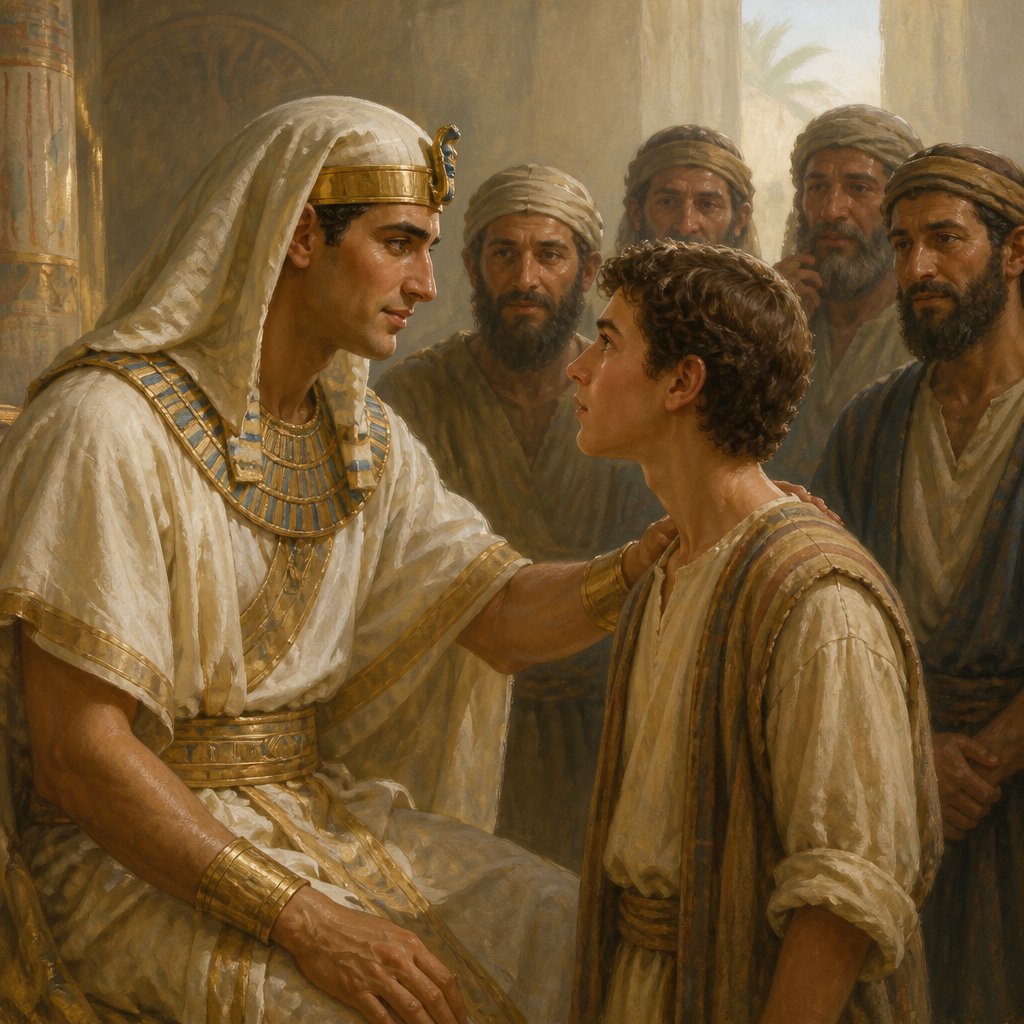
The verse from Genesis 43:29 resonates with profound emotional depth. In the King James Version, we encounter a moment of poignant revelation: "And he lifted up his eyes, and saw his brother Benjamin, his mother's son, and said, Is this your younger brother, of whom ye spake unto me? And he said, God be gracious unto thee, my son." This passage captures not only the physical act of seeing but also the deeper emotional and spiritual recognition of kinship, love, and divine grace.
When Joseph, who at this point was the second most powerful man in Egypt, first laid eyes on his younger brother Benjamin, the moment was filled with layers of meaning. Joseph had been through immense trials and tribulations, enduring betrayal and hardship that seemed insurmountable. He had been sold into slavery by his brothers, exiled from his family, and had risen to power in a foreign land, all while clinging to the hope of one day being reunited with his family.
In this moment, lifting his eyes to see Benjamin, Joseph's heart must have been flooded with a whirlwind of emotions — love, sorrow, joy, and the bittersweet recognition of all that had transpired in their lives. Joseph had not seen Benjamin since he was a child, and the sight of him must have invoked memories of home, innocence, and the familial bonds that once defined his early years. When he asks, "Is this your younger brother, of whom ye spake unto me?" it is more than mere inquiry; it is a deep longing to connect, to reclaim what had been lost.
The significance of Benjamin carrying the same maternal lineage, referred to as "his mother's son," highlights the profound connection they share. In a world where familial relationships often dictate one’s identity, acknowledging Benjamin as his mother’s son also emphasized the pain and loss of their mother, Rachel, who died giving birth to him. Here, we observe a deep cultural truth: our identities are woven together with those we love, and the impacts of grief and loss can shape and define the relationships we have with each other.
And then Joseph, in a gesture filled with tenderness, blesses Benjamin by saying, "God be gracious unto thee, my son." Here we see Joseph as a brother, stepping into the role of protector and well-wisher. Even in his power, it is through this blessing that Joseph recognizes the profound and divine element of their reunion. The phrase itself is a prayer, a cry for divine favor and grace upon Benjamin’s life. It reveals Joseph's understanding that life is not only defined by human actions but, more significantly, by divine interventions.
How frequently do we, like Joseph, find ourselves separated from those we love? Whether through conflict, distance, or life’s unpredictable paths, we often yearn for connection and reconciliation. In our lives, we may encounter the pain of estrangement, misunderstandings, or loss. Yet, in Joseph’s encounter with Benjamin, there is hope — hope that what was once broken can be made whole again through God's grace.
Let us reflect on the divine recognition present in our relationships. We are called not just to see one another but to recognize the God-given worth and dignity in each person. In every moment of reconciliation, be it with family, friends, or communities, we have an opportunity to invoke God's blessing on each other, to lift our eyes and truly see one another as beloved children of God.
In our own lives, are there “Benjamins” waiting to be acknowledged? Perhaps we are called to extend grace, reconciliation, and blessings. As we navigate through life’s complexities, let us be agents of God’s grace, recognizing each other through the eyes of forgiveness, hope, and love. In doing so, we mirror the heart of God who has called us to be reconciled to Him and to one another.
Want to reflect more on Genesis 43:29?
Continue your spiritual journey with Bible Chat — an AI-powered tool for exploring God's Word through conversation. Ask questions, discover connections, and deepen your understanding.
Get Our Apps


Genesis 43:29 Artwork

Genesis 43:29 - "And he lifted up his eyes, and saw his brother Benjamin, his mother's son, and said, Is this your younger brother, of whom ye spake unto me? And he said, God be gracious unto thee, my son."
"And he lifted up his eyes, and saw his brother Benjamin, his mother's son, and said, Is this your younger brother, of whom ye spake unto me? And he said, God be gracious unto thee, my son." - Genesis 43:29

Genesis 24-43

Exodus 29:43 - "And there I will meet with the children of Israel, and the tabernacle shall be sanctified by my glory."

Genesis 43:1 - "And the famine was sore in the land."

"And the famine was sore in the land." - Genesis 43:1

Genesis 43:19 - "And they came near to the steward of Joseph's house, and they communed with him at the door of the house,"

Genesis 43:13 - "Take also your brother, and arise, go again unto the man:"

Genesis 43:17 - "And the man did as Joseph bade; and the man brought the men into Joseph's house."

Genesis 43:20 - "And said, O sir, we came indeed down at the first time to buy food:"

Genesis 43:25 - "And they made ready the present against Joseph came at noon: for they heard that they should eat bread there."

Genesis 30:43 - "And the man increased exceedingly, and had much cattle, and maidservants, and menservants, and camels, and asses."

Genesis 43:4 - "If thou wilt send our brother with us, we will go down and buy thee food:"

Genesis 43:10 - "For except we had lingered, surely now we had returned this second time."

Genesis 43:31 - "And he washed his face, and went out, and refrained himself, and said, Set on bread."

Genesis 29:29 - "And Laban gave to Rachel his daughter Bilhah his handmaid to be her maid."

Genesis 29-2

Genesis 29-6

Genesis 29-5

Genesis 42:29

Genesis 29:1

Genesis 29-7

Genesis 18-29

Genesis 43:24 - "And the man brought the men into Joseph's house, and gave them water, and they washed their feet; and he gave their asses provender."

Genesis 36:43 - "Duke Magdiel, duke Iram: these be the dukes of Edom, according to their habitations in the land of their possession: he is Esau the father of the Edomites."

Genesis 26:29

Genesis 19-29

Genesis 29-8

Genesis 29-3

Genesis 29-4