The Fifth: A Covenant of Trust and Stewardship
“And Joseph made it a law over the land of Egypt unto this day, that Pharaoh should have the fifth part; except the land of the priests only, which became not Pharaoh’s.” — Genesis 47:26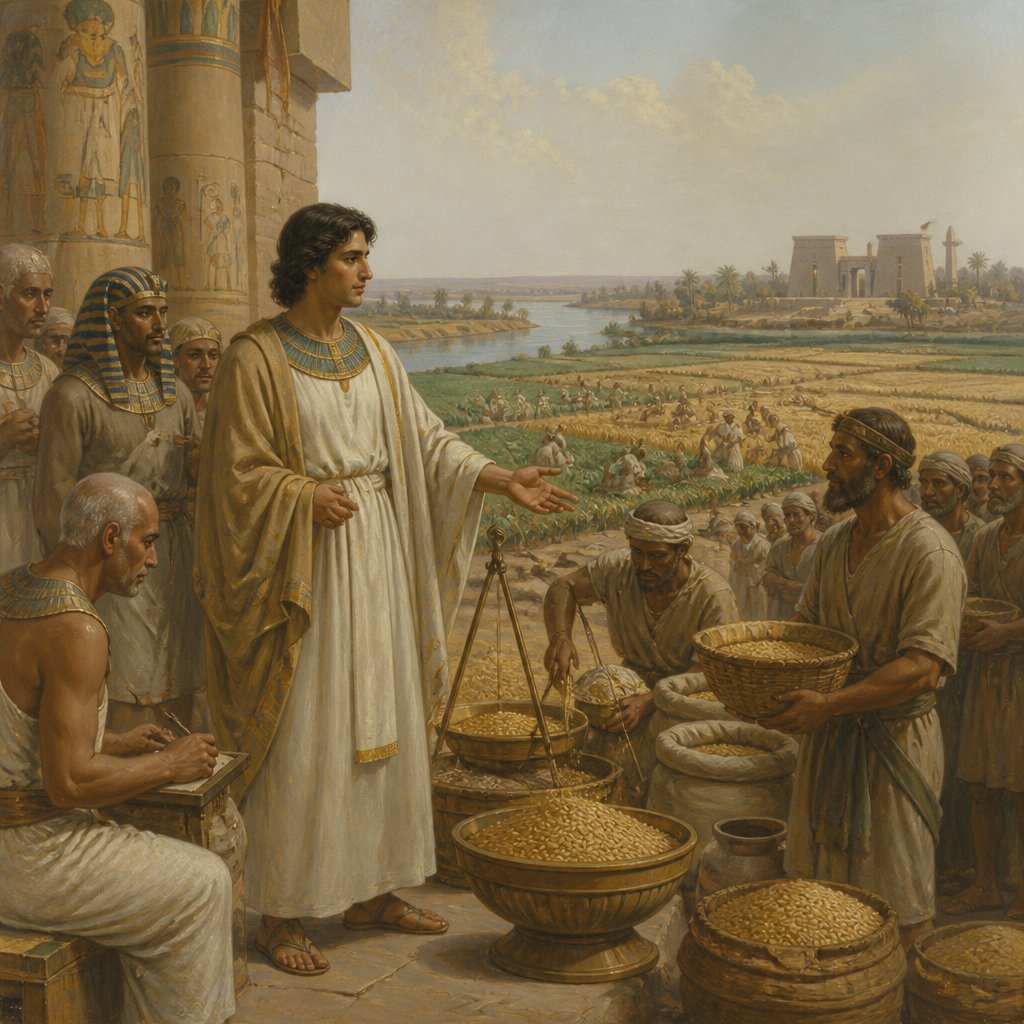
Genesis 47:26 reads, "And Joseph made it a law over the land of Egypt unto this day, that Pharaoh should have the fifth part; except the land of the priests only, which became not Pharaoh's." This verse is particularly significant in its depiction of governance, responsibility, and the divine order in the management of resources amid the trials of famine.
In the narrative leading up to this verse, we witness Joseph’s unparalleled wisdom and integrity as he manages Egypt’s resources during a time of great need. After interpreting Pharaoh's dreams regarding the impending famine, Joseph does not merely act as a chief administrator but embodies a true steward of the land. His strategy to collect one-fifth of all produce during the seven years of plenty is not simply a financial maneuver, but a divinely endorsed solution aiming to stabilize a byzantine society facing severe hunger and economic instability. This law, now entrenched in the fabric of Egyptian life, exemplifies a profound understanding of stewardship.
At the core of this verse is the principle that all we possess is on loan from God and that how we manage it reflects our relationship with Him. Joseph, appointed as a steward of God’s resources, did not hoard wealth for himself. Instead, he established a system where the majority of the landowners surrendered a fifth of their harvests during prosperous times in exchange for security during the lean years. This not only prepared the nation for famine but ensured that the king could provide for his people. This underscores an important point: our responsibility as stewards involves sacrifice. We are called to contribute a portion of our blessings for the welfare of others.
Joseph’s establishment of Pharaoh’s rights also illustrates an essential lesson about authority and governance under a divine mandate. In doing so, Joseph recognized Pharaoh’s ultimate sovereignty but also distinguished between the Egyptians and the priests, who were venerated in society and therefore retained their lands. Their exemption speaks volumes about respect for spiritual roles within the community. In our contemporary context, this reminds us that while authority figures (in both political and social settings) can guide and govern, they are not above the sacred callings some are tasked with, such as that of the clergy or spiritual leaders. The priests were sustained by the offerings of the people, ensuring that the spiritual life of Egypt endured unaffected by the material famine. This distinction reinforces that some aspects of life must remain sacred and free from earthly governance, echoing our need to honor God above worldly pursuits.
Furthermore, the act of giving a fifth of one’s produce aligns with the biblical concept of the tithe, which represents a practice that goes beyond mere obligation; it matures into a discipline of trust. Every time the Egyptians surrendered their harvest, they were tacitly acknowledging God’s providence in their lives. With each harvest brought forth to Pharaoh, they were reminded that their sustenance ultimately came from God. In times of plenty and scarcity alike, their giving offered a form of worship and recognition of God’s sovereignty.
As we reflect on Joseph’s wisdom and his covenantal action, we are invited to evaluate our own relationship with our resources. The idea of giving back a portion—whether it be time, talents, or finances—serves to remind us of our dependence on God and His divine provision. Are we willing to share our blessings and what that could mean for our community? In a world often driven by individualism and greed, the message Joseph delivers through this law is revolutionary.
May we cultivate the heart of a steward who faithfully acknowledges everything we own as a gift from our Creator. Let our lives reflect gratitude manifested through generosity. We too have the power to enact laws of love and kindness in our corner of the world, ensuring that even the least of these are cared for. As we embrace this call, let us commit to living lives where our first act is to give, share, and participate willingly in the stewardship of God’s blessings.
Get our apps


Artwork for Genesis 47:26

Genesis 47:26 - "And Joseph made it a law over the land of Egypt unto this day, that Pharaoh should have the fifth part; except the land of the priests only, which became not Pharaoh's."
"And Joseph made it a law over the land of Egypt unto this day, that Pharaoh should have the fifth part; except the land of the priests only, which became not Pharaoh's." - Genesis 47:26

Genesis 24-47

Genesis 31:47 - "And Laban called it Jegarsahadutha: but Jacob called it Galeed."

Genesis 41:47 - "And in the seven plenteous years the earth brought forth by handfuls."

Genesis 47:10 - "And Jacob blessed Pharaoh, and went out from before Pharaoh."

Genesis 47:8 - "And Pharaoh said unto Jacob, How old art thou?"

Numbers 26:47 - "These are the families of the sons of Asher according to those that were numbered of them; who were fifty and three thousand and four hundred."

Genesis 47:2 - "And he took some of his brethren, even five men, and presented them unto Pharaoh."

Genesis 47:12 - "And Joseph nourished his father, and his brethren, and all his father's household, with bread, according to their families."

Genesis 47:16 - "And Joseph said, Give your cattle; and I will give you for your cattle, if money fail."

Genesis 47:27 - "¶ And Israel dwelt in the land of Egypt, in the country of Goshen; and they had possessions therein, and grew, and multiplied exceedingly."

Genesis 47:7 - "And Joseph brought in Jacob his father, and set him before Pharaoh: and Jacob blessed Pharaoh."

Genesis 47:5 - "And Pharaoh spake unto Joseph, saying, Thy father and thy brethren are come unto thee:"

"And Laban called it Jegarsahadutha: but Jacob called it Galeed." - Genesis 31:47

Genesis 47:28 - "And Jacob lived in the land of Egypt seventeen years: so the whole age of Jacob was an hundred forty and seven years."

Genesis 47:21 - "And as for the people, he removed them to cities from one end of the borders of Egypt even to the other end thereof."

Genesis 47:13 - "¶ And there was no bread in all the land; for the famine was very sore, so that the land of Egypt and all the land of Canaan fainted by reason of the famine."

Genesis 47:31 - "And he said, Swear unto me. And he sware unto him. And Israel bowed himself upon the bed's head."

Matthew 26:47 - "¶ And while he yet spake, lo, Judas, one of the twelve, came, and with him a great multitude with swords and staves, from the chief priests and elders of the people."

Genesis 47:25 - "And they said, Thou hast saved our lives: let us find grace in the sight of my lord, and we will be Pharaoh's servants."

"And in the seven plenteous years the earth brought forth by handfuls." - Genesis 41:47

Genesis 1:26

Genesis 1:26

Genesis 1:26

Genesis 1:26

Genesis 47:11 - "¶ And Joseph placed his father and his brethren, and gave them a possession in the land of Egypt, in the best of the land, in the land of Rameses, as Pharaoh had commanded."

Genesis 47:14 - "And Joseph gathered up all the money that was found in the land of Egypt, and in the land of Canaan, for the corn which they bought: and Joseph brought the money into Pharaoh's house."

"And Jacob blessed Pharaoh, and went out from before Pharaoh." - Genesis 47:10

Genesis 47:3 - "And Pharaoh said unto his brethren, What is your occupation? And they said unto Pharaoh, Thy servants are shepherds, both we, and also our fathers."