A Legacy Beyond the Flood: Lessons from Noah's Life
“And Noah lived after the flood three hundred and fifty years.” — Genesis 9:28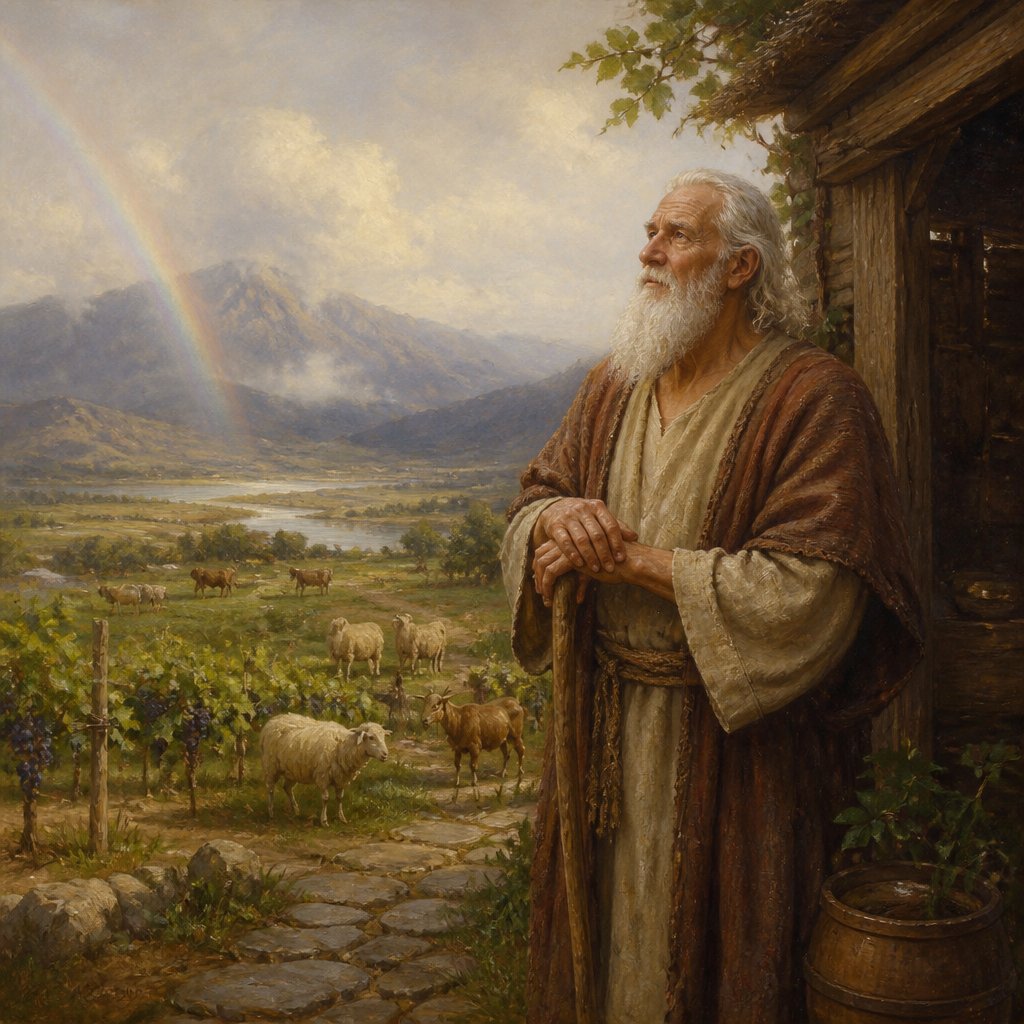
As we turn our hearts and minds to Genesis 9:28, we are confronted with a profound reflection on longevity, purpose, and the enduring legacy that is carved out of trials and tribulations. The verse states, "And Noah lived after the flood three hundred and fifty years." This succinct statement encapsulates so much more than the numerical value of years; it invites us to ponder upon the profound implications of Noah’s life after the cataclysmic events of the Flood.
Noah, a man chosen by God, was not merely a survivor of a world-altering catastrophe; he was the architect of a new beginning. His life, which endured for an additional 350 years post-Flood, symbolizes the potential for renewal and restoration that follows life's storms. It prompts us to consider how we might live with purpose in the aftermath of our own trials and how we can leave a legacy that honors God.
First, let us explore what it means to live after the flood. For Noah, this was not simply a time of existence; it was a period of active participation in God's vision for humanity. After the flood, God reestablished His covenant with Noah and his descendants, a sacred promise that included the command to be fruitful and multiply on the earth (Genesis 9:1). In that moment, not only was Noah’s survival confirmed, but it also set him on a path that required intention and resolve. Therefore, in our own lives, we must ask ourselves: What does it mean for us to live after our personal floods? What does God call us to do in the wake of adversity?
As we reflect on Noah's extended life, we observe that purpose is always intertwined with legacy. Noah’s life after the flood was filled with the cultivation of that legacy. He became the father of three sons—Shem, Ham, and Japheth—each of whom would carry forth the human story after the floodwaters receded. This notion of lineage draws us into a deeper understanding of how our lives and walks with God can impact those who come after us. In a time when many voices compete for attention, we can echo Noah's legacy to our children and those around us by sharing our experiences of faith, leading our households in righteousness, and establishing values that reflect our love for God.
Furthermore, Noah’s life challenges us to embrace our God-given responsibilities. It is easy to feel complacent in the aftermath of a struggle, but Noah took on the mantle of stewardship and nurturing a new world. He was tasked with the responsibility to cultivate the earth, to care for the animals, and to lead his family. As believers, we are called to engage actively in our faith communities, to serve our neighbors, and to influence the environments around us positively. Living out our faith means assuming responsibility—not only for ourselves but for those we can lead to Christ.
In this age of uncertainty, we must also take hope from Noah's narrative. The flood symbolized judgment, yet the aftermath was emblematic of grace and hope. Each day that Noah lived after the flood was an opportunity to reconcile the past with a hopeful future. Likewise, every moment we are given after our own difficult seasons serves as a reminder that God’s grace enables growth and renewal. We may not always realize the true purpose behind our trials, but like Noah, we have the capability to transform our experiences into something beautiful and monumental.
In conclusion, Genesis 9:28 invites us into a renaissance of faith and legacy. Noah's 350 years after the flood were not years of mere survival; they were years of purpose, responsibility, and profound influence. May we, like Noah, seize our "after the flood" moments to live fully in God’s promise, fostering legacies of faith that will ripple through generations. Embrace life after the flood with renewed vigor, knowing that each day is a divine gift to enact God’s will on earth.
Get our apps


Artwork for Genesis 9:28

Genesis 9:28 - "¶ And Noah lived after the flood three hundred and fifty years."
"¶ And Noah lived after the flood three hundred and fifty years." - Genesis 9:28

Genesis 28:9 - "Then went Esau unto Ishmael, and took unto the wives which he had Mahalath the daughter of Ishmael Abraham's son, the sister of Nebajoth, to be his wife."

Genesis 28:9 KJV Then went Esau unto Ishmael, and took unto the wives which he had Mahalath the daughter of Ishmael Abraham's son, the sister of Nebajoth, to be his wife.

Genesis 28-15

Genesis 28-12

Genesis 28-16

Genesis 28-21

Genesis 28-22

Genesis 28-17

Genesis 21:28

Genesis 28:18

Genesis 24:28

Genesis 28:18

Genesis 28-20

Genesis 28-13

Genesis 28-19

Genesis 28-14

Genesis 28-11

Genesis 19-28

Genesis 28:10

Genesis 18-28

Genesis 10:28 - "And Obal, and Abimael, and Sheba,"

Genesis 36:28 - "The children of Dishan are these; Uz, and Aran."

Genesis 35:28 - "And the days of Isaac were an hundred and fourscore years."

Luke 9:28-45

Genesis 21:28 - "And Abraham set seven ewe lambs of the flock by themselves."

"And Obal, and Abimael, and Sheba," - Genesis 10:28

Genesis 5:28 - "¶ And Lamech lived an hundred eighty and two years, and begat a son:"

Genesis 30:28 - "And he said, Appoint me thy wages, and I will give it."