The Illusions of False Security
"Where are the gods of Hamath and Arphad? where are the gods of Sepharvaim? and have they delivered Samaria out of my hand?" - Isaiah 36:19
**Introduction**
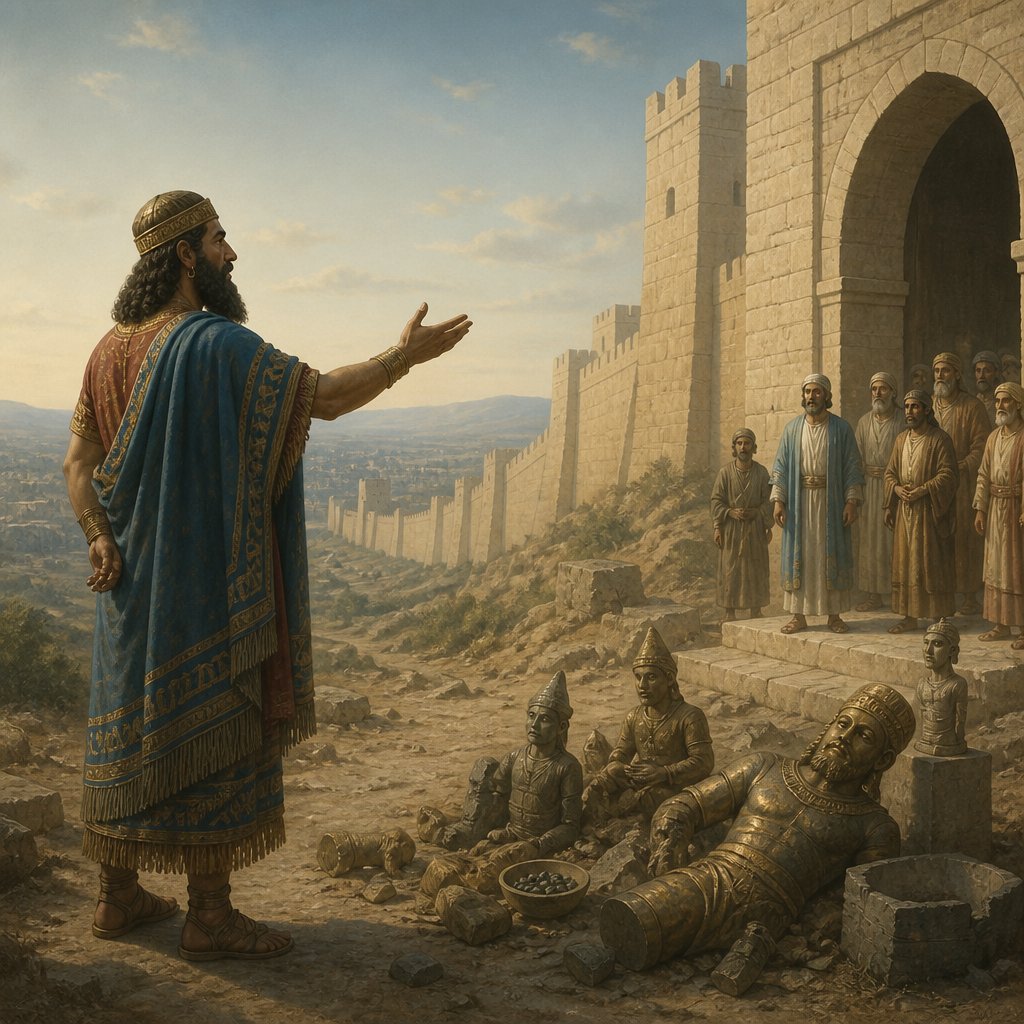
In the heart of the Old Testament, the book of Isaiah confronts the realities of idolatry and the futility of trusting in false gods. Isaiah 36:19 reads: "Where are the gods of Hamath and Arphad? where are the gods of Sepharvaim? and have they delivered Samaria out of my hand?" This verse is spoken by the Assyrian king Sennacherib, who, with arrogance, challenges the Israelites regarding their reliance on their God amidst his military threats. The question he poses reverberates throughout history, reminding us to examine whom we genuinely rely upon in our times of trouble.
**Contextual Insights**
Understanding the historical context is crucial. The Assyrians were known for their brutal conquests, and Sennacherib was at the height of his power, boasting of victories against many nations, including Israel. He mocks Israel’s God, directly questions the efficacy of the gods worshipped by neighboring nations, and belittles any hope that the Israelites may have in their divine protection. This confrontation was not just a political maneuver; it was a spiritual assault that invited Israel to trust in their own strength or the strength of their pagan allies instead of in the One who had delivered them throughout their history.
**The Nature of False Gods**
Sennacherib’s rhetoric highlights a fundamental truth about idolatry—it exists as a form of false comfort and security that ultimately leads to disappointment and destruction. The gods of Hamath, Arphad, and Sepharvaim represent worldly power and influence, yet they could not provide true salvation or deliverance. In our contemporary context, we too might be tempted to place our trust in various "gods" — wealth, status, relationships, or even our own intellect. The allure of these false securities can be strong, yet when trials inevitably arise, they leave us empty, just as Sennacherib left those nations without any real deliverance.
**God's Sovereignty Amidst Chaos**
When Sennacherib taunted the Israelites, he inadvertently affirmed God's sovereignty. The question isn’t just about the inability of foreign gods but ultimately about recognizing “the God of Israel.” In the face of despair and doubt, what we might perceive as destruction can be the backdrop against which God’s glory shines the brightest. Isaiah, the prophet, often portrays a God who is not only aware of our struggles but actively engaged in our deliverance.
**Personal Reflection and Application**
As we reflect on Isaiah 36:19, we must ask ourselves: where do we place our trust? In moments of uncertainty or distress, what do we lean on? Are we, like the Israelites, tempted to rely on our understanding or the promises of the world? True deliverance does not rest in the shifting sands of human constructs but lies in the unfailing nature of God Himself. Let us also evaluate our spiritual lives; are there elements that we consider to be our "gods"? Perhaps it is the need for control, or the pursuit of happiness through material means. Are we falling into the trap of earthly security, believing it can offer the peace that only God can provide?
**Conclusion**
It's easy to mock Sennacherib for his arrogance, yet let us not overlook the underlying message within his challenge. The real battle remains the continual choice to trust in God amidst chaos. We are reminded that while the gods of this world may falter, our God is constant and faithful. May we embrace the truth of Psalm 121:2, which clearly states, "My help cometh from the Lord, which made heaven and earth."
As we navigate our own lives, let us place our complete faith in the Sovereign Lord, who alone has the power to save and deliver. Only He can bring us true peace amidst the storms of life.
Want to reflect more on Isaiah 36:19?
Continue your spiritual journey with Bible Chat — an AI-powered tool for exploring God's Word through conversation. Ask questions, discover connections, and deepen your understanding.
Get Our Apps


Isaiah 36:19 Artwork

Isaiah 36:19 - "Where are the gods of Hamath and Arphad? where are the gods of Sepharvaim? and have they delivered Samaria out of my hand?"
"Where are the gods of Hamath and Arphad? where are the gods of Sepharvaim? and have they delivered Samaria out of my hand?" - Isaiah 36:19

Genesis 19-36

Joshua 19:36 - "And Adamah, and Ramah, and Hazor,"

Genesis 36:19 - "These are the sons of Esau, who is Edom, and these are their dukes."

Luke 19:36 - "And as he went, they spread their clothes in the way."

Genesis 19:36 - "Thus were both the daughters of Lot with child by their father."

"And Adamah, and Ramah, and Hazor," - Joshua 19:36

Job 36:19 - "Will he esteem thy riches? no, not gold, nor all the forces of strength."

Isaiah 36:21 - "But they held their peace, and answered him not a word: for the king's commandment was, saying, Answer him not."

2 Kings 19:36 - "So Sennacherib king of Assyria departed, and went and returned, and dwelt at Nineveh."

John 19:36 - "For these things were done, that the scripture should be fulfilled, A bone of him shall not be broken."

Isaiah 36:14 - "Thus saith the king, Let not Hezekiah deceive you: for he shall not be able to deliver you."

Acts 19:36 - "Seeing then that these things cannot be spoken against, ye ought to be quiet, and to do nothing rashly."

"And as he went, they spread their clothes in the way." - Luke 19:36

"These are the sons of Esau, who is Edom, and these are their dukes." - Genesis 36:19

Exodus 36:19 - "And he made a covering for the tent of rams' skins dyed red, and a covering of badgers' skins above that."

Isaiah 41, 19

Isaiah 19:8

Isaiah 43:19

Isaiah 36:13 - "Then Rabshakeh stood, and cried with a loud voice in the Jews' language, and said, Hear ye the words of the great king, the king of Assyria."

Isaiah 19:1

Isaiah 43:19

Jeremiah 36:19 - "Then said the princes unto Baruch, Go, hide thee, thou and Jeremiah; and let no man know where ye be."

Isaiah 36:3 - "Then came forth unto him Eliakim, Hilkiah's son, which was over the house, and Shebna the scribe, and Joah, Asaph's son, the recorder."

2 Samuel 19:36 - "Thy servant will go a little way over Jordan with the king: and why should the king recompense it me with such a reward?"

Isaiah 43:18-19

Isaiah 19:19 - "In that day shall there be an altar to the LORD in the midst of the land of Egypt, and a pillar at the border thereof to the LORD."

Isaiah 3:19 - "The chains, and the bracelets, and the mufflers,"

Isaiah 36:17 - "Until I come and take you away to a land like your own land, a land of corn and wine, a land of bread and vineyards."