Awakening from the Sleep of Death: A Reflection on Job 14:12
"So man lieth down, and riseth not: till the heavens be no more, they shall not awake, nor be raised out of their sleep." - Job 14:12

The solemn words of Job 14:12 resonate deeply with the human experience: "So man lieth down, and riseth not: till the heavens be no more, they shall not awake, nor be raised out of their sleep." This verse paints a poignant picture of mortality, a reminder of the fleeting nature of our time on this earth. In this devotional, we will explore the depth of its implications, the reality of death, and the hope that resides in our faith.
In the broader context of the Book of Job, we find a character grappling with profound suffering and the unsettling truths of life. Job, a man of uprightness and faith, faces the unfathomable pain of loss and illness. As he laments, he questions the purpose of life and the certainty of death. In chapter 14, Job articulates a stark reality that many of us avoid confronting: the inevitability of our mortality. "So man lieth down, and riseth not…" serves as a reminder that death is an inherent part of our existence; it is not just a conclusion but a transition that we all must face.
What does it mean to “lie down” and not “rise”? In the scripture, Job uses the metaphor of sleep to describe death. The imagery of sleep conveys a sense of rest, yet it is a rest from which there is no awakening in our current earthly state. Job's declaration speaks to the finality of death—a phenomenon that appears to engulf the human spirit in an unyielding slumber. This reality can at times evoke fear or despair, especially when we are confronted with the loss of loved ones or our own mortality. However, it is crucial to approach this verse not merely with melancholy but with a lens of understanding.
Death, as depicted in Job’s lament, is often seen as the ultimate end; however, it prompts us to reflect on what lies beyond. The notion that "till the heavens be no more" adds an evocative layer, suggesting that there is a divine timeline and cosmic order in God's creation. In recognizing that our existence does not merely end with death, we are beckoned to embrace a perspective of eternity. As believers, we are assured through the resurrection of Jesus Christ that death is not the final word. The New Testament echoes this assurance in 1 Corinthians 15:54-55, proclaiming that death has been swallowed up in victory, mocking its sting.
Despite Job’s despair, his thoughts lead us to understand a central theme of hope. We can glean from his honest expression of fear and frustration a call to trust in God’s overarching plan. Even in our darkest moments, we are invited to hold fast to our faith, believing that the God who created us holds our lives in His loving hands. As we endure grief or face the uncertainties of life, we must remember that our souls do not simply vanish into oblivion. The promise of eternal life through faith redefines the meaning of death for us.
Let us take a moment to reflect on our lives in light of Job's solemn declaration. Are there areas where we are living in denial of mortality? How can we embrace the gift of each day with a deeper appreciation for the life God has given us? In knowing that death is a part of our human experience, we are called not to live in fear but to create a legacy of love, faith, and hope. Let us strive to fill our lives with purpose, cultivating deep connections with each other and nurturing our spiritual lives in alignment with God's will.
In conclusion, while Job's words highlight the sobering aspect of death, they also challenge us to consider our faith amidst uncertainty. There is a profound hope in God's promise of resurrection and eternal life. As we journey through life, let us lift our hearts and spirits, embracing both the beauty and fragility of our existence with the assurance that, in Christ, we have the victory over death. May we live each day in the light of this truth, ready to embrace both the challenges and the joys that lie ahead.
Want to reflect more on Job 14:12?
Continue your spiritual journey with Bible Chat — an AI-powered tool for exploring God's Word through conversation. Ask questions, discover connections, and deepen your understanding.
Get Our Apps


Job 14:12 Artwork

Job 14:12 - "So man lieth down, and riseth not: till the heavens be no more, they shall not awake, nor be raised out of their sleep."

"So man lieth down, and riseth not: till the heavens be no more, they shall not awake, nor be raised out of their sleep." - Job 14:12

Job 12:14 - "Behold, he breaketh down, and it cannot be built again: he shutteth up a man, and there can be no opening."

Job 12:1 - "And Job answered and said,"

Job 12:12 - "With the ancient is wisdom; and in length of days understanding."
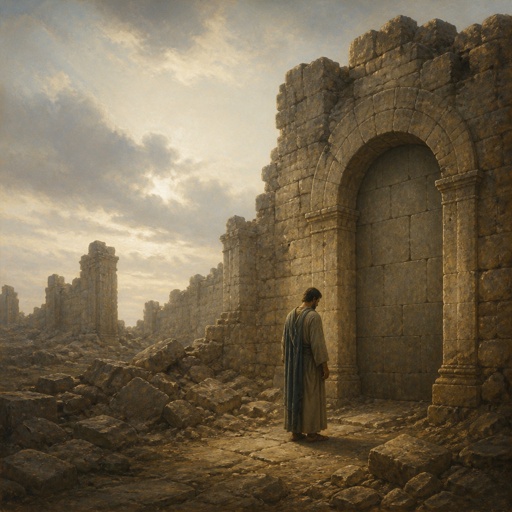
"Behold, he breaketh down, and it cannot be built again: he shutteth up a man, and there can be no opening." - Job 12:14

"And Job answered and said," - Job 12:1

Job 37:14 - "Hearken unto this, O Job: stand still, and consider the wondrous works of God."

Job 14:2

Job 1:14 - "And there came a messenger unto Job, and said, The oxen were plowing, and the asses feeding beside them:"

Job 32:12 - "Yea, I attended unto you, and, behold, there was none of you that convinced Job, or that answered his words:"

Job 38:14 - "It is turned as clay to the seal; and they stand as a garment."

Job 36:14 - "They die in youth, and their life is among the unclean."

"With the ancient is wisdom; and in length of days understanding." - Job 12:12

Job 5:14 - "They meet with darkness in the daytime, and grope in the noonday as in the night."

Job 28:14 - "The depth saith, It is not in me: and the sea saith, It is not with me."

Ezekiel 14:14 - "Though these three men, Noah, Daniel, and Job, were in it, they should deliver but their own souls by their righteousness, saith the Lord GOD."

Job 12:16 - "With him is strength and wisdom: the deceived and the deceiver are his."

Job 14:1 - "Man that is born of a woman is of few days, and full of trouble."

Job 21:12 - "They take the timbrel and harp, and rejoice at the sound of the organ."

Job 14:14 - "If a man die, shall he live again? all the days of my appointed time will I wait, till my change come."

Job 39:14 - "Which leaveth her eggs in the earth, and warmeth them in dust,"

Job 23:14 - "For he performeth the thing that is appointed for me: and many such things are with him."

Job 7:14 - "Then thou scarest me with dreams, and terrifiest me through visions:"

Job 24:14 - "The murderer rising with the light killeth the poor and needy, and in the night is as a thief."

Job 12:2 - "No doubt but ye are the people, and wisdom shall die with you."

Job 12:13 - "With him is wisdom and strength, he hath counsel and understanding."

Job 12:19 - "He leadeth princes away spoiled, and overthroweth the mighty."

Job 28:12 - "But where shall wisdom be found? and where is the place of understanding?"

Job 12:9 - "Who knoweth not in all these that the hand of the LORD hath wrought this?"