Beyond Our Command: Learning Trust from the Eagle on High
“Doth the eagle mount up at thy command, and make her nest on high?” — Job 39:27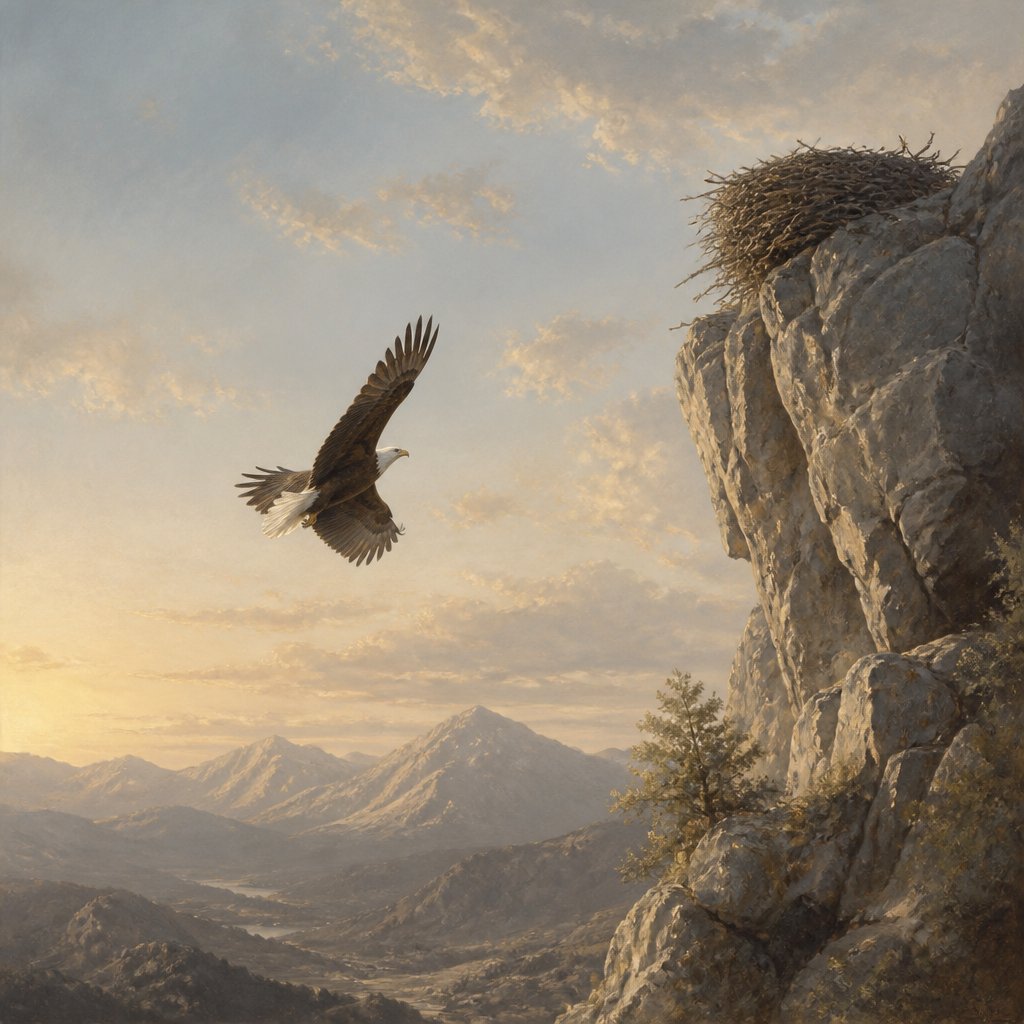
“Doth the eagle mount up at thy command, and make her nest on high?” (Job 39:27, KJV)
Job 39 is a turning point in the book of Job, not because Job suddenly receives all the answers he has longed for, but because God addresses the deeper issue beneath Job’s questions: the limits of human control and the vastness of divine wisdom. In this single verse, God confronts Job with an image both majestic and humbling—the eagle that rises into the heights and settles her home in places unreachable. The question is simple, but it carries immense weight: “Doth the eagle mount up at thy command…?”
God’s question is not meant to mock Job; it is meant to restore him. Job has experienced losses so deep that words can hardly touch them—health, family, security, reputation, and the sense that the world is orderly. In pain, it is natural to reach for something we can grasp. We want explanations. We want timelines. We want guarantees. And if we cannot have those, we may at least want control—some lever to pull, some command to give, some way to make life obey. Yet God asks Job to consider the eagle: Can you command it? Can you orchestrate its flight? Can you decide where it will build? The implied answer is “no,” and in that “no” is a surprising mercy.
The eagle is a picture of a world that operates beyond our management. Its ability to “mount up” speaks of strength, instinct, timing, and design. Its choice to “make her nest on high” points to safety, perspective, and separation from ground-level threats. These are not qualities Job can manufacture by sheer effort or wisdom. The eagle’s life, in its freedom and instinctive mastery of the skies, is part of God’s ordered creation—ordered, not by human hands, but by God’s.
This verse invites us to examine how often we live as if we are meant to be in God’s place. We may not say it out loud, but our anxiety can reveal it. When we feel that everything must be solved by our planning, or when we believe peace will come only after we have anticipated every possible outcome, we are living like we should be able to command the eagle. But the Lord’s question exposes that assumption. We are not the Commander of creation. We are not the Architect of outcomes. We are not the One who ensures that the eagle rises at the right moment, catches the wind, and finds a high place to dwell.
And yet, rather than leaving us with helplessness, Job 39:27 leads us into humility that heals. If we cannot command the eagle, then the burden of ultimate control was never meant to be ours. That is not an invitation to passivity; it is an invitation to trust. There is a difference between faithful responsibility and fearful control. Faithful responsibility says, “I will do what God has placed before me today.” Fearful control says, “I must secure every tomorrow.” God’s question calls us back to the first.
Consider also what it means that the eagle “make her nest on high.” High places in Scripture often speak to perspective—seeing farther, seeing clearer, seeing what cannot be seen from the dust of immediate circumstances. Job, in his suffering, has been forced low: low in body, low in spirit, low in understanding. But God, by pointing to the eagle’s heights, gently reminds Job that there is a vantage point beyond his present pain. Not all realities are visible from where Job sits. Not all purposes can be grasped from the ground. God’s wisdom is not limited to what we can explain.
When your life feels unmanageable—when grief, uncertainty, or disappointment makes you ask, “Why?”—Job 39:27 offers a stabilizing truth: God is God, and you are not. That may sound stark, but it is profoundly comforting. If everything depended on you, you would be crushed by the weight. But if creation itself moves according to God’s design, then your life is not drifting in chaos, even when it feels like it is.
Let this verse become a prayer in your own struggles: “Lord, I cannot command the eagle. I cannot command my outcomes. But I can trust the One who made the eagle and governs the heights.” The same God who questions Job is the God who holds all things together. He is not threatened by your questions, but He lovingly redirects you from demanding control to receiving confidence in His wisdom.
Reflection Questions:
1) Where are you trying to “command the eagle”—to control what only God can govern?
2) What would it look like to exchange anxious control for faithful responsibility today?
3) How might God be inviting you to see from a higher perspective, even if you cannot yet understand the full story?
Prayer:
Lord, when I am tempted to believe I must manage everything, remind me of Your wisdom and power. Teach me to trust You when I cannot understand. Help me rest in the truth that You are the One who guides what rises and what settles “on high.” Amen.
Get our apps


Artwork for Job 39:27

Job 39:27 - "Doth the eagle mount up at thy command, and make her nest on high?"
"Doth the eagle mount up at thy command, and make her nest on high?" - Job 39:27

"Doth the eagle mount up at thy command, and make her nest on high?" - Job 39:27

Job 39:13-25

Matthew 27:39 - "¶ And they that passed by reviled him, wagging their heads,"

Job 39:9 - "Will the unicorn be willing to serve thee, or abide by thy crib?"

Job 39:23 - "The quiver rattleth against him, the glittering spear and the shield."

Job 39:14 - "Which leaveth her eggs in the earth, and warmeth them in dust,"

Job 38:39 - "Wilt thou hunt the prey for the lion? or fill the appetite of the young lions,"

Job 39:7 - "He scorneth the multitude of the city, neither regardeth he the crying of the driver."

Job 39:3 - "They bow themselves, they bring forth their young ones, they cast out their sorrows."

Job 39:28 - "She dwelleth and abideth on the rock, upon the crag of the rock, and the strong place."

Job 27:1 - "Moreover Job continued his parable, and said,"

Job 39:24 - "He swalloweth the ground with fierceness and rage: neither believeth he that it is the sound of the trumpet."

Job 39:8 - "The range of the mountains is his pasture, and he searcheth after every green thing."

Job 39:13 - "Gavest thou the goodly wings unto the peacocks? or wings and feathers unto the ostrich?"

Job 39:15 - "And forgetteth that the foot may crush them, or that the wild beast may break them."

Exodus 39:27 - "¶ And they made coats of fine linen of woven work for Aaron, and for his sons,"

Job 39:20 - "Canst thou make him afraid as a grasshopper? the glory of his nostrils is terrible."

Job 39:26 - "Doth the hawk fly by thy wisdom, and stretch her wings toward the south?"

Job 39:22 - "He mocketh at fear, and is not affrighted; neither turneth he back from the sword."

Job 39:6 - "Whose house I have made the wilderness, and the barren land his dwellings."

Job 39:29 - "From thence she seeketh the prey, and her eyes behold afar off."

Job 39:19-25 – "Do you give the horse its strength or clothe its neck with a flowing mane?"

Job 39:2 - "Canst thou number the months that they fulfil? or knowest thou the time when they bring forth?"

Job 39:19 - "Hast thou given the horse strength? hast thou clothed his neck with thunder?"

Job 39:21 - "He paweth in the valley, and rejoiceth in his strength: he goeth on to meet the armed men."

Job 39:17 - "Because God hath deprived her of wisdom, neither hath he imparted to her understanding."

Job 39:10 - "Canst thou bind the unicorn with his band in the furrow? or will he harrow the valleys after thee?"

Job 39:12 - "Wilt thou believe him, that he will bring home thy seed, and gather it into thy barn?"