The Paradox of Perfection: Understanding Our True Worth in God
“Though I were perfect, yet would I not know my soul: I would despise my life.” — Job 9:21
In Job 9:21, we find profound and poignant words: "Though I were perfect, yet would I not know my soul: I would despise my life." At first glance, this verse seems to reflect contradiction—a man recognized for his righteousness and faithfulness before God expressing the futility of self-assuredness. Job, amidst his suffering, grapples not merely with the loss of his possessions and health but questions the very essence of his existence. In this reflection, we embark on a journey to explore the depth of Job's lament and the theological implications of his words regarding human perfection and divine understanding.
Job was a man considered blameless, someone who had faithfully followed God's laws, offering sacrifices for his children, hoping to cover their unintentional sins. Yet despite his devotion, he was thrust into a maelstrom of suffering that resulted in the loss of his children, wealth, and health. His friends came to comfort him but often added to his agony by suggesting that his suffering was a result of sin. Job's assertion, in 9:21, becomes a clarion call that resonates across the ages, teaching us that our perception of righteousness is frail and nuanced.
The paradox presented in this verse invites contemplation. Job claims that even if he were to attain perfection—something humanly impossible—he would still not fully understand his soul and would end up despising his life. What a striking thought! In a world that places immense value on perfection, Job reorients our understanding. He acknowledges that perfection does not grant us the wisdom to understand our purpose or worth.
How often do we labor under the weight of striving for perfection? We often find ourselves ensnared by the illusion that perfection equates to acceptance and identity. Yet, the pursuit frequently leads to despair instead of fulfillment, as Job illustrates. The truth is, our worth is not defined by our moral achievements or failures but by our relationship with God. Being perfect may not lead us to a clearer understanding of our existence; it can instead lead us to pride and self-reliance, which ultimately distances us from God.
Moreover, Job's reflection on despising his life brings us closer to understanding the fragility of human existence. In our society, it is easy to match our value with our accomplishments and the perception others have of us. In moments of trials and tribulations, like Job, we might reach a juncture where we question life itself—its purpose and our role within it. The despair encapsulated in this verse underlines the necessity of recognizing our intrinsic worth as children of God, regardless of our earthly statuses.
God does not demand perfection from us. Instead, He invites us into an authentic relationship, one that is conditional upon grace, humility, and dependency on Him. Our mistakes, shortcomings, and imperfections—these are the aspects of our humanity where His grace shines brightest. God, in His omniscience, understands the frailty of our nature much more than we do. Therefore, our responsibility is not to be perfect but to pursue Him relentlessly, allowing His perfect love to saturate our imperfect lives.
In our deep longing for understanding and acceptance, let us place our trust in God’s sufficient grace rather than our perceived perfection. Let us take courage from Job’s acknowledgment and strive to know our worth without being burdened by the impossibility of perfection. In doing so, we move from self-realization to divine recognition, honoring our imperfection as a doorway to a greater understanding of who we are in Christ. Embrace grace over perfection, for in the lens of the Gospel, it is our weakness that leads us to His wondrous strength.
Reflect on these truths today: your worth is not measured by your perfection but is defined by the immeasurable love God has for you. In your imperfections, His grace is sufficient, and His power is made perfect. Hold fast to this wisdom as you navigate the complexities of life.
Get our apps


Artwork for Job 9:21
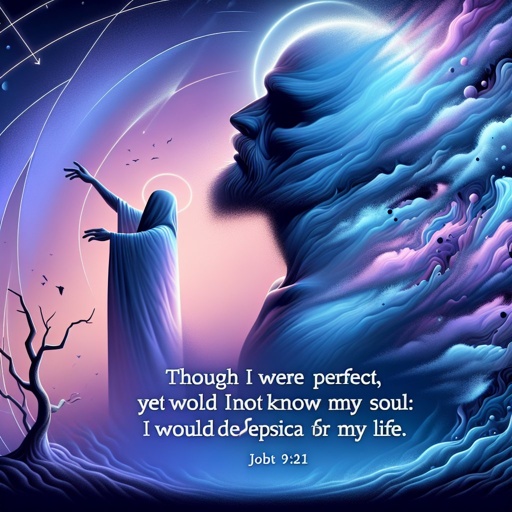
Job 9:21 - "Though I were perfect, yet would I not know my soul: I would despise my life."

"Though I were perfect, yet would I not know my soul: I would despise my life." - Job 9:21

Job 21:9 - "Their houses are safe from fear, neither is the rod of God upon them."

"Their houses are safe from fear, neither is the rod of God upon them." - Job 21:9

Job 21:1 - "But Job answered and said,"

Job 9:1 - "Then Job answered and said,"

"But Job answered and said," - Job 21:1

Job 1:21

Job 1:21

Job 3:20-21 - "Job 3:20-21: Why is light given to those in misery, and life to the bitter of soul, to those who long for death that does not come, who search for it more than for hidden treasure?"

"Then Job answered and said," - Job 9:1

Job 1:9 - "Then Satan answered the LORD, and said, Doth Job fear God for nought?"

Job 9:9 - "Which maketh Arcturus, Orion, and Pleiades, and the chambers of the south."

Job 21:21 - "For what pleasure hath he in his house after him, when the number of his months is cut off in the midst?"

Job 21:12 - "They take the timbrel and harp, and rejoice at the sound of the organ."

Job 21:8 - "Their seed is established in their sight with them, and their offspring before their eyes."

Job 21:2 - "Hear diligently my speech, and let this be your consolations."

Job 21:13 - "They spend their days in wealth, and in a moment go down to the grave."

Job 21:18 - "They are as stubble before the wind, and as chaff that the storm carrieth away."

Job 18:21 - "Surely such are the dwellings of the wicked, and this is the place of him that knoweth not God."

Job 1:9 no words

Job 21:24 - "His breasts are full of milk, and his bones are moistened with marrow."

Job 12:21 - "He poureth contempt upon princes, and weakeneth the strength of the mighty."

Job 1:9 no words

Matthew 9:21

Job 21:11 - "They send forth their little ones like a flock, and their children dance."

Job 21:10 - "Their bull gendereth, and faileth not; their cow calveth, and casteth not her calf."

Job 21:16 - "Lo, their good is not in their hand: the counsel of the wicked is far from me."

Job 40:21 - "He lieth under the shady trees, in the covert of the reed, and fens."

Job 21:25 - "And another dieth in the bitterness of his soul, and never eateth with pleasure."