The Unforeseen Majesty of the Cross
"¶ And Pilate wrote a title, and put it on the cross. And the writing was, JESUS OF NAZARETH THE KING OF THE JEWS." - John 19:19
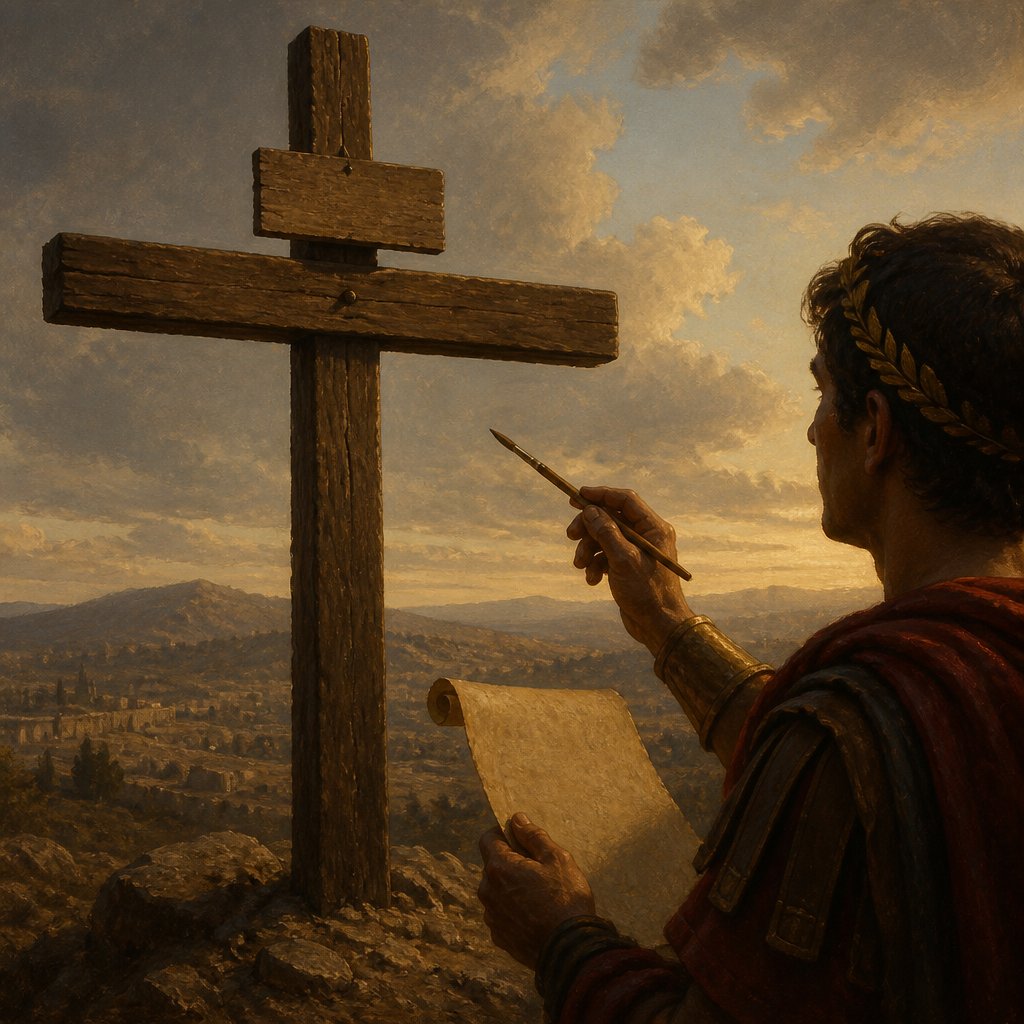
As we delve into the poignant scene at Golgotha, the place known as the skull, we encounter a moment steeped in paradox—where the cross, an emblem of shame and rupture, becomes the very throne of the King of Kings. John 19:19 presents us with a simple yet profound inscription: "And Pilate wrote a title, and put it on the cross. And the writing was, JESUS OF NAZARETH THE KING OF THE JEWS." In this statement, we find a rich tapestry of theological significance and human irony.
To begin with, we must acknowledge the backdrop of the crucifixion. Jesus, the Son of God, stood before Pilate, accused by the very people He came to save. Their rejection of Him reached a fever pitch, culminating in a demand for His execution. Pilate, caught in the political machinations of the day, was compelled to placate the crowd despite knowing Jesus was innocent. Yet in an act of spite or wisdom, depending on how one views this act, he ordered the title to be inscribed upon the cross. At face value, it might appear to be a simple labeling exercise, but it is brimming with deeper significance.
First, we consider the title itself: "Jesus of Nazareth the King of the Jews." To the casual observer, this was simply a mockery of Jesus' claim to kingship. The title was intended to embarrass and belittle Him, effectively saying to passersby, "Here hangs your Messiah, powerless and defeated." In this context, it serves as a stark reminder of humanity's tendencies to misjudge and mislabel. Often, it is in our wounds that we find others ready to declare us unworthy—yet, isn’t it perplexing and sobering to see who God declares us to be?
Look deeper still, and you realize that this title, meant for scorn, was divinely orchestrated to express a truth that transcends the moment. For in this public declaration, whether intended as truth or slander, God, in His sovereign power, validated Jesus' identity as King. Here, on the cross—a symbol of pain and humiliation—Jesus transforms it into a symbol of victory and authority. It is as if heaven was proclaiming, "This is indeed my King!" The inscription proclaims a rightful kingship, for though the world had condemned Him, the Father’s plan was unfolding perfectly through the very act of sacrificial love.
The irony of Pilate's title takes on multiple layers when we consider the audience it aimed to mock. The Jewish leaders, who so adamantly rejected Jesus, must have been enraged at Pilate's designation of Jesus as king. Yet their fury becomes a profound lesson; they sought a political king to deliver them from Roman oppression, not a spiritual Savior who would redeem their souls from sin. How often do we, like those leaders, craft our expectations of God, missing the true nature of His kingship? It is easy to clamour for a God who meets our immediate needs—one who is triumphant in a worldly sense—while failing to embrace the sacrificial King who reigns over a Kingdom not of this world.
This brings us to consider our own lives. As followers of Christ, we may bear our own crosses, often feeling the weight of ridicule, misunderstanding, or failure. Yet let us remember that the cross is not the end; it is the threshold to glorious resurrection. In Christ's apparent defeat, we behold the triumph of God’s love and the promise that our struggles do not diminish our dignity as children of the Most High.
As we meditate upon this verse, let's find hope in our identity in Christ—loved, valued, and declared worthy by the King who willingly bore our sins. John 19:19 reminds us that the cross, which may appear as a place of darkness, is, in fact, the site where the true nature of our Savior shines most brilliantly. Let us carry this truth in our hearts—"Jesus of Nazareth, the King of our hearts,” forever enthroned as our Savior and Lord.
Want to reflect more on John 19:19?
Continue your spiritual journey with Bible Chat — an AI-powered tool for exploring God's Word through conversation. Ask questions, discover connections, and deepen your understanding.
Get Our Apps


John 19:19 Artwork

John 19:19 - "¶ And Pilate wrote a title, and put it on the cross. And the writing was, JESUS OF NAZARETH THE KING OF THE JEWS."
"¶ And Pilate wrote a title, and put it on the cross. And the writing was, JESUS OF NAZARETH THE KING OF THE JEWS." - John 19:19

John 19:38

John 19:1

John 17.6-19

John 19:1-3

John 19:25-27

John 19:25-27

John 19:26-27

John 21:15-19

John 10:19 - "¶ There was a division therefore again among the Jews for these sayings."

John 1:19 - "¶ And this is the record of John, when the Jews sent priests and Levites from Jerusalem to ask him, Who art thou?"

John 19:1 - "Then Pilate therefore took Jesus, and scourged him."

John 19:25-27 with emphasis on Mary

John 19:3 - "And said, Hail, King of the Jews! and they smote him with their hands."

Isaiah 11:1-9

Numbers 7:1-9

Isaiah 11:1-9

Isiah 42 1-9

Joshua 1:9

Daniel 1:9

James 1:9

Jude 1:9

1 John 4:19 - "We love him, because he first loved us."

1 John 5:19 - "And we know that we are of God, and the whole world lieth in wickedness."

John 17:19 - "And for their sakes I sanctify myself, that they also might be sanctified through the truth."

John 19:22 - "Pilate answered, What I have written I have written."

John 18:19 - "¶ The high priest then asked Jesus of his disciples, and of his doctrine."

John 19:8 - "¶ When Pilate therefore heard that saying, he was the more afraid;"

John 19:36 - "For these things were done, that the scripture should be fulfilled, A bone of him shall not be broken."