Caught in the Act: Grace in Our Failures
“They say unto him, Master, this woman was taken in adultery, in the very act.” — John 8:4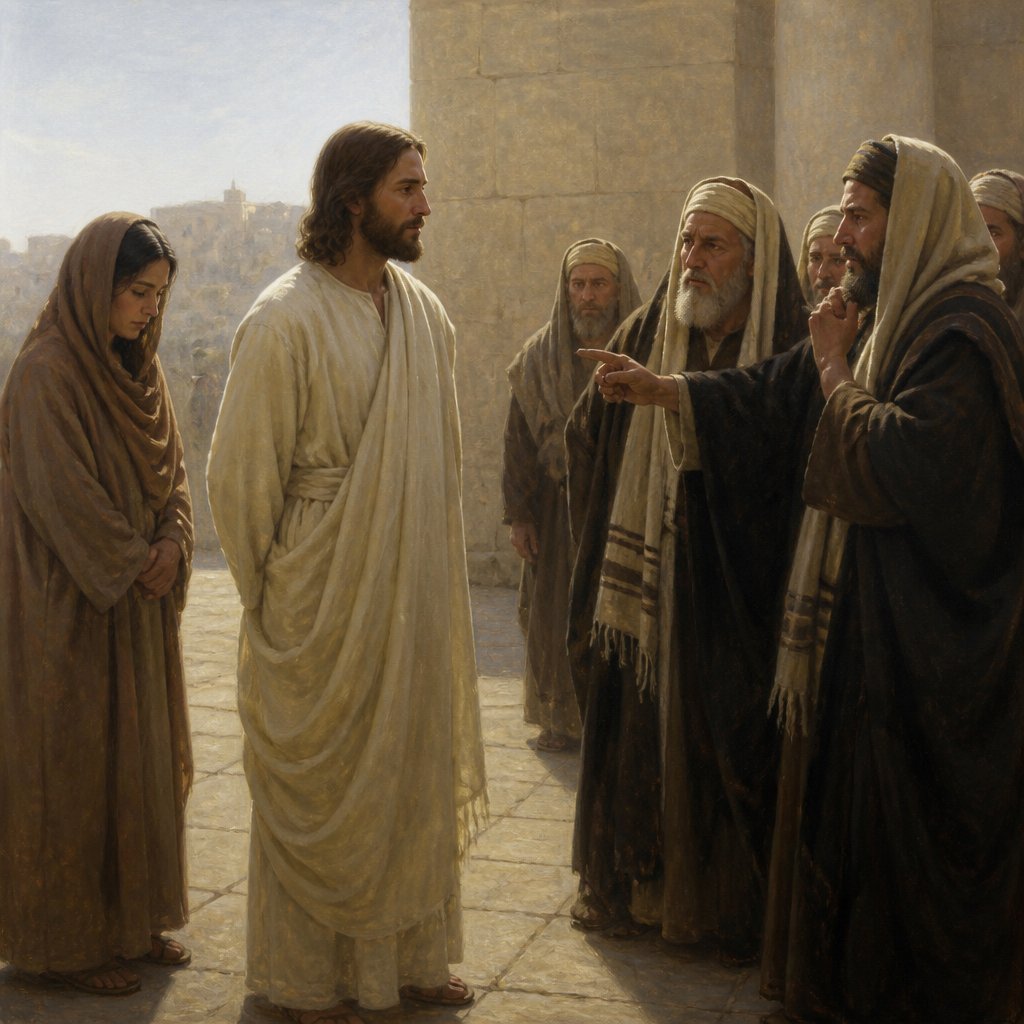
As we turn our attention to the events surrounding John 8:4, we encounter a tense moment that unfolds in the ministry of Jesus: "They say unto him, Master, this woman was taken in adultery, in the very act." This scripture invites us into a world where humanity’s frailty meets divine grace, and the condemnation of the law intersects with the mercy of God.
The context of this verse is critical to understanding its implications. The scribes and Pharisees, representing the legalistic view of the Law of Moses, bring before Jesus a woman seized in the act of adultery. They are not merely seeking justice; they aim to trap Jesus, to force Him to contradict the Law they so rigidly adhered to and defended. They remind Him of the stark reality of the Law, which dictated that such a woman should be stoned (Deuteronomy 22:22). Thus, in their minds, the situation was simple: she was guilty, and her punishment was clear.
In these few words, recorded in the King James Version, we witness the raw and painful reality of sin. The woman stands exposed, not only in a physical sense but in a moral and spiritual one. She is publicly declared guilty, an object of scorn and judgment. Here in this moment of desperation, we can all see a reflection of our own lives. We have all stumbled, been caught in our failures and shortcomings, perhaps even ‘in the very act’ of sin.
Jesus, however, responds in a way that flips the entire situation upside down. As we read on, we find that instead of reacting as the leaders assumed, He neither condones the sin nor aligns Himself with the legalistic expectations. He bends down and writes on the ground with His finger (John 8:6), intriguing us with His calmness amidst chaos. This gesture itself is a beautiful reminder that God notices our struggles, our failures, but He does not leave us in our shame.
What is significant here is that Jesus turns the table of judgment back onto the accusers. He famously states, "He that is without sin among you, let him first cast a stone at her" (John 8:7). His words cut through the pretense, revealing that all are guilty before God, whether they wish to acknowledge it or not. It is a powerful lesson in humility—a reminder that none of us can stand in condemnation without confronting our own sin.
This story exemplifies grace in a magnificent way. What follows is a moment of self-reflection for the crowd as one by one they depart, leaving the woman alone with her Savior. Jesus then asks her, "Woman, where are those thine accusers? hath no man condemned thee?" (John 8:10). Here, we witness not only the absence of judgment but also the great gift of compassion. His final words to her, "Neither do I condemn thee: go, and sin no more" (John 8:11), capture the essence of the gospel message.
In our own lives, we may find ourselves feeling crushed by our failures, feeling condemned by our shortcomings. However, the Word reminds us that there is no condemnation for those who are in Christ Jesus (Romans 8:1). In this passage, we are encouraged to reflect not merely on the act of sin but on the nature of our Savior. He embodies the love that confronts sin without rejection, meets us in our shame, and offers redemption.
Today, let us remember that we too have been given the same grace that was extended to the woman caught in adultery. We are called to respond to that grace with a life marked by transformation and the abandonment of our sinful habits. May we learn to approach others with the same compassion that we received, extending grace rather than judgment, knowing well that we too are in need of mercy every day.
Get our apps


Artwork for John 8:4

John 8:4-11

John 8:4 - "They say unto him, Master, this woman was taken in adultery, in the very act."
"They say unto him, Master, this woman was taken in adultery, in the very act." - John 8:4

Visualize a scene from biblical times inspired by John 8:4-12, A woman is resting on one arm as she sits to the side of Jesus. Jesus is depicted as a long-haired, bearded man in loose, ancient clothing, outdoors under a sunny sky. There is a tall beige block wall behind the men in the background. The woman's demeanor communicates shame, while Jesus expresses understanding and benevolence. Jesus is writing in the dirt. There is a group of angry men standing in front of the wall holding stones

Visualize a scene from biblical times inspired by John 8:4-12, A woman is resting on one arm as she sits to the side of Jesus. Jesus is depicted as a long-haired, bearded man in loose, ancient clothing, outdoors under a sunny sky with the Jewish temple in the background. The woman's demeanor communicates shame, while Jesus expresses understanding and benevolence. Jesus is writing in the dirt. There is a group of angry men in the background holding stones

1 John 4:8 - "He that loveth not knoweth not God; for God is love."

John 4:8 - "(For his disciples were gone away unto the city to buy meat.)"

"He that loveth not knoweth not God; for God is love." - 1 John 4:8
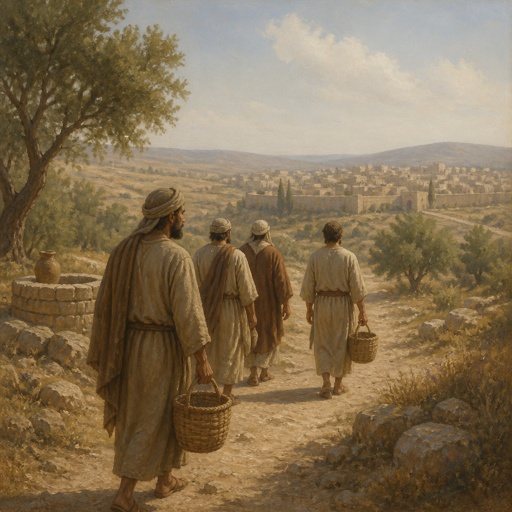
"(For his disciples were gone away unto the city to buy meat.)" - John 4:8

"Beloved, let us love one another, for love is from God, and whoever loves has been born of God and knows God. Anyone who does not love does not know God, because God is love." - 1 John 4:7-8

John 8

John 8

John 8:44

John 8:44

John 8:44

John 8:8 - "And again he stooped down, and wrote on the ground."

1 John 4:7-8 - "Beloved, let us love one another, for love is from God, and whoever loves has been born of God and knows God. Anyone who does not love does not know God, because God is love."

John 8:12

John 8:12

John 8:12

John 8:12

John 8:12

1 John 4:8-9 - "Whoever does not love does not know God, because God is love. This is how God showed his love among us: He sent his one and only Son into the world that we might live through him."

John 4:4 - "And he must needs go through Samaria."

John 3:5-8

John 6:8-9

John 15:1-8

John 3:5-8

John 4:16

John 3:4