A Cord of Faith: The Brave Act of Rahab
"Then she let them down by a cord through the window: for her house was upon the town wall, and she dwelt upon the wall." - Joshua 2:15
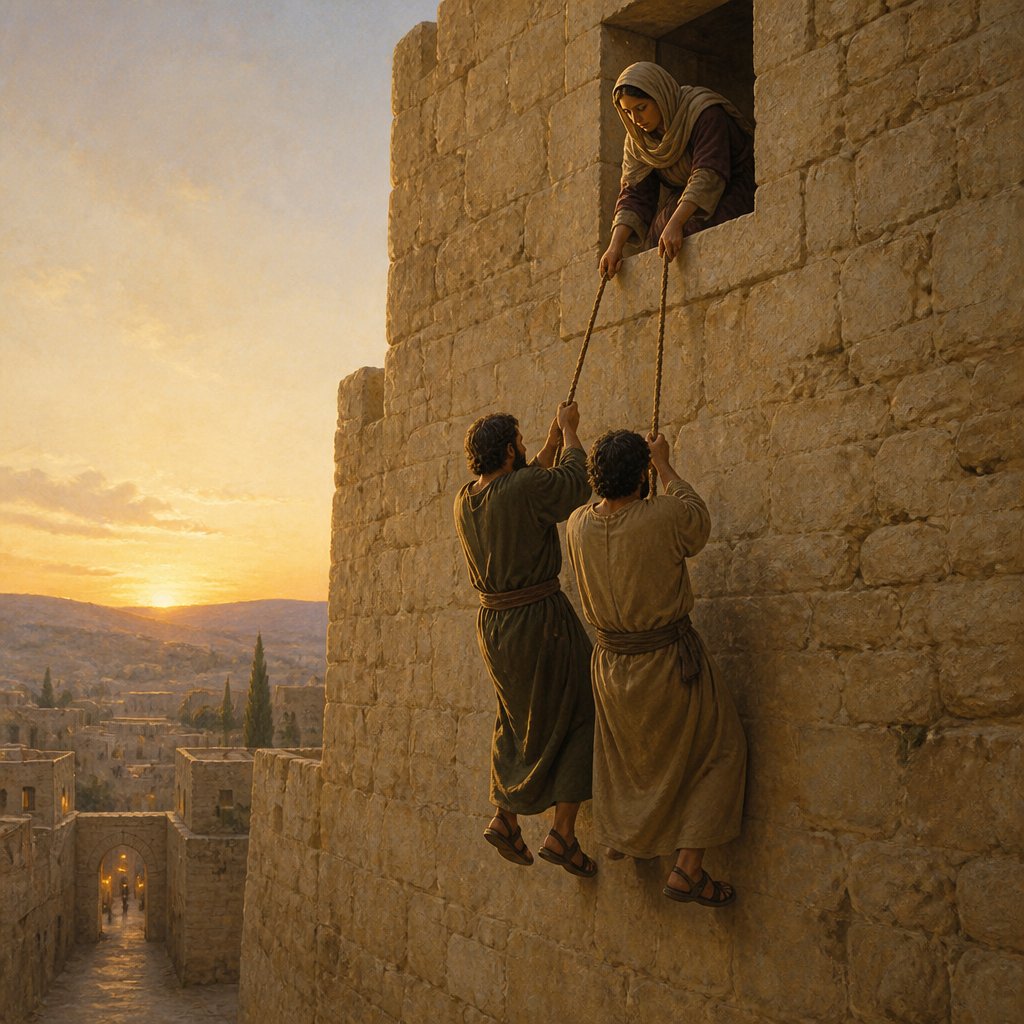
As we delve into the heart of Rahab's story in Joshua 2:15, we encounter an incredible narrative that intertwines courage, faith, and divine providence: "Then she let them down by a cord through the window: for her house was upon the town wall, and she dwelt upon the wall." This single verse encapsulates not only the historical context of the Israelites entering the Promised Land but also serves as a striking metaphor for our own journeys of faith.
Rahab, a woman considered an outsider in the Hebrew story—identified as a harlot, an unlikely heroine—crafted a narrative of redemption that resonates through the ages. Her position, quite literally at the edge of Jericho's walls, positioned her uniquely to witness the impending doom of her city and the imminent arrival of God’s people. This precarious perch echoing our own lives, often caught between faith and fear, allows us to explore a vital truth: that God's grace can shine brightly through the most unconventional vessels.
As Rahab lowers the Israelite spies by a cord from her window, we are reminded of several layers of meaning. First, the cord symbolizes faith, a tangible representation of her belief in the God of Israel and His promises. Despite her societal standing, she recognized the truth outlined in the stories of the Israelites—their God was not just any deity, but the Almighty One who had parted the Red Sea and delivered them from bondage in Egypt. Rahab took a leap of faith, acting on her belief without certainty of the outcome. How often do we find ourselves at the edge of our own walls, needing to make a critical decision? Like Rahab, we must be willing to trust God’s promise, even when the path ahead seems obscured.
Another profound aspect of this scripture is the window. Windows are portals; they offer a viewpoint to see the world outside while providing a sense of vulnerability. For Rahab, this window marked her willingness to cross over from her past to a new horizon—a bold declaration of allegiance to the Israelites and their God. It is through this window that she plays a pivotal role in Israel's conquest, altering her destiny and that of her family. In our lives, windows symbolize the gaps between where we currently are and where God is calling us to be. What is the ‘window’ that is presently open in your life, inviting you to embrace faith and step out of your comfort zone?
Moreover, let us not overlook the significance of the rope or cord. It serves as a lifeline not only for Rahab but also for the spies. They too are in a dangerous situation, reliant on her bravery and discretion. In our spiritual journeys, we often serve as cords for others, acting as conduits of faith, encouragement, and support. Are we willing to support those around us by being their lifeline, stepping out and living out faith in our communities?
Finally, the fact that Rahab's house was on the wall is critical. The walls, strong and fortified, ultimately would crash when God's will was executed. However, her house, identified by its window—a place of vulnerability—stood firm due to her faith. God’s protection was promised to Rahab and her family if they remained within that household when judgment came. It is a reminder that our faith can hold us up against the tumultuous tides of life, and it is in the refuge of His promises that we find shelter.
In conclusion, Rahab’s act of courage teaches us to let down our own cords of faith. Each day brings with it situations where we can either cling to fear or release ourselves into the arms of God, trusting Him to hold us. Let us have the courage of Rahab to act in faith, be a lifeline for others, and find our safety in surrender.
May we walk forward, emboldened by the legacy of Rahab and the many ways God can use us, as we live out our faith in a world that desperately needs its light.
Want to reflect more on Joshua 2:15?
Continue your spiritual journey with Bible Chat — an AI-powered tool for exploring God's Word through conversation. Ask questions, discover connections, and deepen your understanding.
Get Our Apps


Joshua 2:15 Artwork

Joshua 2:15 - "Then she let them down by a cord through the window: for her house was upon the town wall, and she dwelt upon the wall."

Joshua 2:15 (KJVA) 15 Then she let them down by a cord through the window: for her house was upon the town wall, and she dwelt upon the wall.

Joshua 2:15 (KJVA) 15 Then she let them down by a cord through the window: for her house was upon the town wall, and she dwelt upon the wall.

Create a photorealistic picture of a window in an ancient wall with a scarlet cord hangin out of the window and an old testament man descending down that cord. This is based on Joshua 2:15
"Then she let them down by a cord through the window: for her house was upon the town wall, and she dwelt upon the wall." - Joshua 2:15

Joshua 15:2 - "And their south border was from the shore of the salt sea, from the bay that looketh southward:"

Joshua 4:15 - "And the LORD spake unto Joshua, saying,"

Joshua 10:15 - "¶ And Joshua returned, and all Israel with him, unto the camp to Gilgal."

Joshua 24:15

Joshua 8:15 - "And Joshua and all Israel made as if they were beaten before them, and fled by the way of the wilderness."

Joshua 24:15

Joshua 24:15

"And the LORD spake unto Joshua, saying," - Joshua 4:15

Joshua 15:29 - "Baalah, and Iim, and Azem,"

Joshua 15:42 - "Libnah, and Ether, and Ashan,"

Joshua 15:50 - "And Anab, and Eshtemoh, and Anim,"

Joshua 15:30 - "And Eltolad, and Chesil, and Hormah,"

Joshua 15:40 - "And Cabbon, and Lahmam, and Kithlish,"

Joshua 15:23 - "And Kedesh, and Hazor, and Ithnan,"

Joshua 15:22 - "And Kinah, and Dimonah, and Adadah,"

Joshua 11:15 - "¶ As the LORD commanded Moses his servant, so did Moses command Joshua, and so did Joshua; he left nothing undone of all that the LORD commanded Moses."

Joshua 5:15 - "And the captain of the LORD'S host said unto Joshua, Loose thy shoe from off thy foot; for the place whereon thou standest is holy. And Joshua did so."

Joshua 15:39 - "Lachish, and Bozkath, and Eglon,"

Joshua 15:31 - "And Ziklag, and Madmannah, and Sansannah,"

Joshua 15:43 - "And Jiphtah, and Ashnah, and Nezib,"

Joshua 15:26 - "Amam, and Shema, and Moladah,"

Joshua 15:38 - "And Dilean, and Mizpeh, and Joktheel,"

Joshua 15:24 - "Ziph, and Telem, and Bealoth,"

Joshua 15:56 - "And Jezreel, and Jokdeam, and Zanoah,"

Joshua 15:52 - "Arab, and Dumah, and Eshean,"