Courage in Secrecy: Lessons from Rahab's Faith
“And the woman took the two men, and hid them, and said thus, There came men unto me, but I wist not whence they were:” — Joshua 2:4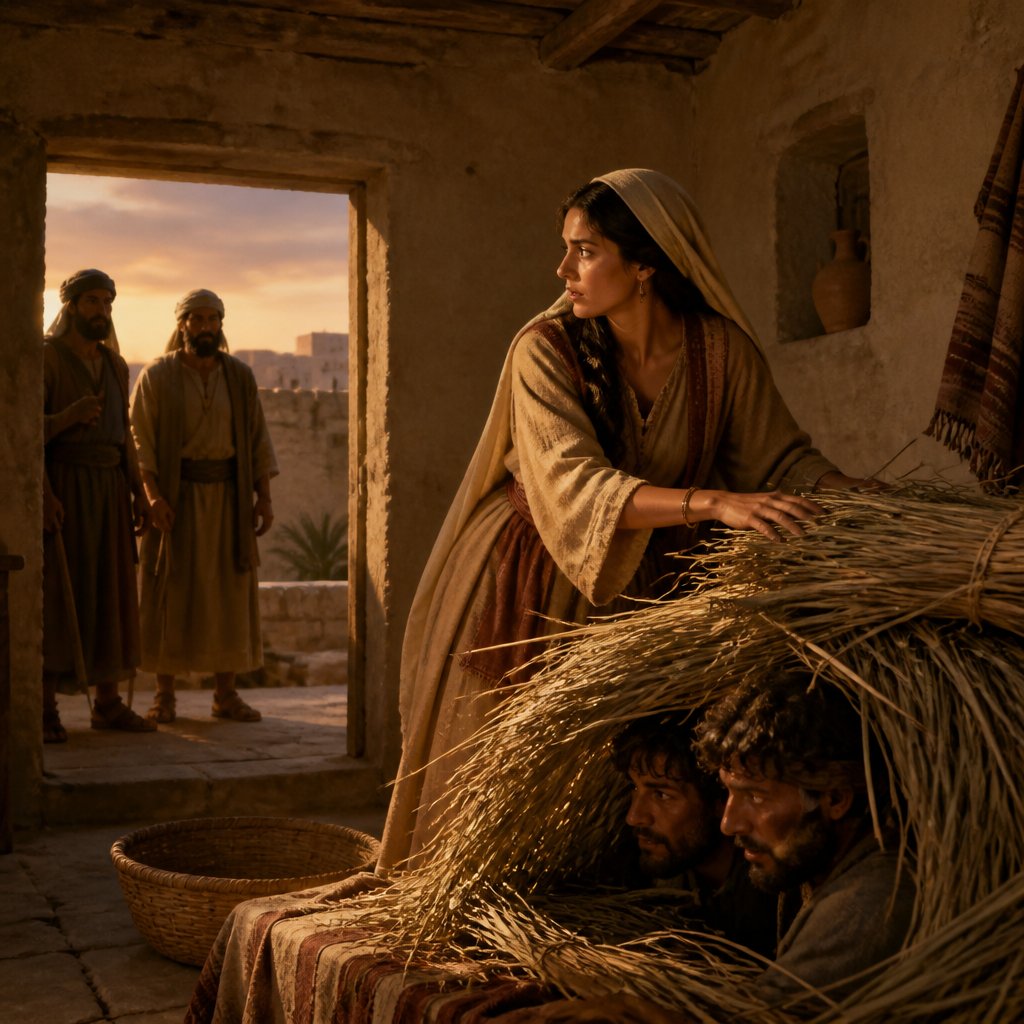
In Joshua 2:4, we find the remarkable story of Rahab, a woman who played a pivotal role in the conquest of Jericho and the larger narrative of Israel's journey into the Promised Land. The verse reads, "And the woman took the two men, and hid them, and said thus, There came men unto me, but I wist not whence they were." This simple statement conceals a profound depth of faith, courage, and the complexity of choosing sides when the stakes are incredibly high.
Rahab was a woman who lived in Jericho, a city that stood as a fortress against the advancing Israelites. By all appearances, her life was marked by sin and societal contempt, as she was identified as a harlot. Yet, it is within this backdrop of shame and isolation that Rahab's choices reveal a heart that understands the truth of God, a truth that perhaps even the Israelites had struggled to embody.
At that moment in history, the Israelite spies were in peril, sent on a mission to gather intelligence about Jericho just before God’s triumphant entry into the land He promised to His people. Rahab’s actions challenge us to consider our own responses to God’s presence in difficult situations. When confronted with the danger of the two spies being discovered, Rahab makes an astounding choice. She does not merely protect them; she actively deceives her own people, employing bravery that many might shy away from. Her affirmation, "but I wist not whence they were," reflects both her cunning and the deepest truth—she chose to side with the God she recognized as mighty and sovereign.
Rahab’s faith is underscored by her secrecy, which begs an important question for us today: How often do we hide our faith in God when we find ourselves in environments hostile to our beliefs? Rahab's act of hiding the spies symbolizes the necessity of protection—both for those we believe in and for the faith that is sometimes under siege. It speaks to the understanding that faith is not always about making loud proclamations but may often involve quiet, courageous actions that might put us at risk.
Moreover, we recognize that Rahab's story is deeply intertwined with the grace of God. Despite her past and societal judgments about her, God chose to work through her, proving that His plans are not hindered by human perceptions of worthiness. In the New Testament, Rahab is remembered not for her actions as a harlot but as a part of the lineage of Jesus Christ (Matthew 1:5) and as a model of faith (Hebrews 11:31; James 2:25). This demonstrates that God redeems our stories, and when we align ourselves with His will, regardless of our past, He can use us for His glory.
As we reflect upon Rahab's example, we are encouraged to consider the risks and rewards associated with our faith. Are there situations in our own lives where God is calling us to take a stand—perhaps to hide our faith in quiet defiance of worldly pressures and norms? Just as Rahab's act of concealment led to the preservation of her family and her inclusion in the community of believers, there is great reward in safeguarding the truth amidst adversity.
In conclusion, let us remember Rahab's courage in hiding the spies. Her actions illustrate a profound lesson about the nature of faith: it often calls us to secrecy, safety, and courage when we feel the weight of threat from our surroundings. May we find strength in our convictions and seek to align ourselves with God's purposes, knowing that He can use us in powerful ways, regardless of our past or the judgments of others. Let us not forget, like Rahab, that such courage matters, and it has the potential to change the course of history.
Get our apps


Artwork for Joshua 2:4

Joshua 2:4 - "And the woman took the two men, and hid them, and said thus, There came men unto me, but I wist not whence they were:"
"And the woman took the two men, and hid them, and said thus, There came men unto me, but I wist not whence they were:" - Joshua 2:4

Joshua 4:2 - "Take you twelve men out of the people, out of every tribe a man,"

Joshua 4:15 - "And the LORD spake unto Joshua, saying,"

Joshua 4:4 - "Then Joshua called the twelve men, whom he had prepared of the children of Israel, out of every tribe a man:"

Joshua 4:17 - "Joshua therefore commanded the priests, saying, Come ye up out of Jordan."

Joshua 4:20 - "And those twelve stones, which they took out of Jordan, did Joshua pitch in Gilgal."

Joshua 3:4

Joshua 3:4

"And the LORD spake unto Joshua, saying," - Joshua 4:15
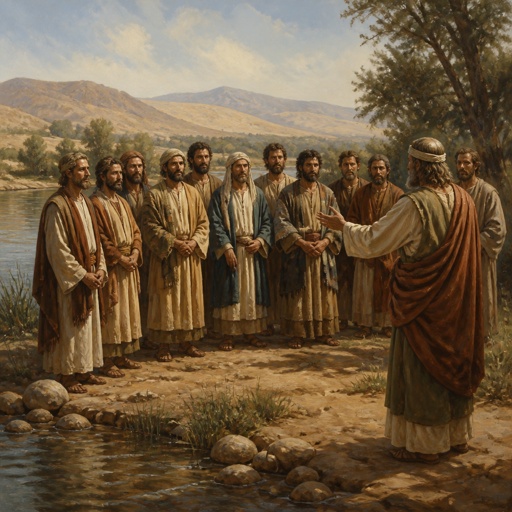
"Take you twelve men out of the people, out of every tribe a man," - Joshua 4:2

Joshua 19:4 - "And Eltolad, and Bethul, and Hormah,"

Joshua 4:1-8

Joshua 4:1 - "And it came to pass, when all the people were clean passed over Jordan, that the LORD spake unto Joshua, saying,"

Joshua 4:14 - "¶ On that day the LORD magnified Joshua in the sight of all Israel; and they feared him, as they feared Moses, all the days of his life."

Joshua 4:1-8

Joshua 10:4 - "Come up unto me, and help me, that we may smite Gibeon: for it hath made peace with Joshua and with the children of Israel."

Joshua 4:10 - "¶ For the priests which bare the ark stood in the midst of Jordan, until every thing was finished that the LORD commanded Joshua to speak unto the people, according to all that Moses commanded Joshua: and the people hasted and passed over."

Joshua 9:2 - "That they gathered themselves together, to fight with Joshua and with Israel, with one accord."

Joshua 4:9 - "And Joshua set up twelve stones in the midst of Jordan, in the place where the feet of the priests which bare the ark of the covenant stood: and they are there unto this day."

"Then Joshua called the twelve men, whom he had prepared of the children of Israel, out of every tribe a man:" - Joshua 4:4

Haggai 2:4 - "Yet now be strong, O Zerubbabel, saith the LORD; and be strong, O Joshua, son of Josedech, the high priest; and be strong, all ye people of the land, saith the LORD, and work: for I am with you, saith the LORD of hosts:"

Joshua 4:8 - "And the children of Israel did so as Joshua commanded, and took up twelve stones out of the midst of Jordan, as the LORD spake unto Joshua, according to the number of the tribes of the children of Israel, and carried them over with them unto the place where they lodged, and laid them down there."

Joshua 16:4 - "So the children of Joseph, Manasseh and Ephraim, took their inheritance."

"And Eltolad, and Bethul, and Hormah," - Joshua 19:4

Joshua 2:9

"Joshua therefore commanded the priests, saying, Come ye up out of Jordan." - Joshua 4:17

Joshua 5:4 - "And this is the cause why Joshua did circumcise: All the people that came out of Egypt, that were males, even all the men of war, died in the wilderness by the way, after they came out of Egypt."

Joshua 4:16 - "Command the priests that bear the ark of the testimony, that they come up out of Jordan."

Joshua 5:2 - "¶ At that time the LORD said unto Joshua, Make thee sharp knives, and circumcise again the children of Israel the second time."