The Weight of Sacrifice: Understanding Aaron's Dilemma
"And Aaron said unto Moses, Behold, this day have they offered their sin offering and their burnt offering before the LORD; and such things have befallen me: and if I had eaten the sin offering to day, should it have been accepted in the sight of the LORD?" - Leviticus 10:19
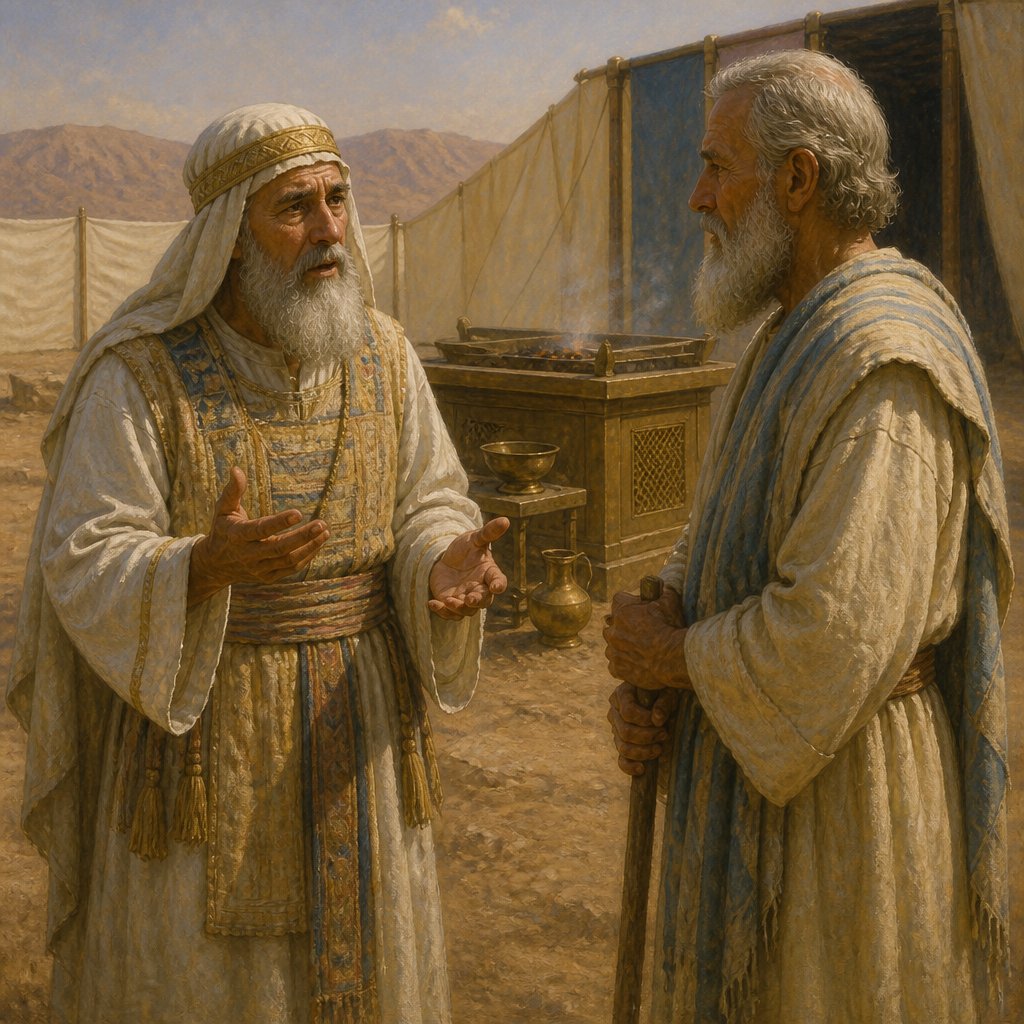
Leviticus 10:19 states, "And Aaron said unto Moses, Behold, this day have they offered their sin offering and their burnt offering before the LORD; and such things have befallen me: and if I had eaten the sin offering today, should it have been accepted in the sight of the LORD?" This verse rests in the aftermath of a devastating moment in Aaron’s life—just days following the death of his sons, Nadab and Abihu, who had perished as they offered strange fire before the Lord. In the weight of loss and duty, we hear the tremor of Aaron’s voice as he conveys a profound theological dilemma: the nature of sacrifice, holiness, and acceptance in the eyes of God.
Aaron’s initial reaction encapsulates the heart of human struggle in relation to divine standards. As the high priest, Aaron was tasked with performing rituals that were not merely forms of worship but profound representations of atonement and reconciliation between the Israelites and a holy God. He had witnessed firsthand the consequences of dishonoring God’s commandments, and now he is engulfed in grief while fulfilling his duties. The tension is palpable—how can he partake in the sin offering after experiencing profound personal loss?
When Aaron states, "should it have been accepted in the sight of the LORD?", he questions the very idea of worthiness and appropriateness in worship. This moment brings to light the complexities of our relationship with God, particularly in moments of trial or suffering. How often do we feel unworthy or unfit to approach God when our hearts are heavy or our lives are overshadowed by circumstances beyond our control? Aaron's hesitance illustrates a deep understanding of reverence to the sacrificial system's significance, yet it also connects with our innate need for grace amidst sorrow.
Furthermore, the conversation between Aaron and Moses reveals an important biblical truth: God is concerned not just with the act of sacrifice but with the condition of the heart offering that sacrifice. Aaron, whose role demanded the utmost holiness and a clear conscience, grappled with his emotional state. Would his grief taint the sanctity of the sacrifice? Would God see his actions through the lens of his sorrow? At this intersection, we see a reflection of how worship necessitates authenticity; God yearns for a heart aligned with His will, especially when rendered in deep despair.
From this narrative, we gain insight into our own sacrificial moments. We may offer prayers, praise, or service to God during times of grief and struggle, and we may wonder if these offerings are truly sincere or acceptable. The answer lies not in perfection, but in the honesty of our hearts. God does not expect our worship to be without the reality of our struggles; rather, He invites us to come as we are—broken, weary, or grieving. It is not the presentation but the posture that counts.
This brings us to the crux of our understanding as we contemplate Aaron’s role. His struggle is a reminder that our sacrifices must be rooted in truthfulness—acknowledging our circumstances while still believing in God’s goodness and grace. In the New Testament, we are assured that we can approach the throne of grace boldly, fully aware of our imperfections (Hebrews 4:16).
As we navigate through life's sacred events, let us reflect on our own offerings before God. Are we coming forth in authentic worship? Are we addressing our pain and loss while seeking to honor Him? Like Aaron, we are called to present our lives as a living sacrifice, holy and acceptable (Romans 12:1), but that journey is most profound when it is deeply interwoven with truth, honesty, and the acceptance of a holy God who meets us where we are.
Want to reflect more on Leviticus 10:19?
Continue your spiritual journey with Bible Chat — an AI-powered tool for exploring God's Word through conversation. Ask questions, discover connections, and deepen your understanding.
Get Our Apps


Leviticus 10:19 Artwork

Leviticus 10:19 - "And Aaron said unto Moses, Behold, this day have they offered their sin offering and their burnt offering before the LORD; and such things have befallen me: and if I had eaten the sin offering to day, should it have been accepted in the sight of the LORD?"
"And Aaron said unto Moses, Behold, this day have they offered their sin offering and their burnt offering before the LORD; and such things have befallen me: and if I had eaten the sin offering to day, should it have been accepted in the sight of the LORD?" - Leviticus 10:19

Leviticus 19:10 - "And thou shalt not glean thy vineyard, neither shalt thou gather every grape of thy vineyard; thou shalt leave them for the poor and stranger: I am the LORD your God."

Leviticus 21:19 - "Or a man that is brokenfooted, or brokenhanded,"

Leviticus 6:19 - "¶ And the LORD spake unto Moses, saying,"

Leviticus 19:1 - "And the LORD spake unto Moses, saying,"

Leviticus 10:10 - "And that ye may put difference between holy and unholy, and between unclean and clean;"

Leviticus 11:19 - "And the stork, the heron after her kind, and the lapwing, and the bat."

Leviticus 19:7 - "And if it be eaten at all on the third day, it is abominable; it shall not be accepted."

leviticus 16:7-10

"Or a man that is brokenfooted, or brokenhanded," - Leviticus 21:19

Leviticus 5:19 - "It is a trespass offering: he hath certainly trespassed against the LORD."

Leviticus 19:35 - "¶ Ye shall do no unrighteousness in judgment, in meteyard, in weight, or in measure."

Leviticus 10:20 - "And when Moses heard that, he was content."
Leviticus 10:8 - "¶ And the LORD spake unto Aaron, saying,"

Leviticus 8:19 - "And he killed it; and Moses sprinkled the blood upon the altar round about."

Leviticus 19:33 - "¶ And if a stranger sojourn with thee in your land, ye shall not vex him."

Leviticus 19:11 - "¶ Ye shall not steal, neither deal falsely, neither lie one to another."

Leviticus 19:24 - "But in the fourth year all the fruit thereof shall be holy to praise the LORD withal."

Leviticus 13:19 - "And in the place of the boil there be a white rising, or a bright spot, white, and somewhat reddish, and it be shewed to the priest;"

Leviticus 22:19 - "Ye shall offer at your own will a male without blemish, of the beeves, of the sheep, or of the goats."

Leviticus 9:19 - "And the fat of the bullock and of the ram, the rump, and that which covereth the inwards, and the kidneys, and the caul above the liver:"

Leviticus 4:19 - "And he shall take all his fat from him, and burn it upon the altar."

Leviticus 19:30 - "¶ Ye shall keep my sabbaths, and reverence my sanctuary: I am the LORD."

Leviticus 19:5 - "¶ And if ye offer a sacrifice of peace offerings unto the LORD, ye shall offer it at your own will."

Leviticus 24:19 - "And if a man cause a blemish in his neighbour; as he hath done, so shall it be done to him;"

"And the LORD spake unto Moses, saying," - Leviticus 19:1

"¶ And the LORD spake unto Moses, saying," - Leviticus 6:19

Luke 10:18-19

Luke 10:18-19