The Flavor of Faith: Understanding the Covenant of Salt
"And every oblation of thy meat offering shalt thou season with salt; neither shalt thou suffer the salt of the covenant of thy God to be lacking from thy meat offering: with all thine offerings thou shalt offer salt." - Leviticus 2:13
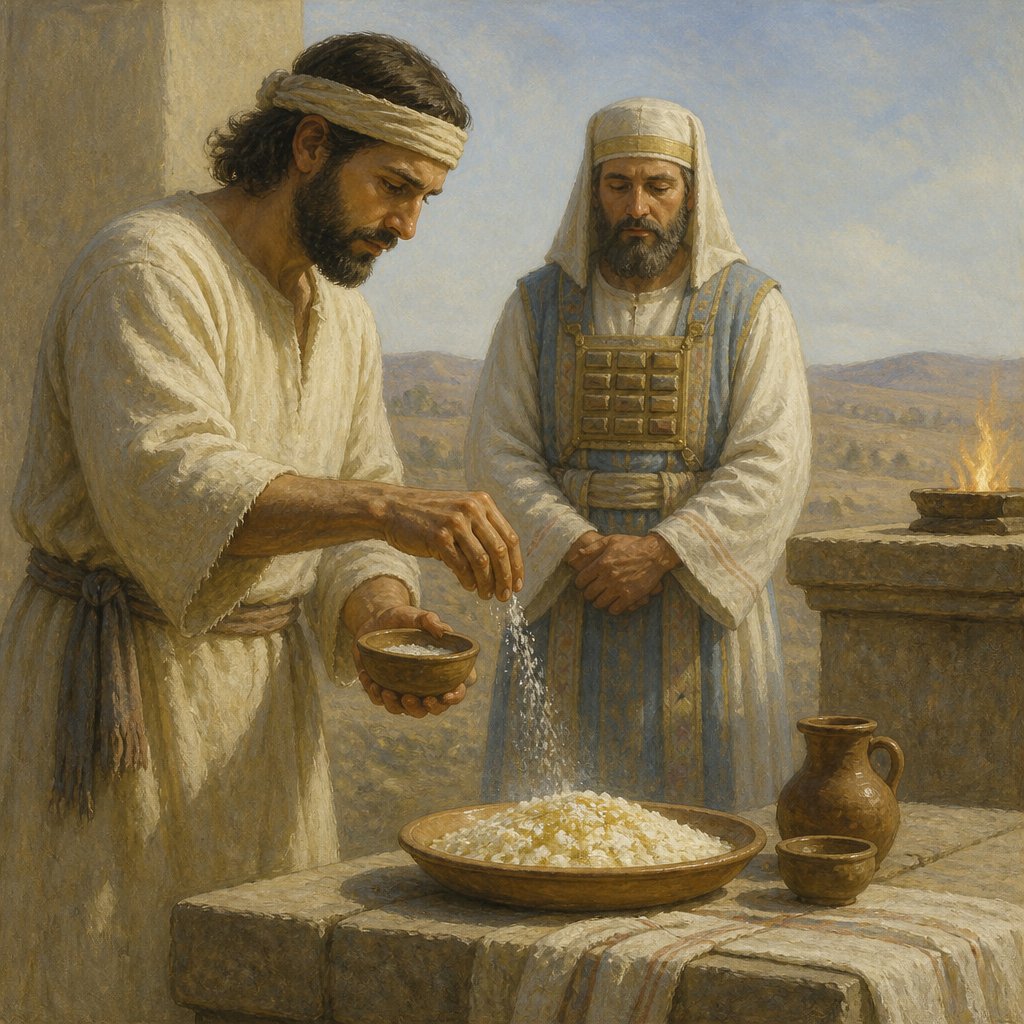
In Leviticus 2:13, we encounter an intriguing command from God regarding the meat offerings of the Israelites: "And every oblation of thy meat offering shalt thou season with salt; neither shalt thou suffer the salt of the covenant of thy God to be lacking from thy meat offering: with all thine offerings thou shalt offer salt" (KJV). This passage, while seemingly specific to the Old Testament sacrificial system, carries profound implications for our present-day walk with the Lord.
The instruction to season meat offerings with salt can be viewed through several lenses: symbolism, covenant, and sacrifice. Understanding these layers helps us appreciate how God desires to interact with His people.
**Symbol of Purity and Preservation**
In ancient cultures, salt was not only a seasoning but also a preservative. It prevented decay and spoilage, qualities that are reflective of the righteousness of God. By requiring salt in offerings, God was reminding His people that their sacrifices needed to be pure and without blemish, imbuing them with an element of holiness. Salt symbolizes the purity that is expected in our worship and devotion.
When we bring our offerings—whether they be offerings of praise, time, or resources—are we doing so in a manner that is seasoned with 'salt'? Our offerings should be reflective of a pure heart, free from selfish motives and sin. Jesus once said that His followers are the salt of the earth (Matthew 5:13), indicating that we are called to preserve and flavor the world around us. Our spiritual offerings should carry the same flavor.
**The Covenant of Salt**
God mentions here a 'covenant of salt', which has both historical and theological significance. In the ancient world, salt was often used in covenants, signifying loyalty, endurance, and faithfulness. A covenant of salt illustrates an everlasting bond. This idea extends to our relationship with God; just as salt does not lose its properties, so too does God's faithfulness endure.
When we consider our own relationship with the Lord, we must ask ourselves if we are honoring this covenant. Are we bringing our whole selves, seasoned with our commitment to God, to our worship? In what ways can we deepen our relationship with Him, ensuring that our lives reflect His unchanging love? The flavor of our worship should reflect the salt of His covenant—transformation, loyalty, and faithfulness.
**Living Sacrifices**
In Romans 12:1, we are instructed to present our bodies as living sacrifices, holy and acceptable to God. This presents an intriguing parallel to the Levitical instructions. Just as the offerings were enhanced by the addition of salt, our lives are to be seasoned with the grace and holiness of God.
What does it mean for us to live as a 'living sacrifice'? It means embracing a lifestyle of worship that permeates all areas of our lives. It requires us to season our actions with the holiness of God and reflect His character in our daily decisions. When we are aligned with His righteousness and grace, our lives can be a testimony of His goodness to those around us, bringing glory to His name.
**Conclusion**
In a world that often seeks to diminish the importance of sacrificial living, the command from Leviticus serves as a clarion call to return to a place of reverence and purity in our worship. Every oblation we bring should be seasoned with salt—the salt of His covenant which signifies faithfulness, purity, and enduring love. May our lives be an offering pleasing to God, enriched by the salt that He has commanded us to include. As we approach our Creator with our offerings, let us ensure that they are seasoned with care, reflecting our heartfelt commitment to His covenant.
Want to reflect more on Leviticus 2:13?
Continue your spiritual journey with Bible Chat — an AI-powered tool for exploring God's Word through conversation. Ask questions, discover connections, and deepen your understanding.
Get Our Apps


Leviticus 2:13 Artwork

Leviticus 2:13 - "And every oblation of thy meat offering shalt thou season with salt; neither shalt thou suffer the salt of the covenant of thy God to be lacking from thy meat offering: with all thine offerings thou shalt offer salt."
"And every oblation of thy meat offering shalt thou season with salt; neither shalt thou suffer the salt of the covenant of thy God to be lacking from thy meat offering: with all thine offerings thou shalt offer salt." - Leviticus 2:13

Leviticus 24:13 - "And the LORD spake unto Moses, saying,"

Leviticus 21:13 - "And he shall take a wife in her virginity."

Leviticus 13:1 - "And the LORD spake unto Moses and Aaron, saying,"

Leviticus 13:35 - "But if the scall spread much in the skin after his cleansing;"

Leviticus 13:2 - "When a man shall have in the skin of his flesh a rising, a scab, or bright spot, and it be in the skin of his flesh like the plague of leprosy; then he shall be brought unto Aaron the priest, or unto one of his sons the priests:"

Leviticus 13:29 - "¶ If a man or woman have a plague upon the head or the beard;"

Leviticus 13:18 - "¶ The flesh also, in which, even in the skin thereof, was a boil, and is healed,"

Leviticus 13:14 - "But when raw flesh appeareth in him, he shall be unclean."

Leviticus 13:47 - "¶ The garment also that the plague of leprosy is in, whether it be a woollen garment, or a linen garment;"

Leviticus 13:9 - "¶ When the plague of leprosy is in a man, then he shall be brought unto the priest;"

Leviticus 13:22 - "And if it spread much abroad in the skin, then the priest shall pronounce him unclean: it is a plague."

Leviticus 25:13 - "In the year of this jubile ye shall return every man unto his possession."

Leviticus 6:13 - "The fire shall ever be burning upon the altar; it shall never go out."

Leviticus 13:19 - "And in the place of the boil there be a white rising, or a bright spot, white, and somewhat reddish, and it be shewed to the priest;"

Leviticus 13:48 - "Whether it be in the warp, or woof; of linen, or of woollen; whether in a skin, or in any thing made of skin;"

Leviticus 13:50 - "And the priest shall look upon the plague, and shut up it that hath the plague seven days:"

Leviticus 13:13 - "Then the priest shall consider: and, behold, if the leprosy have covered all his flesh, he shall pronounce him clean that hath the plague: it is all turned white: he is clean."

Leviticus 27:13 - "But if he will at all redeem it, then he shall add a fifth part thereof unto thy estimation."

Leviticus 13:38 - "¶ If a man also or a woman have in the skin of their flesh bright spots, even white bright spots;"

Leviticus 13:16 - "Or if the raw flesh turn again, and be changed unto white, he shall come unto the priest;"

Leviticus 13:40 - "And the man whose hair is fallen off his head, he is bald; yet is he clean."

Leviticus 13:15 - "And the priest shall see the raw flesh, and pronounce him to be unclean: for the raw flesh is unclean: it is a leprosy."

Leviticus 18:13 - "Thou shalt not uncover the nakedness of thy mother's sister: for she is thy mother's near kinswoman."

Leviticus 13:8 - "And if the priest see that, behold, the scab spreadeth in the skin, then the priest shall pronounce him unclean: it is a leprosy."

"And the LORD spake unto Moses, saying," - Leviticus 24:13

Leviticus 13:23 - "But if the bright spot stay in his place, and spread not, it is a burning boil; and the priest shall pronounce him clean."

Leviticus 11:13 - "¶ And these are they which ye shall have in abomination among the fowls; they shall not be eaten, they are an abomination: the eagle, and the ossifrage, and the ospray,"

Leviticus 13:53 - "And if the priest shall look, and, behold, the plague be not spread in the garment, either in the warp, or in the woof, or in any thing of skin;"