The Aroma of Consecration: Understanding Leviticus 8:27
“And he put all upon Aaron’s hands, and upon his sons’ hands, and waved them for a wave offering before the LORD.” — Leviticus 8:27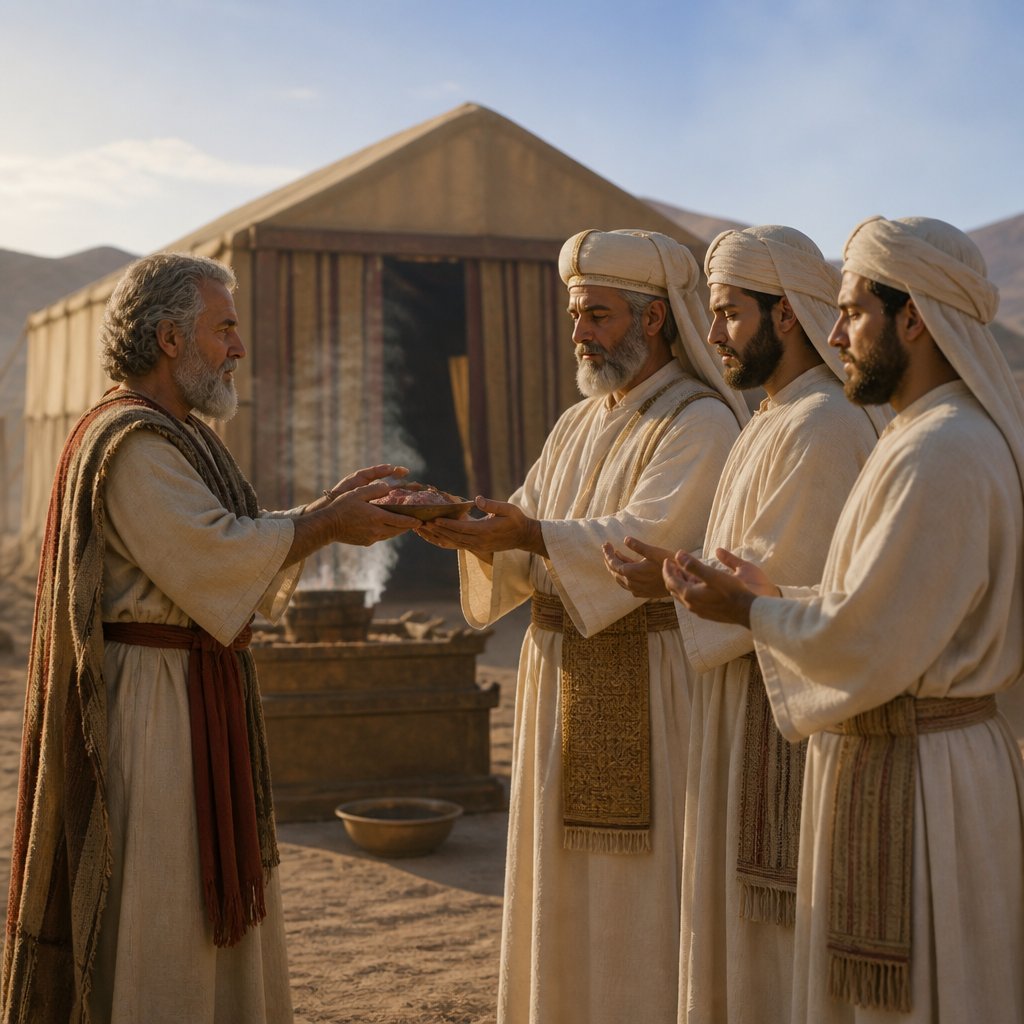
In Leviticus 8:27, we read, "And he put all upon Aaron's hands, and upon his sons' hands, and waved them for a wave offering before the LORD." This single verse encapsulates a profound act of consecration that speaks to the essence of divine dedication and the significance of service unto God.
To fully appreciate this moment, we must consider the context in which it occurs. The book of Leviticus is largely focused on the laws and rituals surrounding the worship of God among His people. The specific event in chapter 8 marks the ordination of Aaron and his sons as priests, distinct from the rest of the Israelites. They were set apart for a holy purpose, appointed to mediate between God and humanity, ensuring that the sacrificial system operated as intended.
When we delve deeper into the act of waving the offerings, we discover layers of meaning and symbolism. Waving was not merely an act of religious ritual; it symbolized acknowledgment and surrender. In this context, the offerings placed in the hands of Aaron and his sons represented the community's devotion, sin, and gratitude towards God. By waving them, they were not only making a physical motion but also communicating an attitude of reverence and submission to the God they served.
This act of waving the offering is a vivid reminder that worship must encompass our entire being—heart, mind, and body. Just as Aaron and his sons were to physically participate in this ritual, we too are called to engage in our worship holistically. In Romans 12:1, the Apostle Paul urges believers to present their bodies as a living sacrifice, holy and acceptable unto God, which is seen as a reasonable service. To wave an offering is to realize and acknowledge God's sovereignty over every part of our lives.
Also significant is the communal aspect of the offerings. Aaron did not stand alone; his sons were also involved, symbolizing that worship and dedication to God is not solely an individual act. It is communal. The Old Testament priests served on behalf of the whole congregation, and in the New Testament, we are reminded that we are collectively a royal priesthood (1 Peter 2:9). Our service, therefore, is intertwined with the service of others, and our worship creates a tapestry that weaves together the experiences and offerings of the broader community.
The act of placing the offerings on the hands of Aaron and his sons reflects a transference—what they received was charged with the weight of responsibility. Similarly, we have been entrusted with the most precious gifts from God: His grace, His Word, and the good news of Jesus Christ. As stewards of such gifts, we should wave our 'offerings'—our talents, time, and resources—before the Lord, using them to bless others and bring glory to His name.
Furthermore, the waving of offerings also signifies acceptance. In the Old Testament, a wave offering was a gesture that God would take what has been dedicated and use it according to His divine will. As we present ourselves and our offerings before God, we must have the faith that He will accept us as we are. Our imperfections do not disqualify us; rather, it is in our coming humbly before Him that we find true acceptance, grace, and empowerment.
In this sacred act of waving, we see the intertwining of divine call and human response. The hands of Aaron and his sons, stretched out with the offerings, represent both the giving of oneself and the receiving of God’s glory. We are reminded in Isaiah 6:8 that when God calls, we should respond, “Here am I; send me.” Let us then examine our hands and consider what we are holding—what we are willing to wave before God. Are there burdens, gratitude, gifts, or lives waiting to be offered? Each wave is an acknowledgment of His grace and an invitation to deepen our commitment.
In conclusion, let us not overlook this seemingly simple act of waving offerings as we read Leviticus 8:27. It is a profound instruction for our lives that calls us into a deeper understanding of worship, service, and communal identity in Christ. We are called to offer Him everything we are and have, weaving our lives together as a harmonious wave of praise and thanksgiving before the LORD.
Get our apps


Artwork for Leviticus 8:27

Leviticus 8:27 - "And he put all upon Aaron's hands, and upon his sons' hands, and waved them for a wave offering before the LORD."
"And he put all upon Aaron's hands, and upon his sons' hands, and waved them for a wave offering before the LORD." - Leviticus 8:27

Leviticus 27:8 - "But if he be poorer than thy estimation, then he shall present himself before the priest, and the priest shall value him; according to his ability that vowed shall the priest value him."

Leviticus 27

Leviticus 27

Leviticus 27

Leviticus 27:1 - "And the LORD spake unto Moses, saying,"

Leviticus 27:4 - "And if it be a female, then thy estimation shall be thirty shekels."

Leviticus 27:27 - "And if it be of an unclean beast, then he shall redeem it according to thine estimation, and shall add a fifth part of it thereto: or if it be not redeemed, then it shall be sold according to thy estimation."

Leviticus 26:27 - "And if ye will not for all this hearken unto me, but walk contrary unto me;"

Leviticus 27:34 - "These are the commandments, which the LORD commanded Moses for the children of Israel in mount Sinai."

Leviticus 16:8

Leviticus 8:30

Leviticus 27:25 - "And all thy estimations shall be according to the shekel of the sanctuary: twenty gerahs shall be the shekel."
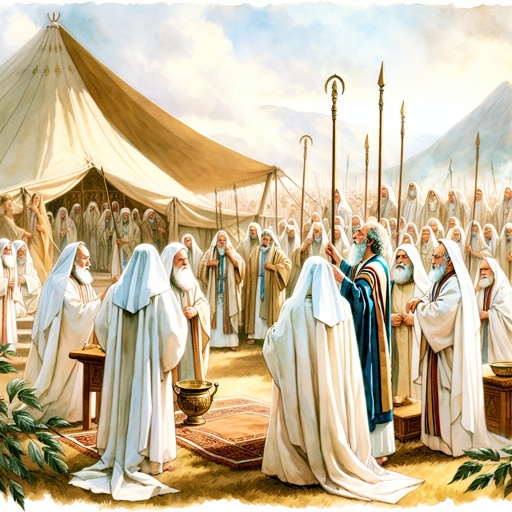
Leviticus 8:1-12

Leviticus 8:8 - "And he put the breastplate upon him: also he put in the breastplate the Urim and the Thummim."

Leviticus 27:13 - "But if he will at all redeem it, then he shall add a fifth part thereof unto thy estimation."

Leviticus 27:30 - "And all the tithe of the land, whether of the seed of the land, or of the fruit of the tree, is the LORD'S: it is holy unto the LORD."

Leviticus 27:17 - "If he sanctify his field from the year of jubile, according to thy estimation it shall stand."

Leviticus 18:27 - "(For all these abominations have the men of the land done, which were before you, and the land is defiled;)"

"And the LORD spake unto Moses, saying," - Leviticus 27:1

Leviticus 27:31 - "And if a man will at all redeem ought of his tithes, he shall add thereto the fifth part thereof."

Leviticus 27:12 - "And the priest shall value it, whether it be good or bad: as thou valuest it, who art the priest, so shall it be."

Psalm 27:8

Psalm 27:8

Leviticus 27:20 - "And if he will not redeem the field, or if he have sold the field to another man, it shall not be redeemed any more."

Leviticus 19:27 - "Ye shall not round the corners of your heads, neither shalt thou mar the corners of thy beard."

Leviticus 27:22 - "And if a man sanctify unto the LORD a field which he hath bought, which is not of the fields of his possession;"

Leviticus 6:8 - "¶ And the LORD spake unto Moses, saying,"
Leviticus 10:8 - "¶ And the LORD spake unto Aaron, saying,"