The Journey of Compassion: Understanding the Good Samaritan
“And Jesus answering said, A certain went down from Jerusalem to Jericho, and fell among thieves, which stripped him of his raiment, and wounded him, and departed, leaving him half dead.” — Luke 10:30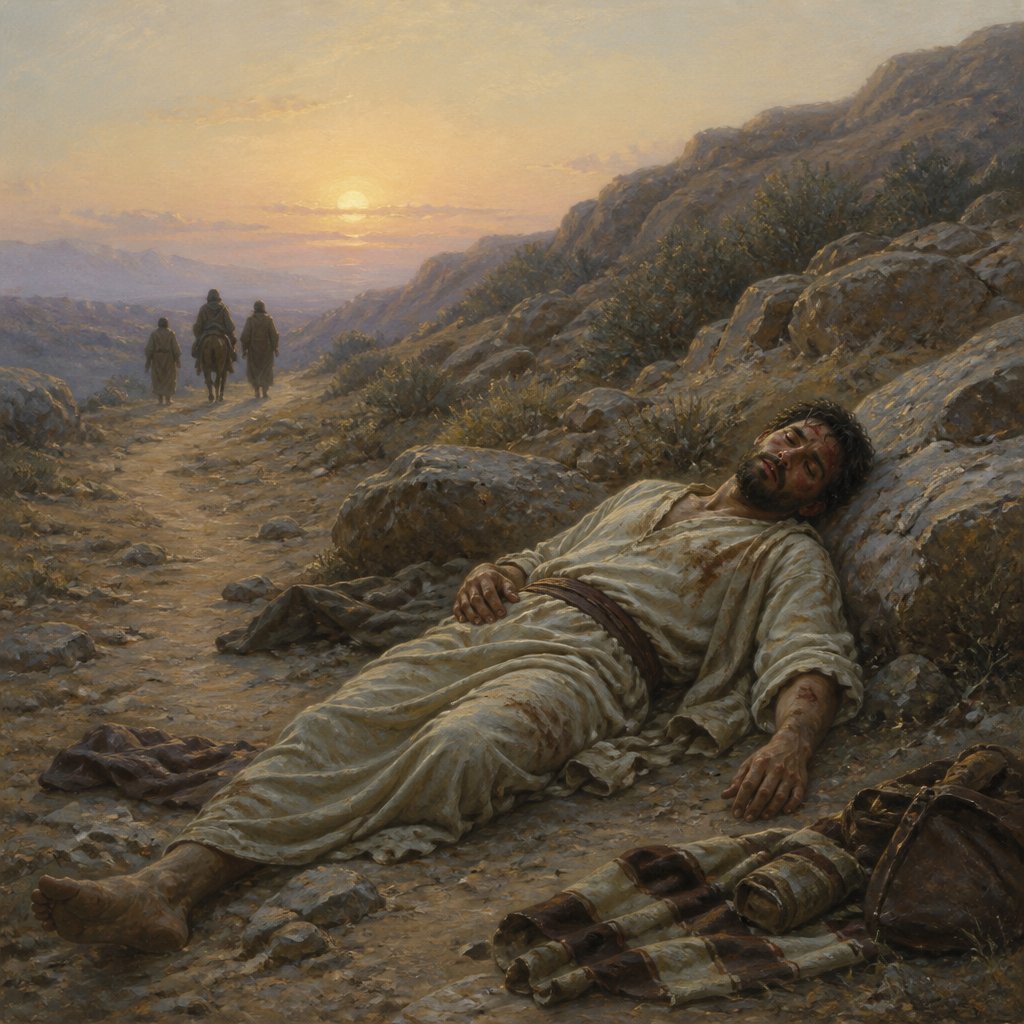
Luke 10:30 (KJV) provides a vivid narrative that transcends the mere act of storytelling; it presents a picture brimming with spiritual insight and moral imperative. The account reads: "And Jesus answering said, A certain man went down from Jerusalem to Jericho, and fell among thieves, which stripped him of his raiment, and wounded him, and departed, leaving him half dead." This singular verse lays the foundation for a profound exploration of human compassion, societal obligation, and divine love.
The scene is set on a treacherous road from Jerusalem to Jericho, a journey that symbolizes both physical and spiritual descent. Jerusalem, the city of peace, represents the heights of relationship with God, while Jericho, known for its lush landscapes, stands metaphorically for the world’s temptations. When the traveler "went down," we see a reflection not only of his geographical movement but also a deeper spiritual decline that many experience when they stray from God’s presence.
The man’s encounter with robbers can be seen as a representation of life’s unexpected hardships. The thieves did not just take his possessions—they stripped him of his raiment, which symbolizes dignity, identity, and security. Wounded and abandoned, the man looms as a figure who has been stripped of hope, echoing countless individuals we encounter daily who are hurting and in need of compassion. In our world today, the highways of life are riddled with those who find themselves assaulted by circumstances beyond their control: betrayal, loss, and suffering that can easily leave one "half dead."
As followers of Christ, we are confronted with the question: Are we aware of the needs around us? Do we pause in our hurried lives to notice those lying wounded on the roadside, emotionally and spiritually stripped bare? The Good Samaritan parable that follows highlights the stark contrast between apathy and compassion. The priest and the Levite pass by, engrossed in their own lives and rituals. They represent legalism and detachment from the humanity that Christ so fiercely championed.
Compassion is a divine attribute. In Hebrew, the word for compassion is "rachamim," which translates to a deep, almost visceral love—love that leads to action. When Jesus tells this story, He is calling out the innate compassion that should reside within us as image bearers of God. The Samaritan, an outsider and traditionally viewed as unworthy, embodies the true essence of love and mercy. He binds the wounds of the fallen man, pouring in oil and wine—a deliberate act that costs him time, resources, and social standing.
This story compels us to consider our own biases, prejudices, and the comfortable bubbles we may inhabit. Are we willing to engage with those who do not fit our narratives? Are we ready to bridge the gaps of societal divides as the Good Samaritan did? The call to love is radical, demanding, and countercultural. It summons us to act with urgency and kindness, often at our own expense.
Moreover, the narrative invites us to witness God’s providence—He is always ready to act through those willing to serve. Each act of compassion is a glimpse of the kingdom of God, a testament to our faith active in love. When we step into the shoes of the suffering, we are reminded that at some point, we too might be the wounded traveler, needing grace, mercy, and a loving hand to lift us.
Ultimately, Luke 10:30 beckons us to examine our hearts and confront our calls to action. Who are we in this story? The thieves, the indifferent priest, or the compassionate Samaritan? Let our lives be aligned with Christ’s heart, wherein we embody love and mercy to all, signifying the travel from death to life, from despair to hope. Recognizing and embracing this divine call to compassion can transform our journeys and lead us closer to His kingdom.
Get our apps


Artwork for Luke 10:30

african american luke 10:30

Luke 10:30 - "And Jesus answering said, A certain man went down from Jerusalem to Jericho, and fell among thieves, which stripped him of his raiment, and wounded him, and departed, leaving him half dead."

Luke 10:30-37 - "Jesus replied, "A man was going down from Jerusalem to Jericho, when he was attacked by robbers. They stripped him of his clothes, beat him and went away, leaving him half dead. A priest happened to be going down the same road, and when he saw the man, he passed by on the other side. So too, a Levite, when he came to the place and saw him, passed by on the other side. But a Samaritan, as he traveled, came where the man was; and when he saw him, he took pity on him. He went to him and bandaged his wounds, pouring on oil and wine. Then he put the man on his own donkey, brought him to an inn and took care of him. The next day he took out two denarii and gave them to the innkeeper. 'Look after him,' he said, 'and when I return, I will reimburse you for any extra expense you may have.' Which of these three do you think was a neighbor to the man who fell into the hands of robbers?" The expert in the law replied, "The one who had mercy on him." Jesus told him, "Go and do likewise.""
"And Jesus answering said, A certain man went down from Jerusalem to Jericho, and fell among thieves, which stripped him of his raiment, and wounded him, and departed, leaving him half dead." - Luke 10:30
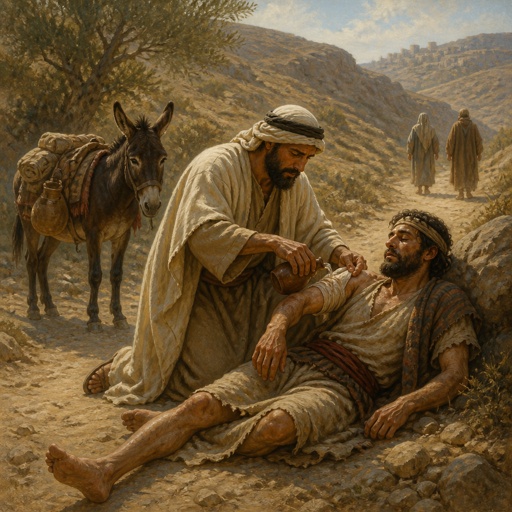
"Jesus replied, "A man was going down from Jerusalem to Jericho, when he was attacked by robbers. They stripped him of his clothes, beat him and went away, leaving him half dead. A priest happened to be going down the same road, and when he saw the man, he passed by on the other side. So too, a Levite, when he came to the place and saw him, passed by on the other side. But a Samaritan, as he traveled, came where the man was; and when he saw him, he took pity on him. He went to him and bandaged his wounds, pouring on oil and wine. Then he put the man on his own donkey, brought him to an inn and took care of him. The next day he took out two denarii and gave them to the innkeeper. 'Look after him,' he said, 'and when I return, I will reimburse you for any extra expense you may have.' Which of these three do you think was a neighbor to the man who fell into the hands of robbers?" The expert in the law replied, "The one who had mercy on him." Jesus told him, "Go and do likewise."" - Luke 10:30-37

Luke 6:10 30 Give to everyone who asks of you. Whoever takes away what is yours, do not demand it back.

Luke 6:10 30 Give to everyone who asks of you. Whoever takes away what is yours, do not demand it back.

Luke 1:30

luke 9:30

luke 6:30

luke 9:29- 30

Luke 14:30 - "Saying, This man began to build, and was not able to finish."

Luke 2:30 - "For mine eyes have seen thy salvation,"

John 10:30

John 10:30

Luke 20:30 - "And the second took her to wife, and he died childless."

Luke 1:30 Gabriel visits Mary

Luke 17:30 - "Even thus shall it be in the day when the Son of man is revealed."

Luke 4:30 - "But he passing through the midst of them went his way,"

Luke 13:30 - "And, behold, there are last which shall be first, and there are first which shall be last."

Luke 23:30 - "Then shall they begin to say to the mountains, Fall on us; and to the hills, Cover us."

Luke 9:30 - "And, behold, there talked with him two men, which were Moses and Elias:"

Mark 10:17-30

2 Chronicles 30:10

Mark 10:17-30

Genesis 30:10-11

John 10:30 - "I and my Father are one."

Luke 7:30 - "But the Pharisees and lawyers rejected the counsel of God against themselves, being not baptized of him."

Luke 11:30 - "For as Jonas was a sign unto the Ninevites, so shall also the Son of man be to this generation."

Luke 10:5