Seeking Assurance in Doubt: The Story of John the Baptist
“Now when John had heard in the prison the works of Christ, he sent two of his disciples,” — Matthew 11:2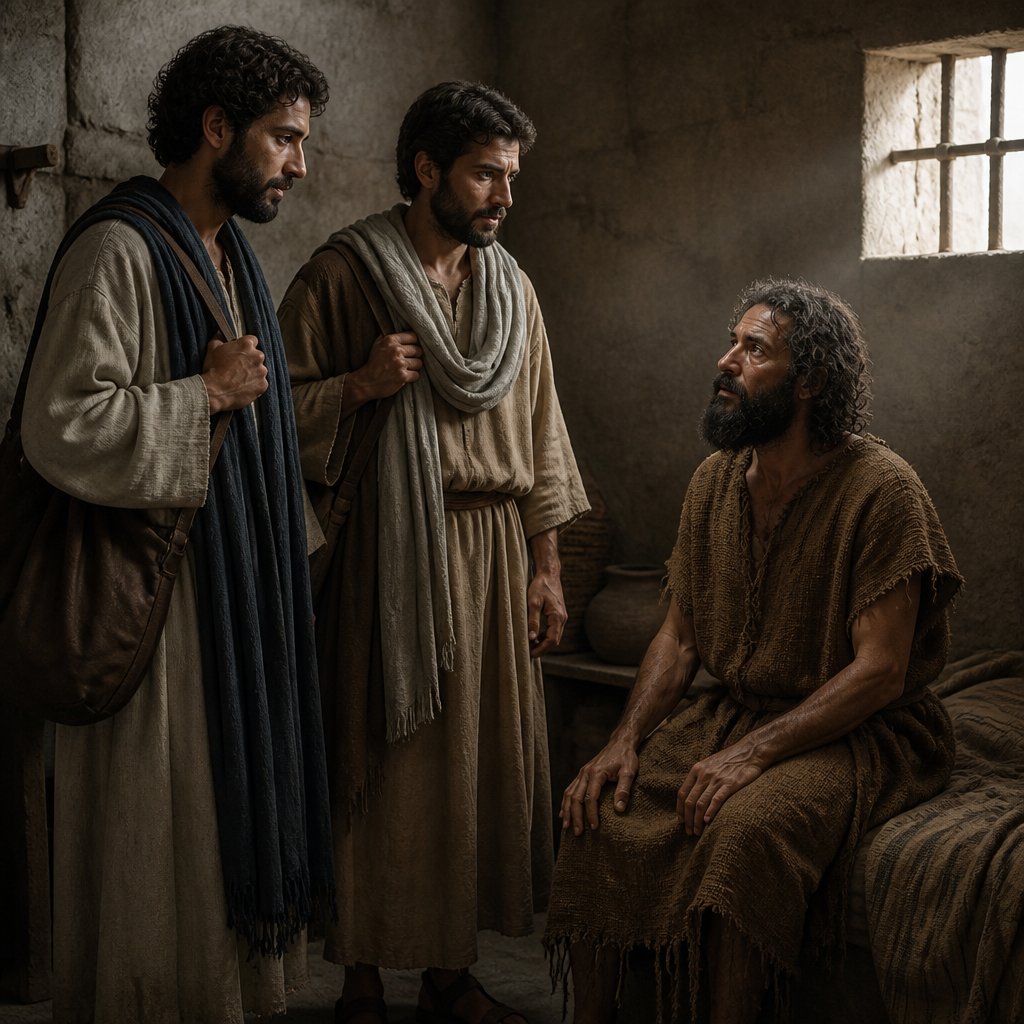
**Introduction**
Matthew 11:2 states, "Now when John had heard in the prison the works of Christ, he sent two of his disciples." At first glance, this verse appears simple, yet it unveils layers of meaning about faith, doubt, and the human condition in our journey with Christ. John the Baptist, a man who had fearlessly proclaimed the coming of the Messiah, was now in prison, surrounded by darkness and uncertainty. This situation prompts us to explore how even the greatest of saints can experience moments of doubt and how they can seek reassurance in their faith.
**Context of John’s Doubt**
To fully grasp the significance of John’s actions, it is important to understand the context. John the Baptist, known for his bold preaching and role in preparing the way for Jesus, found himself imprisoned by King Herod for speaking out against immoral behavior. This imprisonment was not just a physical confinement; it was also a spiritual challenge. John, who had proclaimed Jesus as the Lamb of God, found himself in a dire situation that led him to question whether Jesus was indeed the Messiah he had anticipated.
As he sat in his prison cell, John’s expectations of the Messiah likely conflicted with his reality. He was hoping for a reigning king who would liberate Israel from oppression. Instead, he witnessed the events surrounding the life of Christ: the miracles, the healings, and the teachings that didn’t align with the political deliverance he envisioned. Herein lies a core truth about faith: it often requires us to adjust our expectations to align with God’s greater plan, which may not be immediately apparent or may diverge from our own desires.
**John's Inquiry**
In sending his disciples to ask Jesus, "Art thou he that should come, or do we look for another?" (Matthew 11:3), John exemplifies a critical moment of seeking clarity. He could have wallowed in despair, letting doubt fester, but instead, he took action. He reached out. His inquiry reveals the heart of a servant who, even in his darkest hour, wanted to know the truth. This act on John's part is a reminder that questioning is not a lack of faith; rather, it can be an essential part of faith’s journey. God welcomes our questions and provides avenues for understanding when we earnestly seek Him.
**Jesus’ Response**
Jesus answers John's inquiry not with a direct affirmation but with a list of His works: the blind receive their sight, the lame walk, the lepers are cleansed, the deaf hear, the dead are raised, and the poor have the gospel preached to them (Matthew 11:4-5). In doing so, Jesus points John back to the fulfillment of prophecy and to the very essence of His mission. This response reassures John that the works of Christ align with the Messianic prophecies foretold throughout Scripture.
Jesus encourages John to remember what was prophesied in Isaiah and that the signs he was witnessing confirm God’s hand at work. The subtle message is that faith sometimes demands perspective: what we perceive in our present situation can obscure our understanding of what God is doing.
**Conclusion**
John's moment of doubt in prison illuminates a universal experience of faith and uncertainty. It demonstrates that even the most vibrant faith can encounter shadows of doubt. However, it is in these seasons that we, like John, can reach out for answers and look for Jesus in the midst of our circumstances. His response reminds us that truth is revealed not only through circumstances but through His Word and the works evident in our lives.
So, let us embrace our doubts, seek Jesus, and trust His workings, even if they don't align with our expectations. Like John, we can find assurance amidst uncertainty when we bring our questions to the very feet of Jesus, who holds our ultimate peace and hope.
Get our apps


Artwork for Matthew 11:2

Matthew 11:2 - "Now when John had heard in the prison the works of Christ, he sent two of his disciples,"
"Now when John had heard in the prison the works of Christ, he sent two of his disciples," - Matthew 11:2

Matthew 2:11

Matthew 11:3

Matthew 2:10-11. Depict the magi learning of the birth of Jesus and following the star

Matthew 3:11

Matthew 3:11

Matthew 3:11

Matthew 3:11

Matthew 3:11

Matthew 3:11

Matthew 3:11-12

Matthew 3:11-12

Matthew 3:11

Matthew 3:11

Matthew 3:11

Matthew 11:1

Matthew 11:1

Matthew 28:11

Matthew 2:11 - "¶ And when they were come into the house, they saw the young child with Mary his mother, and fell down, and worshipped him: and when they had opened their treasures, they presented unto him gifts; gold, and frankincense, and myrrh."

Matthew 2:10-11 - "When they saw the star, they were overjoyed. On coming to the house, they saw the child with his mother Mary, and they bowed down and worshiped him. Then they opened their treasures and presented him with gifts of gold, frankincense and myrrh."

Matthew 21:1-11

Matthew 25:11-13

Matthew 11:14 - "And if ye will receive it, this is Elias, which was for to come."

Matthew 11:30 - "For my yoke is easy, and my burden is light."

Matthew 18:11 - "For the Son of man is come to save that which was lost."

Matthew 11:6 - "And blessed is he, whosoever shall not be offended in me."

Matthew 6:11 - "Give us this day our daily bread."

Matthew 21:11 - "And the multitude said, This is Jesus the prophet of Nazareth of Galilee."

Matthew 11:13 - "For all the prophets and the law prophesied until John."