Straining at Gnats: A Call to Inner Purity
“Ye blind guides, which strain at a gnat, and swallow a camel.” — Matthew 23:24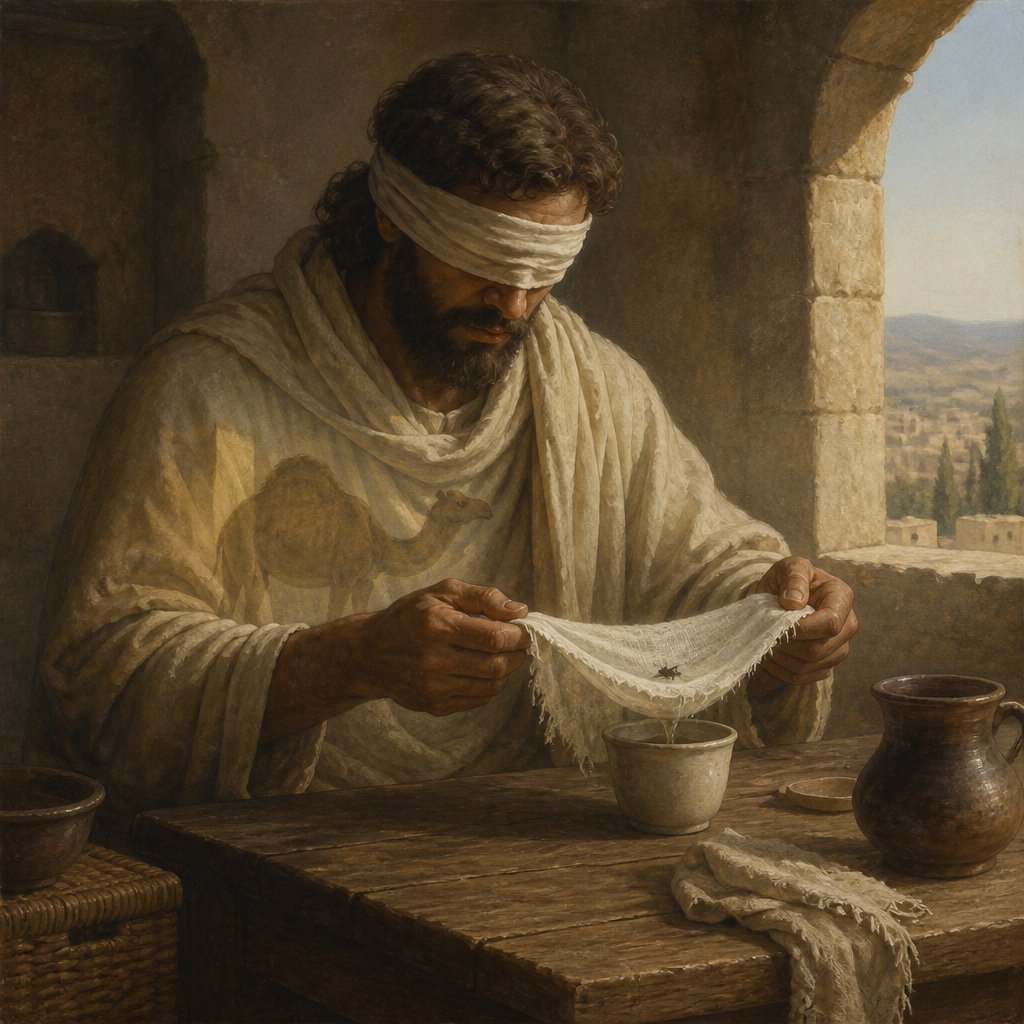
In Matthew 23:24, we are confronted with a stark admonition from Jesus: "Ye blind guides, which strain at a gnat, and swallow a camel." This verse stands at the precipice of a deep inquiry into the nature of our spiritual lives and the tendencies that can lead us astray.
This teaching takes place within a wider discourse where Jesus addresses the Pharisees and religious leaders, critiquing their hyper-focus on the minutiae of the Law while neglecting its weightier matters—justice, mercy, and faith. The gnat, a tiny insect considered unclean under Jewish dietary laws, symbolizes the trivial distractions that can consume our attention, while the camel, the largest unclean animal, signifies the larger, more significant issues that we may overlook.
To fully grasp this verse, we must first understand the cultural context. In Jewish tradition, the act of straining one’s drink to avoid the unclean gnat aligns with a commitment to purity; however, in their ritualistic zeal, the Pharisees missed the greater call to holiness that demands inner transformation over outer observance. Thus, they become blind guides—leaders who misdirect their followers by prioritizing human tradition over divine truth.
In our contemporary context, it becomes imperative to ask ourselves whether we also strain at gnats while swallowing camels in our lives.
We may meticulously adhere to external practices—be they church attendance, tithing, or morality—while failing to address the deeper, more sobering issues of our hearts, such as love for our neighbors, forgiveness for those who have wronged us, and commitment to the gospel's transformative power. Hyper-focus on these smaller duties can create a spiritual façade that masks deeper issues of pride, unforgiveness, and self-righteousness.
For example, consider our discourse surrounding faith in public spaces. It is not uncommon for believers to become embroiled in debates over the appropriate language in prayers, or whether certain worship styles are acceptable, while the underlying characteristics of faith—such as compassion, humility, and service to others—go unaddressed. As we strain to uphold our notions of reverence, we may swallow the very essence of what it means to love as Christ loved us.
Jesus’ critique is not merely a statement about behavior, but a challenge to the posture of our hearts. It invites us to a robust reflection: are we more concerned with appearing righteous than with actual righteousness that flows from a heart transformed by grace? Matthew 23 serves as a call to internalize our faith and concentrate on our spiritual growth, rather than fixating solely on outward expressions and rites.
Moreover, let us not forget the implications of leading others in our communities. As believers, we are tasked with guiding others on their spiritual journeys. When we become blind guides, it can lead to a culture where perfectionism—achieving holiness through the rigorous fulfilment of rules—supersedes God’s call to love and to live justly. The problem arises when society assumes that our meticulous adherence to the law = holiness. People are left feeling judged rather than cherished and challenged rather than encouraged.
In practicing our faith, may we choose mercy over judgment, love over legalism. The challenge encapsulated in Matthew 23:24 begs us to reflect on the impact of our spiritual priorities, urging us to grasp the underlying heart of God’s commandments. Straining at gnats keeps us from swallowing the rich, transformative truths of the gospel. As we strive for spiritual maturity, let us nurture purity of heart, recognizing our salvation is not earned but freely given, calling us to extend grace as we have received it.
In prayerful consideration, let us go forth, fixed not on the tiny gnats but on the magnificent camels of love and righteousness, in a Kingdom that cares for our hearts and the hearts of others.
Get our apps


Artwork for Matthew 23:24

Matthew 23:24 - "Ye blind guides, which strain at a gnat, and swallow a camel."
"Ye blind guides, which strain at a gnat, and swallow a camel." - Matthew 23:24

Matthew 24:23 - "Then if any man shall say unto you, Lo, here is Christ, or there; believe it not."

"Then if any man shall say unto you, Lo, here is Christ, or there; believe it not." - Matthew 24:23

Matthew 5:23-24 - "Therefore, if you are offering your gift at the altar and there remember that your brother or sister has something against you, leave your gift there in front of the altar. First go and be reconciled to them; then come and offer your gift."

Matthew 24:35

Matthew 24:35

Matthew 24:35

Matthew 24:35

Matthew 24:35

Matthew 24:35

Matthew 24:35

Matthew 24:35

Matthew 24:35

Matthew 24:35

Matthew 6:23

Matthew 24:27

Matthew 24:15

Matthew 6:24

Matthew 24:8

Genesis 24-23

Matthew 25:23

Matthew 2:23

Matthew 15:23

Matthew 2:23

Matthew 23:12

Matthew 23:12

Matthew 6:24

Matthew 6:24

Matthew 6:24