A Heart Broken by Betrayal: The Torment of Regret
"Then Judas, which had betrayed him, when he saw that he was condemned, repented himself, and brought again the thirty pieces of silver to the chief priests and elders," - Matthew 27:3
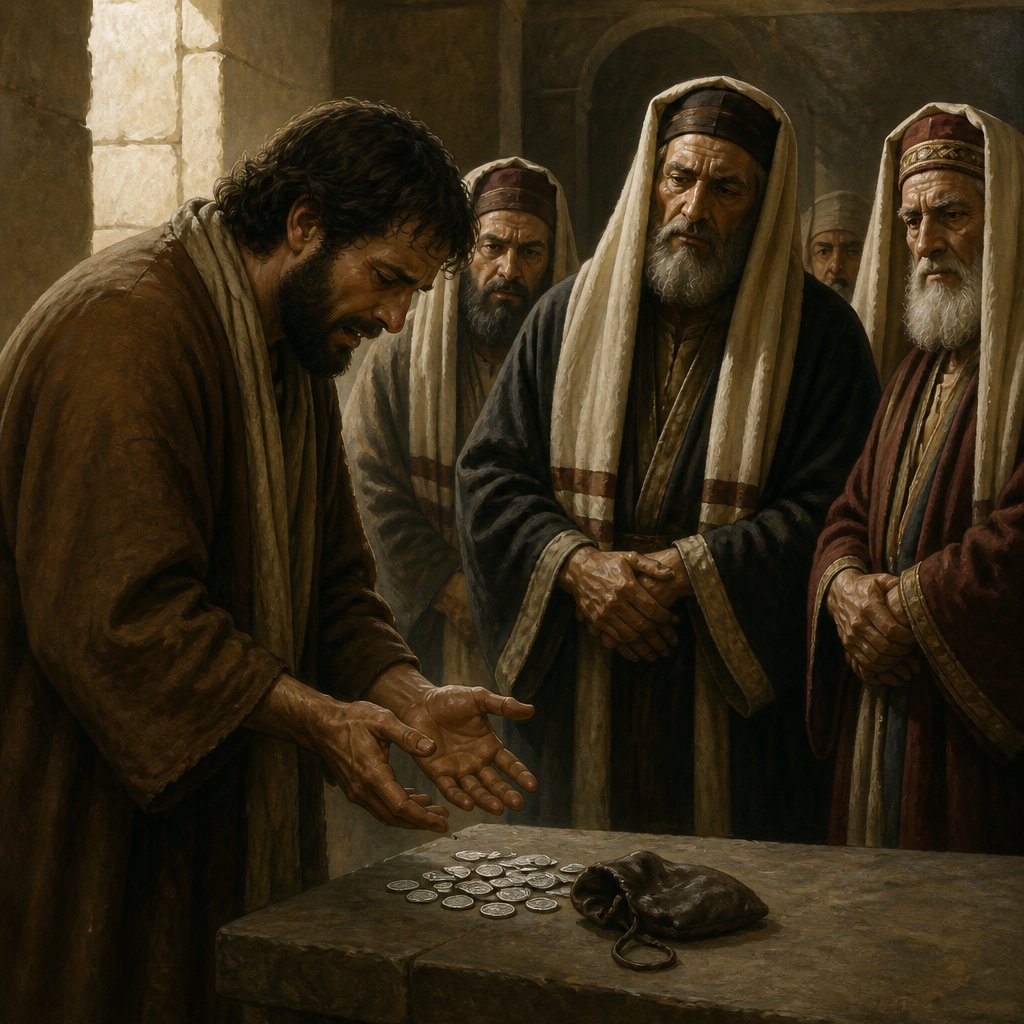
In the Bible, few figures carry the weight of betrayal as heavily as Judas Iscariot. The weight of his actions is captured poignantly in Matthew 27:3: "Then Judas, which had betrayed him, when he saw that he was condemned, repented himself, and brought again the thirty pieces of silver to the chief priests and elders." This verse unveils a profound internal struggle, opening a door into the depths of Judas's heart—the heart of a man who grappled with regret while confronting the unbearable consequences of his decisions.
Judas Iscariot was one of the twelve disciples, a close companion of Jesus during His earthly ministry. He saw the miracles, the healings, and heard the profound teachings that would transform lives. Yet, convinced by greed and a misguided sense of control, he made the fateful choice to betray Jesus for thirty pieces of silver. This decision seemed to promise power and security, but it instead led him down a path of shame and despair.
The moment Judas saw that Jesus was condemned, the gravity of his actions dawned on him in full force. The word "repented" in this context is worth examining. In the Greek, it is a strong term that encompasses not just the feeling of remorse, but a profound sorrow for the consequences of one’s actions. However, the repentance of Judas came too late; it was not the repentance that leads to life, but rather worldly sorrow which produces death (2 Corinthians 7:10). He returned to the very ones who had plotted Jesus’s arrest, not seeking forgiveness but merely trying to alleviate his conscience.
This moment poses critical questions for every believer: What does true repentance look like? How can we discern between worldly sorrow and godly sorrow?
True repentance begins with recognizing the weight of our sins and the destruction they cause—not only to ourselves but also to others. Judas felt the crushing guilt of his betrayal, yet his repentance was hollow. He fled from the presence of the one truly capable of granting forgiveness—Jesus, who embodies love and mercy.
We can take Judas’s story as a cautionary tale about the dangers of yielding to temptation. His alienation from the Lord's presence highlights a significant truth: sin alienates us from God, creating a chasm that can only be bridged through true contrition and surrender to the Father. Without this connection, sorrow becomes a burden that leads us further into darkness, rather than guiding us back into the light. In moments of failing, we must seek authentic reconciliation and not simply try to fix our mistakes through actions that stem from guilt.
Additionally, the stark contrast between Judas and Peter is worth noting. Both disciples failed Jesus—Judas through betrayal and Peter through denial. Yet, while Judas succumbed to despair, leading to his tragic end, Peter, aided by godly sorrow, found restoration and purpose through his tears of repentance.
Jesus often spoke of the transforming power of genuine repentance and forgiveness. In Matthew 18:21-22, He teaches Peter about the boundless nature of forgiveness. The tale of Judas serves as a haunting reminder of what happens when we allow ourselves to live in isolation from God, driven by guilt and shame rather than turning towards Him with an open heart.
In our spiritual journey, let us embrace the lesson from Judas’s tragic fate. Let us not falter in our times of regret but repent genuinely before the Lord, knowing He stands ready to forgive. In moments of deepest sorrow, let us run to the arms of Jesus, who, despite our failures, offers unconditional love and redemption. Reflect deeply on your relationship with God—are you carrying any regrets, any burdens you have not surrendered? Bring them before Him today, and let Him transform your sorrow into joy.
Want to reflect more on Matthew 27:3?
Continue your spiritual journey with Bible Chat — an AI-powered tool for exploring God's Word through conversation. Ask questions, discover connections, and deepen your understanding.
Get Our Apps


Matthew 27:3 Artwork

Matthew 27:3 - "¶ Then Judas, which had betrayed him, when he saw that he was condemned, repented himself, and brought again the thirty pieces of silver to the chief priests and elders,"
"¶ Then Judas, which had betrayed him, when he saw that he was condemned, repented himself, and brought again the thirty pieces of silver to the chief priests and elders," - Matthew 27:3

Matthew 27:46

Matthew 27:35

Matthew 24:27

Matthew 27:26

Matthew 27:26

Matthew 27: 38

Matthew 27:27 - "Then the soldiers of the governor took Jesus into the common hall, and gathered unto him the whole band of soldiers."

Matthew 7:24-27

Matthew 27:36 - "And sitting down they watched him there;"

Matthew 27:16 - "And they had then a notable prisoner, called Barabbas."

Matthew 22:27 - "And last of all the woman died also."

Matthew 27:39 - "¶ And they that passed by reviled him, wagging their heads,"

Matthew 27:18 - "For he knew that for envy they had delivered him."

Matthew 27:28 - "And they stripped him, and put on him a scarlet robe."

Matthew 27:8 - "Wherefore that field was called, The field of blood, unto this day."

Matthew 27:10 - "And gave them for the potter's field, as the Lord appointed me."

Matthew 27:7 - "And they took counsel, and bought with them the potter's field, to bury strangers in."

Matthew 27:61 - "And there was Mary Magdalene, and the other Mary, sitting over against the sepulchre."

Matthew 20:27 - "And whosoever will be chief among you, let him be your servant:"

Matthew 27:30 - "And they spit upon him, and took the reed, and smote him on the head."

Matthew 18:27 - "Then the lord of that servant was moved with compassion, and loosed him, and forgave him the debt."

Matthew 27:41 - "Likewise also the chief priests mocking him, with the scribes and elders, said,"

Matthew 27:52 - "And the graves were opened; and many bodies of the saints which slept arose,"

Matthew 27:12 - "And when he was accused of the chief priests and elders, he answered nothing."

Matthew 27:25 - "Then answered all the people, and said, His blood be on us, and on our children."

Matthew 27:47 - "Some of them that stood there, when they heard that, said, This man calleth for Elias."

Matthew 27:14 - "And he answered him to never a word; insomuch that the governor marvelled greatly."

Matthew 27:66 - "So they went, and made the sepulchre sure, sealing the stone, and setting a watch."