The Silent Grief of Justice
“Declare ye it not at Gath, weep ye not at all: in the house of Aphrah roll thyself in the dust.” — Micah 1:10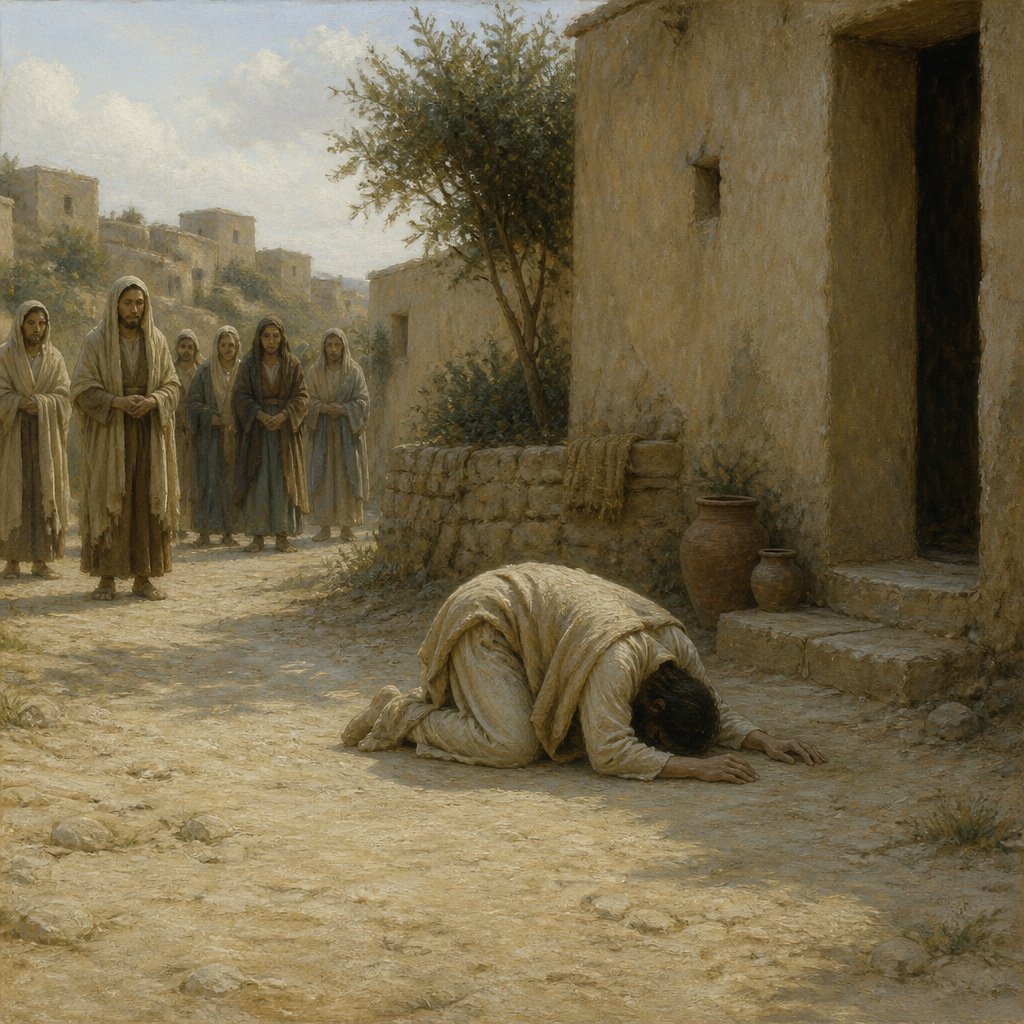
The verse from Micah 1:10 proclaims, "Declare ye it not at Gath, weep ye not at all: in the house of Aphrah roll thyself in the dust." This brief yet profound exhortation holds a wealth of meaning for us as we reflect upon the nature of grief, justice, and the reality of divine judgment.
Micah, a prophet during one of Israel’s darkest times, was charged with delivering messages of warning and lamentation. His audience was a people who had grown complacent in their wickedness, turning their backs on God and the covenant they had with Him. As he speaks to the nation, Micah emphasizes a careful sensitivity regarding the public display of grief and despair. Indeed, his directive "Declare ye it not at Gath" underscores that certain sorrows should remain unvoiced in public arenas. Why might this be? Gath, a Philistine city and a stronghold of Israel's enemies, symbolizes a place of mockery and insensitivity. To announce grief or the calamities facing Israel in Gath could lead to derision among the very nations that rejoice in her downfall.
This brings us to a significant truth about sorrow; there are moments when it is more appropriate to express mourning in a private space or before God rather than in front of those who do not understand or appreciate the weight of it. In the Kingdom of God, sorrow often reflects a heart aligned with divine justice — a heart that weeps for the sins of the world and the consequences they bear. Micah’s directive invites us to consider where and how we express our grief regarding personal or communal injustices in a world that often praises iniquity and derides the righteous.
The second part of the verse, "in the house of Aphrah roll thyself in the dust," intensifies the mourning metaphors employed in this passage. Dust, in Hebrew culture, often represents death and lamentation — a physical and spiritual posture before God. Rolling in the dust is an act of humility, a recognition of one’s lowly state in the face of divine judgment. It symbolizes the severity of the situation and calls for an earnest heart of repentance. In the context of Micah's prophecy, it illustrates the seriousness of Israel’s plight; they must be brought low to truly understand the depths of their sin and the need for restoration.
As modern believers, we must ask ourselves: when confronted with injustice, how do we respond? Are we placing our grief in the right scope and context, allowing God to transform our sorrow into fruitfulness? While the world is quick to grieve publicly, to displace our deep emotional struggles before those who do not value them, we should instead turn our hearts to God, who understands intimately every hurt and sorrow we bear. It is within the sacred space of our hearts, in prayerful drawing near to Him, that our genuine lament can transform into powerful intercession.
In a tumultuous world, we are invited into a deeper understanding of justice that requires stillness in chaos. True mourning does not always need loud declarations; sometimes, it requires us to simply roll in the dust, contemplating the nature of our sin and pleading for mercy. God calls us to a place of honesty in our sorrow, where we can remain steadfast in prayer without the need for external validation or recognition.
As we reflect upon Micah 1:10, may we recognize the magnificence of His call to humility, the power of grief united with divine purpose, and the unshakeable truth that through lament, restoration can begin. Let us bring our mourning to the feet of the Savior, so that when the time comes for Him to declare His perfect justice, we may carry the weight of it with grace and faith.
Get our apps


Artwork for Micah 1:10

Micah 1:10 - "¶ Declare ye it not at Gath, weep ye not at all: in the house of Aphrah roll thyself in the dust."

"¶ Declare ye it not at Gath, weep ye not at all: in the house of Aphrah roll thyself in the dust." - Micah 1:10

Micah 3:10 - "They build up Zion with blood, and Jerusalem with iniquity."

Micah 6:10 - "¶ Are there yet the treasures of wickedness in the house of the wicked, and the scant measure that is abominable?"

Micah 1:1 - "The word of the LORD that came to Micah the Morasthite in the days of Jotham, Ahaz, and Hezekiah, kings of Judah, which he saw concerning Samaria and Jerusalem."

Micah 5:2-5

Micah 2:10 - "Arise ye, and depart; for this is not your rest: because it is polluted, it shall destroy you, even with a sore destruction."

"They build up Zion with blood, and Jerusalem with iniquity." - Micah 3:10

Judges 17:1 - "And there was a man of mount Ephraim, whose name was Micah."

1 Chronicles 8:35 - "And the sons of Micah were, Pithon, and Melech, and Tarea, and Ahaz."

Micah 5:10 - "And it shall come to pass in that day, saith the LORD, that I will cut off thy horses out of the midst of thee, and I will destroy thy chariots:"

"¶ Are there yet the treasures of wickedness in the house of the wicked, and the scant measure that is abominable?" - Micah 6:10

1 Chronicles 9:41 - "And the sons of Micah were, Pithon, and Melech, and Tahrea, and Ahaz."

1 Chronicles 9:40 - "And the son of Jonathan was Merib-baal: and Merib-baal begat Micah."

"The word of the LORD that came to Micah the Morasthite in the days of Jotham, Ahaz, and Hezekiah, kings of Judah, which he saw concerning Samaria and Jerusalem." - Micah 1:1

1 Chronicles 8:34 - "And the son of Jonathan was Merib-baal; and Merib-baal begat Micah."

1 Chronicles 5:5 - "Micah his son, Reaia his son, Baal his son,"

1 Chronicles 9:15 - "And Bakbakkar, Heresh, and Galal, and Mattaniah the son of Micah, the son of Zichri, the son of Asaph;"

Micah 1:14 - "Therefore shalt thou give presents to Moresheth-gath: the houses of Achzib shall be a lie to the kings of Israel."

Judges 17:10 - "And Micah said unto him, Dwell with me, and be unto me a father and a priest, and I will give thee ten shekels of silver by the year, and a suit of apparel, and thy victuals. So the Levite went in."

Micah 1:12 - "For the inhabitant of Maroth waited carefully for good: but evil came down from the LORD unto the gate of Jerusalem."

Micah 1:9 - "For her wound is incurable; for it is come unto Judah; he is come unto the gate of my people, even to Jerusalem."

Micah 1:3 - "For, behold, the LORD cometh forth out of his place, and will come down, and tread upon the high places of the earth."

"And there was a man of mount Ephraim, whose name was Micah." - Judges 17:1

Micah 1:8 - "Therefore I will wail and howl, I will go stripped and naked: I will make a wailing like the dragons, and mourning as the owls."

Micah 2:1 - "Woe to them that devise iniquity, and work evil upon their beds! when the morning is light, they practise it, because it is in the power of their hand."

Micah 1:5 - "For the transgression of Jacob is all this, and for the sins of the house of Israel. What is the transgression of Jacob? is it not Samaria? and what are the high places of Judah? are they not Jerusalem?"

Micah 3:1 - "And I said, Hear, I pray you, O heads of Jacob, and ye princes of the house of Israel; Is it not for you to know judgment?"

Micah 1:4 - "And the mountains shall be molten under him, and the valleys shall be cleft, as wax before the fire, and as the waters that are poured down a steep place."

Micah 1:15 - "Yet will I bring an heir unto thee, O inhabitant of Mareshah: he shall come unto Adullam the glory of Israel."