The Lament of Lost Blessings: Understanding Micah 2:4
“In that day shall one take up a parable against you, and lament with a doleful lamentation, and say, We be utterly spoiled: he hath changed the portion of my people: how hath he removed it from me! turning away he hath divided our fields.” — Micah 2:4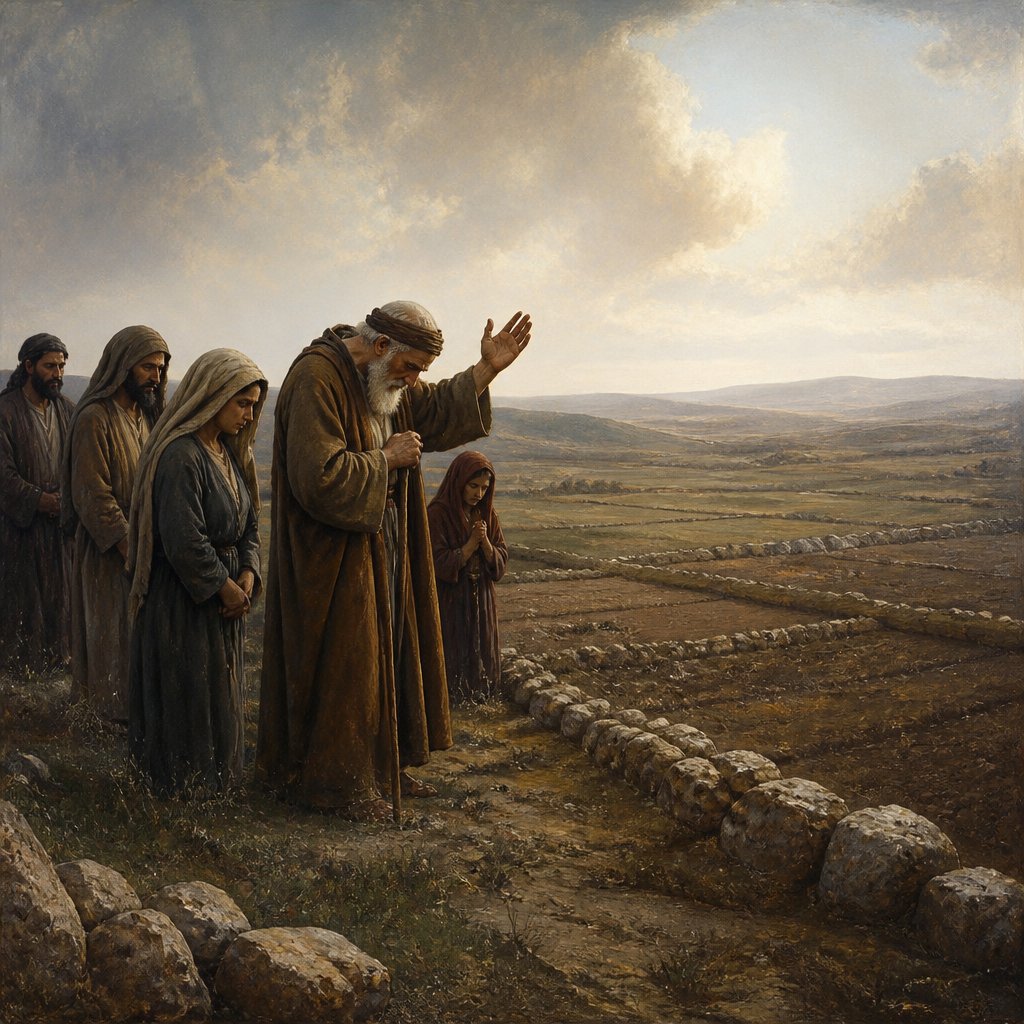
Micah 2:4 presents a poignant image of lamentation and loss concerning the people of Israel, a reflection of profound grief over their socio-political condition. The verse states: "In that day shall one take up a parable against you, and lament with a doleful lamentation, and say, We be utterly spoiled: he hath changed the portion of my people: how hath he removed it from me! turning away he hath divided our fields." This lament resonates deeply in its historical and spiritual implications, serving as a timeless message about stewardship, justice, and divine judgment.
The historical backdrop of Micah's prophecies is critical for understanding this verse. Micah prophesied during the reigns of Jotham, Ahaz, and Hezekiah, a time marked by immense socio-economic disparity and ethical breakdown. The wealthy were exploiting the poor, and false prophets were peddling messages of peace that contradicted the moral decay of the nation. When Micah delivers this mournful prophecy, he is voicing the anguish and desperation of those who have faced the unjust reallocation of their land and livelihood—an act that signifies not only economic ruin but also a deep spiritual crisis.
When he says, "We be utterly spoiled," the term ‘spoil’ is significant. In ancient cultures, land was more than just property; it was a representation of identity, divine promise, and community. The sharing of land was intertwined with the understanding of God’s covenant with His people. Thus, to say, "We be utterly spoiled" indicates that they feel stripped not only of their resources but of their dignity and covenantal rights as God’s chosen people. It reflects a state of profound disarray and hopelessness.
The phrase "he hath changed the portion of my people" highlights a shift in God’s blessings, illustrating how the people of Israel were experiencing the consequences of their unfaithfulness. God had promised them a land flowing with milk and honey, which symbolized abundance and divine favor. Yet here, in their moment of suffering, they lament the alteration of their fortune. One profound takeaway from this could be the realization that it is possible to fall from grace through choices, injustices, and systemic corruption. The lamentation serves as a mirror reflecting our own lives. Have we too, at times, felt as if our divine portion has been reassigned, leading us to question God about our own losses?
Moreover, the phrase "turning away he hath divided our fields" indicates a divine withdrawal—a theme prevalent in the Old Testament when God withdrew His protection due to the people's sins. It encourages deep introspection about our relationship with God. How often do we take for granted that protection and blessing? How frequently do we contribute to injustice and then suffer the consequences?
The call to lament and reflect is an essential spiritual practice. In our lives today, we face various forms of depletion—emotional, spiritual, and communal. We can find ourselves in settings that echo Micah's lament, experiencing injustice, betrayal, and dislocation. Yet, it is during these times of anguish that we are called not to despair but to search for resolution through repentance and restoration.
In conclusion, Micah 2:4 serves not only as a historical lament but as a contemporary exhortation to evaluate our lives and society. It is a reminder to seek justice, protect the marginalized, and engage in collective repentance. May we find the courage to turn away from practices that lead to spiritual depletion and strive to restore what has been lost. Allow this verse to resonate in your heart, prompting a transformation toward faithfulness and stewardship, aligning our actions with God’s will for justice and community.
Get our apps


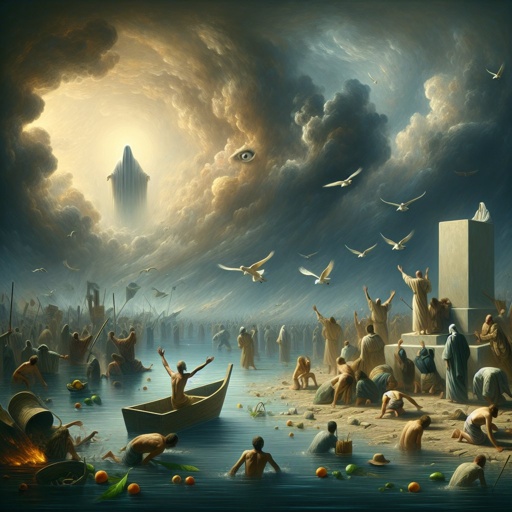
Artwork for Micah 2:4

Micah 2:4 - "¶ In that day shall one take up a parable against you, and lament with a doleful lamentation, and say, We be utterly spoiled: he hath changed the portion of my people: how hath he removed it from me! turning away he hath divided our fields."
"¶ In that day shall one take up a parable against you, and lament with a doleful lamentation, and say, We be utterly spoiled: he hath changed the portion of my people: how hath he removed it from me! turning away he hath divided our fields." - Micah 2:4

Micah 5:2-5

Micah 4:4 - "But they shall sit every man under his vine and under his fig tree; and none shall make them afraid: for the mouth of the LORD of hosts hath spoken it."

Micah 4:12 - "But they know not the thoughts of the LORD, neither understand they his counsel: for he shall gather them as the sheaves into the floor."

Micah 4:2 - "And many nations shall come, and say, Come, and let us go up to the mountain of the LORD, and to the house of the God of Jacob; and he will teach us of his ways, and we will walk in his paths: for the law shall go forth of Zion, and the word of the LORD from Jerusalem."
![Micah 4:4
[4]Everyone will sit under their own vine
and under their own fig tree,
and no one will make them afraid,
for the Lord Almighty has spoken.](https://media.bible.art/8a86fa9e-f417-42fe-bc29-f62f431781f4-thumbnail.jpg)
Micah 4:4 [4]Everyone will sit under their own vine and under their own fig tree, and no one will make them afraid, for the Lord Almighty has spoken.

Micah 4:6 - "In that day, saith the LORD, will I assemble her that halteth, and I will gather her that is driven out, and her that I have afflicted;"

Micah 1:4 - "And the mountains shall be molten under him, and the valleys shall be cleft, as wax before the fire, and as the waters that are poured down a steep place."

Judges 18:4 - "And he said unto them, Thus and thus dealeth Micah with me, and hath hired me, and I am his priest."

Micah 4:5 - "For all people will walk every one in the name of his god, and we will walk in the name of the LORD our God for ever and ever."

Micah 2:6 - "Prophesy ye not, say they to them that prophesy: they shall not prophesy to them, that they shall not take shame."

Micah 4:11 - "¶ Now also many nations are gathered against thee, that say, Let her be defiled, and let our eye look upon Zion."

Micah 2:5 - "Therefore thou shalt have none that shall cast a cord by lot in the congregation of the LORD."

Micah 2:2 - "And they covet fields, and take them by violence; and houses, and take them away: so they oppress a man and his house, even a man and his heritage."
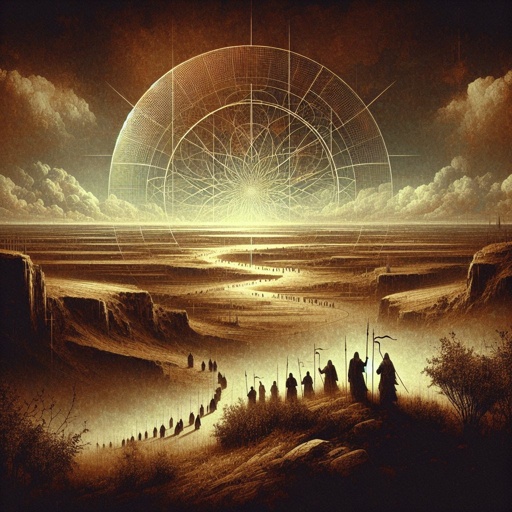
Micah 7:4 - "The best of them is as a brier: the most upright is sharper than a thorn hedge: the day of thy watchmen and thy visitation cometh; now shall be their perplexity."
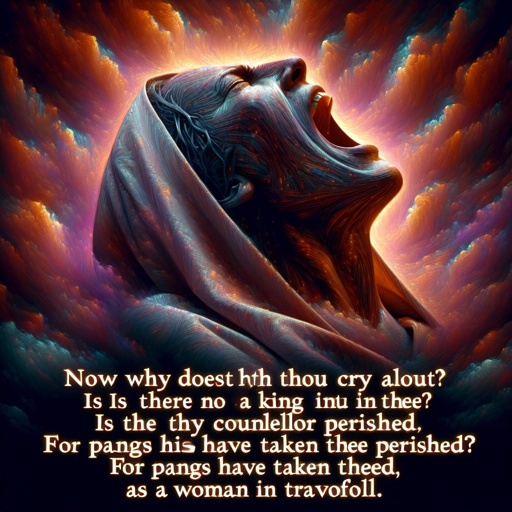
Micah 4:9 - "Now why dost thou cry out aloud? is there no king in thee? is thy counsellor perished? for pangs have taken thee as a woman in travail."

Micah 2:10 - "Arise ye, and depart; for this is not your rest: because it is polluted, it shall destroy you, even with a sore destruction."

Micah 6:4 - "For I brought thee up out of the land of Egypt, and redeemed thee out of the house of servants; and I sent before thee Moses, Aaron, and Miriam."
Micah 3:4 - "Then shall they cry unto the LORD, but he will not hear them: he will even hide his face from them at that time, as they have behaved themselves ill in their doings."

Micah 5:4 - "¶ And he shall stand and feed in the strength of the LORD, in the majesty of the name of the LORD his God; and they shall abide: for now shall he be great unto the ends of the earth."

Micah 4:8 - "¶ And thou, O tower of the flock, the strong hold of the daughter of Zion, unto thee shall it come, even the first dominion; the kingdom shall come to the daughter of Jerusalem."

Micah 4:1 - "But in the last days it shall come to pass, that the mountain of the house of the LORD shall be established in the top of the mountains, and it shall be exalted above the hills; and people shall flow unto it."

"But in the last days it shall come to pass, that the mountain of the house of the LORD shall be established in the top of the mountains, and it shall be exalted above the hills; and people shall flow unto it." - Micah 4:1

Micah 2:1 - "Woe to them that devise iniquity, and work evil upon their beds! when the morning is light, they practise it, because it is in the power of their hand."

Micah 4:7 - "And I will make her that halted a remnant, and her that was cast far off a strong nation: and the LORD shall reign over them in mount Zion from henceforth, even for ever."

2 Chronicles 34:20 - "And the king commanded Hilkiah, and Ahikam the son of Shaphan, and Abdon the son of Micah, and Shaphan the scribe, and Asaiah a servant of the king's, saying,"

Micah 6:2 - "Hear ye, O mountains, the LORD'S controversy, and ye strong foundations of the earth: for the LORD hath a controversy with his people, and he will plead with Israel."

Micah 7:2 - "The good man is perished out of the earth: and there is none upright among men: they all lie in wait for blood; they hunt every man his brother with a net."

Micah 2:7 - "¶ O thou that art named the house of Jacob, is the spirit of the LORD straitened? are these his doings? do not my words do good to him that walketh uprightly?"