Boldness in Christ: The Call to Love and Forgiveness
“Wherefore, though I might be much bold in Christ to enjoin thee that which is convenient,” — Philemon 1:8
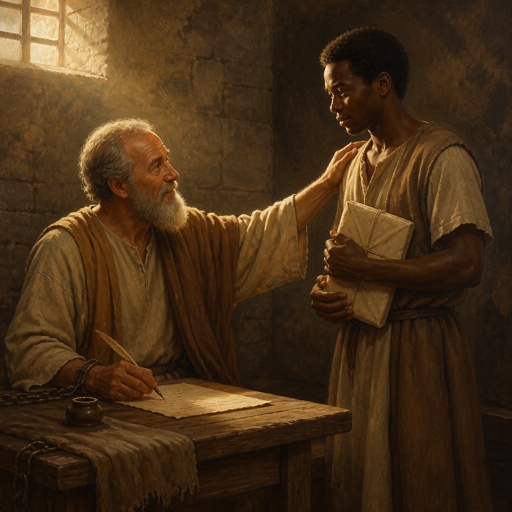
Philemon 1:8 (KJV) states, "Wherefore, though I might be much bold in Christ to enjoin thee that which is convenient." In this brief but profound epistle, the Apostle Paul addresses Philemon, a beloved friend and fellow laborer in the faith, concerning Onesimus, a runaway slave who had found refuge with Paul. Through this message, Paul exemplifies how relationships within the Christian community should be handled with grace, love, and a willingness to forgive.
Let us first consider the context of Paul’s words. He could have approached Philemon with authority, reminding him of his status as an Apostle. After all, Paul was not just any follower of Christ; he had seen the risen Lord and had been commissioned by Him to preach the Gospel. However, instead of exerting his apostolic authority, Paul chooses a path of humility, expressing a desire to appeal to Philemon's heart rather than command obedience. This sets a crucial precedent for us today: leadership in the Christian family is not about exercising power, but about nurturing an environment of love, understanding, and mutual respect.
Paul's expression of possible boldness gives us pause to consider the nature of our own interactions within the church and among fellow believers. When faced with difficult situations, how often do we utilize our influence or authority to demand certain actions? Are we, like Paul, willing to approach others with gentleness and love, recognizing that true change often comes not from pressure but from a passionate appeal to the heart?
Additionally, the phrase "to enjoin thee that which is convenient" points us toward the essence of what it means to live out our faith. The word "enjoin" signifies more than just to instruct or order; it suggests a deep-rooted connection and encouragement to act right. Paul desires for Philemon to act in a manner that aligns with Christ-like values — values of grace, compassion, and forgiveness. The acknowledgment of what is "convenient" indicates that being a follower of Christ is not merely about observing societal norms, but about adhering to the higher call of love that transcends cultural and societal expectations.
Philemon was faced with a choice: he could either not forgive Onesimus, allowing resentment to grow and disrupting the harmony within the Christian community, or he could demonstrate the radical love of Christ. Paul’s encouragement can be seen as a gentle push toward the latter. How often are we faced with similar choices in our own lives? When someone wrongs us, do we opt for anger and resentment, or do we choose the path of love and reconciliation?
In today’s world, where division and conflict often prevail, this epistle invites us to reflect on our responses. We are called to be peacemakers, recognizing that we, too, have been recipients of grace. Just as Paul urges Philemon to embrace Onesimus with love and forgiveness, so too are we called to extend grace to those who may have wronged us.
The question arises, how can we be bold in Christ? Our boldness is rooted in our understanding of His love and sacrifice. When we truly grasp the depths of Christ’s forgiveness toward us, how can we withhold forgiveness from others? This is the transformative power of the Gospel. The good news isn't just for our own salvation; it's meant to change how we engage with the world around us.
As we meditate on Philemon 1:8, let it serve as a reminder of the fundamental principles of our faith: love, forgiveness, and humility. Let us strive to create environments where these values flourish, where we can encourage one another boldly yet lovingly, and where we can all grow toward the full understanding of what it means to be disciples of Christ. May our actions reflect His love, ensuring that our relationships become channels of His grace in the everyday situations we face.
Get our apps


Artwork for Philemon 1:8

Philemon 1:8 - "Wherefore, though I might be much bold in Christ to enjoin thee that which is convenient,"

"Wherefore, though I might be much bold in Christ to enjoin thee that which is convenient," - Philemon 1:8

Philemon 1:8-20 - "Therefore, although in Christ I could be bold and order you to do what you ought to do, yet I prefer to appeal to you on the basis of love. It is as none other than Paul—an old man and now also a prisoner of Christ Jesus— that I appeal to you for my son Onesimus, who became my son while I was in chains. Formerly he was useless to you, but now he has become useful both to you and to me. I am sending him—who is my very heart—back to you. I would have liked to keep him with me so that he could take your place in helping me while I am in chains for the gospel. But I did not want to do anything without your consent, so that any favor you do would not seem forced but would be voluntary. Perhaps the reason he was separated from you for a little while was that you might have him back forever— no longer as a slave, but better than a slave, as a beloved brother. He is very dear to me but even dearer to you, both as a fellow man and as a brother in the Lord. So if you consider me a partner, welcome him as you would welcome me. If he has done you any wrong or owes you anything, charge it to me. I, Paul, am writing this with my own hand. I will pay it back—not to mention that you owe me your very self."
"Therefore, although in Christ I could be bold and order you to do what you ought to do, yet I prefer to appeal to you on the basis of love. It is as none other than Paul—an old man and now also a prisoner of Christ Jesus— that I appeal to you for my son Onesimus, who became my son while I was in chains. Formerly he was useless to you, but now he has become useful both to you and to me. I am sending him—who is my very heart—back to you. I would have liked to keep him with me so that he could take your place in helping me while I am in chains for the gospel. But I did not want to do anything without your consent, so that any favor you do would not seem forced but would be voluntary. Perhaps the reason he was separated from you for a little while was that you might have him back forever— no longer as a slave, but better than a slave, as a beloved brother. He is very dear to me but even dearer to you, both as a fellow man and as a brother in the Lord. So if you consider me a partner, welcome him as you would welcome me. If he has done you any wrong or owes you anything, charge it to me. I, Paul, am writing this with my own hand. I will pay it back—not to mention that you owe me your very self." - Philemon 1:8-20

Philemon 1:1 - "Paul, a prisoner of Jesus Christ, and Timothy our brother, unto Philemon our dearly beloved, and fellowlabourer, 2 And to our beloved Apphia, and Archippus our fellowsoldier, and to the church in thy house:"

Philemon 1:4-7

Philemon 1:24 - "Marcus, Aristarchus, Demas, Lucas, my fellowlabourers."

Philemon 1:23 - "There salute thee Epaphras, my fellowprisoner in Christ Jesus;"

Philemon 1:17 - "If thou count me therefore a partner, receive him as myself."

Philemon 1:25 - "The grace of our Lord Jesus Christ be with your spirit. Amen."

Philemon 1:11 - "Which in time past was to thee unprofitable, but now profitable to thee and to me:"

Philemon 1:15 - "For perhaps he therefore departed for a season, that thou shouldest receive him for ever;"

Philemon 1:3 - "Grace to you, and peace, from God our Father and the Lord Jesus Christ."

Philemon 1:4 - "I thank my God, making mention of thee always in my prayers,"

Philemon 1:18 - "If he hath wronged thee, or oweth thee ought, put that on mine account;"

Philemon 1:10 - "I beseech thee for my son Onesimus, whom I have begotten in my bonds:"

Philemon 1:12 - "Whom I have sent again: thou therefore receive him, that is, mine own bowels:"

Philemon 1:20 - "Yea, brother, let me have joy of thee in the Lord: refresh my bowels in the Lord."

Philemon 1:5 - "Hearing of thy love and faith, which thou hast toward the Lord Jesus, and toward all saints;"

Philemon 1:14 - "But without thy mind would I do nothing; that thy benefit should not be as it were of necessity, but willingly."

Philemon 1:7 - "For we have great joy and consolation in thy love, because the bowels of the saints are refreshed by thee, brother."

"Marcus, Aristarchus, Demas, Lucas, my fellowlabourers." - Philemon 1:24

Philemon 1:6 - "That the communication of thy faith may become effectual by the acknowledging of every good thing which is in you in Christ Jesus."

"Paul, a prisoner of Jesus Christ, and Timothy our brother, unto Philemon our dearly beloved, and fellowlabourer, 2 And to our beloved Apphia, and Archippus our fellowsoldier, and to the church in thy house:" - Philemon 1:1

Philemon 1:22 - "But withal prepare me also a lodging: for I trust that through your prayers I shall be given unto you."

Philemon 1:16 - "Not now as a servant, but above a servant, a brother beloved, specially to me, but how much more unto thee, both in the flesh, and in the Lord?"

"There salute thee Epaphras, my fellowprisoner in Christ Jesus;" - Philemon 1:23

Philemon 1:9 - "Yet for love's sake I rather beseech thee, being such an one as Paul the aged, and now also a prisoner of Jesus Christ."

Philemon 1:13 - "Whom I would have retained with me, that in thy stead he might have ministered unto me in the bonds of the gospel:"

Philemon 1:21 - "Having confidence in thy obedience I wrote unto thee, knowing that thou wilt also do more than I say."